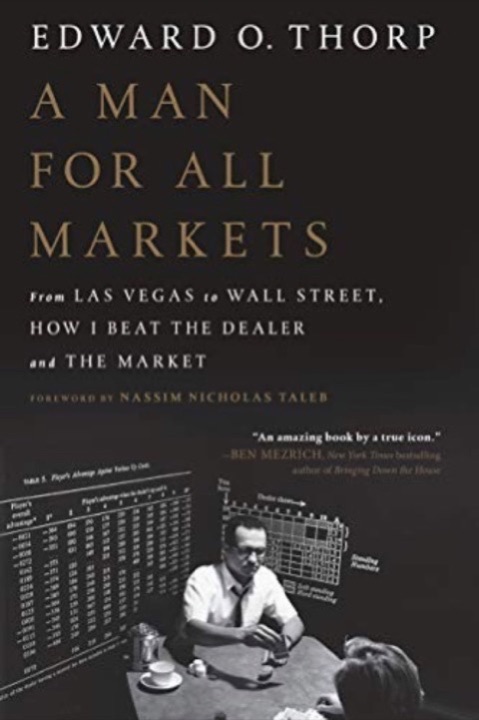
A Man for All Markets: From Las Vegas to Wall Street, How I Beat the Dealer and the Market
Applying the lessons from "A Man for All Markets" by Edward O. Thorp to your life can be a rewarding endeavor, given your interests and experiences. Here are some ways you might integrate these lessons:
-
Mathematical Rigor and Analytical Thinking: Given your background and interests, you can apply Thorp's emphasis on mathematical rigor and analytical thinking to your daily decision-making processes. Whether in your professional life as a physician or in personal pursuits like investing or flying, adopting a systematic approach to problem-solving can enhance your effectiveness and outcomes.
-
Innovation and Adaptability: Thorp's ability to transition from gambling to finance highlights the importance of adaptability. You can leverage your diverse experiences, such as your near-death experiences and your varied interests, to explore new opportunities and innovate in your field. This might involve integrating new technologies or methodologies into your practice or personal projects.
-
Risk Management: Thorp's focus on managing risk effectively is crucial. In your life, this could mean being mindful of the risks associated with flying, investing, or even trying new activities like skydiving. Developing a robust risk management strategy can help you minimize potential downsides while pursuing your passions.
-
Ethical Considerations: Thorp's emphasis on ethics aligns with your values of kindness and empathy. In your medical practice and personal interactions, continue to prioritize ethical behavior and fairness. This might involve advocating for patients' rights or supporting social causes that align with your beliefs.
-
Lifelong Learning and Curiosity: Thorp's journey underscores the importance of continuous learning. Your commitment to being a lifelong learner and your interest in diverse subjects can be further fueled by exploring new areas of knowledge, whether through reading, attending seminars, or engaging in discussions with experts in various fields.
-
Persistence and Resilience: Your personal philosophy of "never, ever quit" resonates with Thorp's persistence. Continue to apply this mindset to overcome challenges and pursue your goals, whether in your career, personal life, or advocacy work.
-
Leveraging Technology: Thorp was a pioneer in using technology for financial analysis. You can apply this lesson by staying informed about technological advancements in medicine, aviation, or any other field of interest. Embrace tools and innovations that can enhance your efficiency and effectiveness.
By integrating these lessons into your life, you can continue to grow personally and professionally while staying true to your core values and aspirations.
What the book covers
"A Man for All Markets: From Las Vegas to Wall Street, How I Beat the Dealer and the Market" is an autobiographical account by Edward O. Thorp, a mathematician, hedge fund manager, and author, with a foreword by Nassim Nicholas Taleb. The book chronicles Thorp's journey from academia to becoming a pioneer in the world of quantitative finance and gambling strategies.
Summary:
Early Life and Academic Pursuits:
Edward Thorp begins by detailing his early life and academic background. He grew up during the Great Depression, which instilled in him a sense of curiosity and a drive to understand the world through mathematics. Thorp pursued higher education in physics and mathematics, eventually earning a Ph.D. in mathematics.
Breaking the Casino:
Thorp's interest in probability and statistics led him to the world of gambling, particularly blackjack. He developed the first scientifically proven system for beating the game, which he detailed in his groundbreaking book, "Beat the Dealer." Thorp's card counting strategy revolutionized the game and made him a target for casinos, which subsequently changed their rules to counteract his methods.
Transition to Wall Street:
After his success in Las Vegas, Thorp turned his attention to the stock market. He applied his mathematical skills to develop quantitative trading strategies, becoming one of the first to use computers for financial analysis. Thorp founded one of the earliest hedge funds, Princeton/Newport Partners, which achieved remarkable returns by exploiting market inefficiencies.
Innovations and Contributions:
Thorp's work laid the foundation for modern quantitative finance. He was an early adopter of the Black-Scholes option pricing model and contributed to the development of various financial instruments and risk management techniques. His approach emphasized the importance of rigorous analysis, disciplined risk management, and the use of technology in trading.
Personal Reflections:
Throughout the book, Thorp shares personal anecdotes and reflections on his life and career. He discusses the ethical considerations of gambling and investing, the importance of intellectual curiosity, and the value of perseverance in the face of challenges.
Key Takeaways and Lessons:
-
Mathematical Rigor: Thorp's success in both gambling and finance underscores the power of mathematical analysis and the importance of a disciplined, systematic approach to problem-solving.
-
Innovation and Adaptability: Thorp's ability to adapt his skills from one domain to another highlights the value of innovation and the willingness to explore new opportunities.
-
Risk Management: A key lesson from Thorp's career is the importance of managing risk effectively. His strategies were not just about maximizing returns but also about minimizing potential losses.
-
Ethical Considerations: Thorp emphasizes the need for ethical behavior in both gambling and investing, advocating for transparency and fairness.
-
Lifelong Learning: Thorp's journey is a testament to the importance of continuous learning and intellectual curiosity. He remained open to new ideas and technologies throughout his career.
-
Persistence and Resilience: Thorp's experiences demonstrate the value of persistence and resilience in overcoming obstacles and achieving success.
In summary, "A Man for All Markets" is not only a fascinating account of Edward Thorp's life but also a valuable resource for anyone interested in the intersection of mathematics, gambling, and finance. The book offers insights into the mindset and strategies that can lead to success in both personal and professional endeavors.