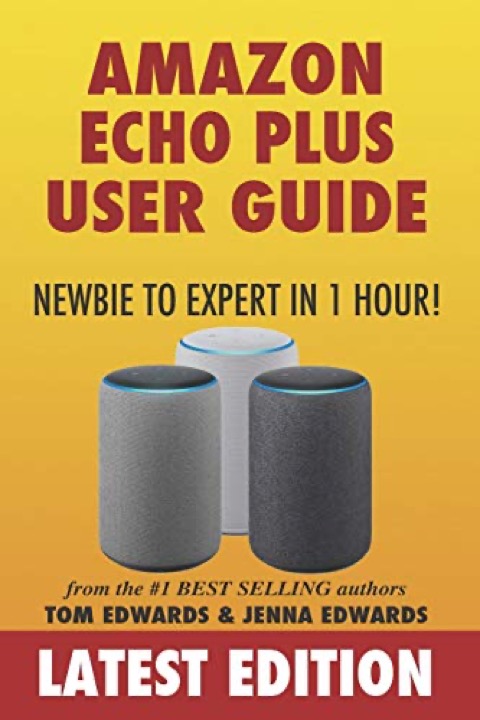
Amazon Echo User Guide: Newbie to Expert in 1 Hour!
Applying the lessons from "Amazon Echo User Guide: Newbie to Expert in 1 Hour!" by Tom Edwards to your life can be a transformative step toward optimizing your personal and professional bandwidth through the strategic use of ambient computing. Here are some ways you might integrate these lessons:
- Leverage Voice-First Efficiency: - In demanding environments like a medical clinic or a cockpit, your hands and eyes are often occupied; you can integrate voice-command habits to offload cognitive tasks such as setting reminders, checking data points, or managing schedules without breaking your physical workflow. This minimizes "friction" in your daily operations and allows you to maintain focus on high-stakes tasks.
- Optimize Through Automation: - View your home and office as an integrated ecosystem rather than a collection of disparate tools. By mastering the integration of smart devices, you can automate routine environmental factors—lighting, temperature, security—allowing you to reserve your decision-making energy for complex entrepreneurial ventures and leadership challenges.
- Strategic Information Filtering: - Use the "Flash Briefing" concept to curate a high-signal, low-noise stream of information. In an era of information overload, you can program your environment to deliver only the most relevant medical, financial, or legal news the moment you start your day, ensuring you remain a well-informed "lifelong learner" without wasting time.
- Rapid Technical Upskilling: - Embrace the "Newbie to Expert in 1 Hour" philosophy by seeking out condensed, high-impact knowledge for new technologies. Whether it is a new EHR system in healthcare or a new avionics suite, you should prioritize finding the "power user" shortcuts that provide 80% of the utility in 20% of the learning time.
- Systemic Troubleshooting and Resilience: - Apply the book’s troubleshooting logic to your business systems. Just as you would reset a device or check a connection when a command fails, you must approach leadership bottlenecks with a methodical diagnostic mindset, identifying whether the failure is in the "hardware" (infrastructure) or the "software" (processes/communication).
- Mastering the User Interface of Life: - Recognize that the way you "prompt" your team or your technology dictates the quality of the output. Just as Alexa requires clear syntax, your leadership requires clear, concise communication to avoid ambiguity and ensure that your strategic vision is executed accurately by your staff and partners.
By integrating these lessons, you move beyond merely owning technology to truly commanding it, creating a seamless interface between your goals and your environment that reflects a commitment to staying hungry for innovation and humble enough to master the basics.
What the book covers
"Amazon Echo User Guide: Newbie to Expert in 1 Hour!" by Tom Edwards is a practical, technical primer designed to help early adopters and non-technical users alike master the first generation of Amazon’s voice-controlled ecosystem. The book serves as a roadmap for transitioning from basic unboxing to advanced automation, emphasizing the efficiency gains possible through the Alexa interface. By breaking down complex natural language processing capabilities into manageable commands, Edwards provides a functional blueprint for integrating artificial intelligence into daily life. This guide focuses on maximizing the utility of the hardware to save time and streamline domestic and professional environments.
Summary:
- Hardware Overview and Initial Setup: - The guide begins by detailing the physical architecture of the Amazon Echo, explaining the significance of the seven-microphone array and the light ring indicators. It provides a step-by-step walkthrough of the initialization process, including connecting the device to a Wi-Fi network and syncing it with the Amazon Alexa companion app on a smartphone or tablet. - Edwards emphasizes the importance of optimal placement within a room to ensure voice recognition accuracy, advising users on how to minimize acoustic interference from walls or other electronic appliances.
- Mastering Voice Command Logic: - A significant portion of the book is dedicated to the "wake word" system and the specific syntax required for Alexa to process requests accurately. Edwards explains how the device uses far-field voice recognition to distinguish user commands from ambient noise or television audio. - The author provides a comprehensive list of core commands, ranging from simple queries about the time and weather to complex requests involving multiple variables, helping the user understand the logic behind the AI’s responses.
- Productivity and Information Management: - The book highlights the Echo’s utility as a personal assistant, detailing how to manage shopping lists, to-do lists, and calendar integrations. Edwards illustrates how these lists can be accessed remotely via the app, creating a bridge between home-based voice commands and mobile execution. - It also covers the retrieval of real-time data, such as news briefings, traffic reports for commutes, and sports scores, showing users how to customize their "Flash Briefing" to filter for specific interests.
- Media, Entertainment, and Audio Integration: - Edwards explores the Echo's capabilities as a high-fidelity speaker and media hub, detailing its integration with Amazon Music, Spotify, and Pandora. He provides instructions on how to control playback, volume, and playlist selection using exclusively voice commands. - The guide also covers the integration of Audible and Kindle books, explaining the "Text-to-Speech" and audiobook playback features that allow users to consume literature while performing other tasks.
- Smart Home Automation and Third-Party Skills: - The author delves into the Echo’s role as a central hub for the Internet of Things (IoT), explaining how to pair the device with smart bulbs, thermostats, and switches from brands like Philips Hue and Belkin WeMo. This section introduces the concept of the "Smart Home" as an interconnected ecosystem controlled by a single voice interface. - Furthermore, the book introduces "Skills," which are third-party applications that expand Alexa’s functionality. Edwards explains how to browse the Skills store to enable specialized features like ordering food, requesting a ride-share, or guided meditation.
This guide was significant during the early years of the smart speaker revolution, acting as a bridge for those intimidated by the shift toward voice-first computing. It demystified AI interaction for the general public, proving that advanced technology could be accessible, functional, and highly beneficial for personal organization and household management.