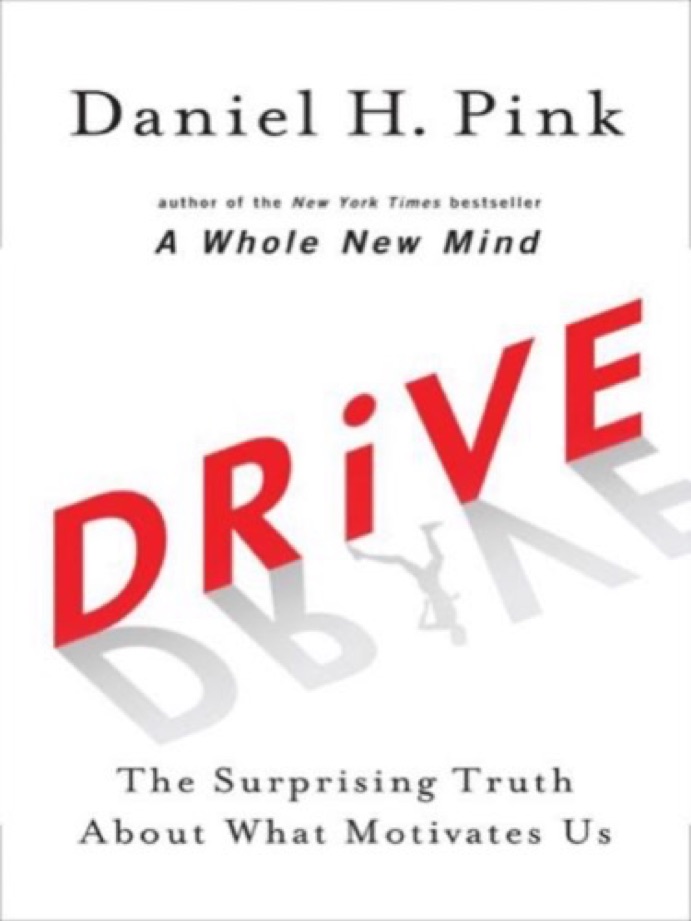
Drive: The Surprising Truth About What Motivates Us
Applying the lessons from "Drive: The Surprising Truth About What Motivates Us" by Daniel H. Pink to your life can be a catalyst for creating more engaged teams and a more fulfilling personal journey. Here are some ways you might integrate these lessons:
- Lead Through Autonomy: - In high-stakes environments like medicine or aviation, you should look for opportunities to grant your team more control over how they execute their duties. By trusting experts to manage their own "four Ts"—task, time, technique, and team—you foster a culture of ownership that reduces burnout and sparks the kind of creative problem-solving essential in a startup or emergency room.
- Cultivate a Mastery Mindset: - Whether you are perfecting a surgical technique, mastering a new legal framework, or learning to fly a new aircraft, you should view the process as a lifelong journey rather than a destination. Encourage those you mentor to embrace the "grit" required for mastery, emphasizing that the struggle to improve is where the most significant professional satisfaction is found.
- Connect Every Task to a Larger Purpose: - As an entrepreneur and VC leader, you must ensure that your mission goes beyond the bottom line. Regularly communicate the "why" behind every project, helping your team see how their individual contributions improve patient outcomes or disrupt outdated healthcare systems, thereby fueling their intrinsic drive to succeed.
- Re-evaluate Reward Systems: - You should evaluate how you incentivize performance in your business ventures, moving away from "if-then" rewards for creative work. Instead, use "now-that" rewards—spontaneous recognition or bonuses given after a task is completed—which acknowledge hard work without creating the perverse incentives that stifle innovation and long-term thinking.
- Encourage "Flow" States: - You can design your workspaces and schedules to minimize interruptions, allowing yourself and your employees to reach the state of "flow" where mastery occurs. This is particularly vital in complex fields like law and entrepreneurship, where deep work is required to navigate intricate problems and make sound strategic decisions.
- Model Type I Behavior: - You should lead by example by demonstrating a commitment to intrinsic goals like learning, contribution, and personal growth. By showing that your personal mantra is fueled by a desire to solve problems and help others rather than just seeking status or wealth, you set a powerful standard for your organizations.
By integrating these lessons, you can build more resilient, innovative, and deeply satisfied teams while maintaining your own drive across multiple demanding disciplines. Transitioning from a management style based on control to one based on support and autonomy will ultimately lead to more sustainable excellence in all your professional and personal endeavors.
What the book covers
"Drive: The Surprising Truth About What Motivates Us" by Daniel H. Pink is a transformative examination of the psychology behind human motivation and how it differs from traditional management techniques. Pink argues that the conventional "carrot-and-stick" approach—relying on external rewards and punishments—is increasingly ineffective for the complex, creative tasks that define the modern workforce. By synthesizing decades of behavioral science research, the book provides a blueprint for a new motivational system centered on the innate human need to direct our own lives and learn new things. Ultimately, Pink offers a compelling case for why autonomy, mastery, and purpose are the true drivers of high performance and personal satisfaction.
Summary:
- The Evolution of Motivation: - Pink traces the history of human motivation from "Motivation 1.0," which focused on biological survival, to "Motivation 2.0," the system of external rewards and punishments that powered the industrial age. He explains that while the reward-based system worked for routine, algorithmic tasks, it is woefully inadequate for the heuristic, creative work that dominates the modern economy.
- The Seven Deadly Flaws of External Rewards: - The book identifies several critical flaws of using external rewards to motivate complex behavior, including the fact that they can extinguish intrinsic motivation, diminish performance, and crush creativity. Pink explains how traditional incentives often encourage short-term thinking and unethical behavior, effectively acting as "if-then" transactions that narrow our focus and limit cognitive flexibility.
- Type I and Type X Behavior: - Pink distinguishes between Type X behavior, which is fueled by extrinsic desires and the pursuit of external validation, and Type I behavior, which is fueled by intrinsic desires and the satisfaction of the activity itself. He asserts that while Type X behavior is often learned, Type I behavior is a fundamental part of human nature that leads to better long-term health and professional success.
- The First Pillar: Autonomy: - Autonomy is the desire to be self-directed and is the first of the three pillars of Motivation 3.0. Pink breaks this down into the "four Ts"—task, time, technique, and team—showing how giving employees control over what they do, when they do it, how they do it, and who they do it with can lead to unprecedented levels of innovation.
- The Second Pillar: Mastery: - Mastery is the urge to get better and better at something that matters, requiring a state of "flow" where the challenge of a task matches an individual's skill level. Pink notes that mastery is a mindset that requires effort and grit, and while absolute perfection is an asymptote that can never be fully reached, the pursuit of it provides deep fulfillment.
- The Third Pillar: Purpose: - The final pillar is purpose, the yearning to do what we do in the service of something larger than ourselves. Pink highlights that humans are naturally "purpose seekers" and that organizations that emphasize "purpose-maximization" alongside "profit-maximization" see significantly higher levels of employee engagement and long-term organizational health.
- The Toolkit for Motivation 3.0: - The book concludes with a practical toolkit for individuals and organizations to implement these concepts, suggesting strategies like "FedEx Days" for innovation and peer-to-peer recognition systems. Pink emphasizes that shifting to an intrinsic motivation model requires a fundamental change in how we view the relationship between work and human fulfillment.
The significance of "Drive" lies in its ability to translate complex psychological research into a practical framework for the 21st-century leader. By advocating for a move away from outdated, control-based management styles, Pink offers a path toward more meaningful work and a more vibrant, self-actualized society.