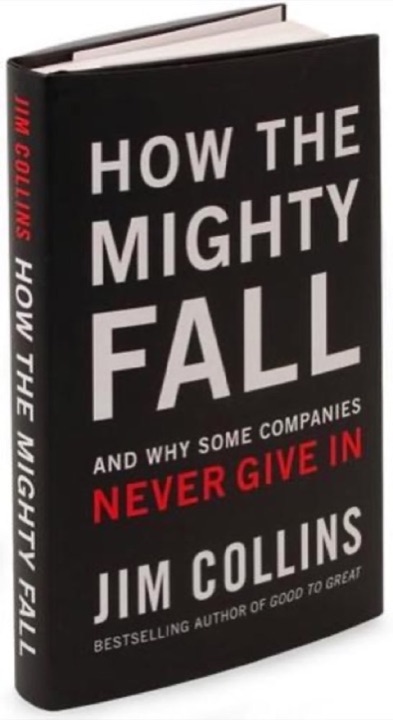
How the Mighty Fall: And Why Some Companies Never Give In
Applying the lessons from "How the Mighty Fall: And Why Some Companies Never Give In" by Jim Collins to your life can be an essential practice in maintaining the longevity of your ventures and the integrity of your professional path. Here are some ways you might integrate these lessons:
-
Cultivate Intellectual Humility: - You must constantly remind yourself that past success does not guarantee future results, whether in the clinic, the courtroom, or the boardroom. Avoid the trap of Stage 1 hubris by remaining a lifelong student and always questioning whether your current methods are still the most effective or if you are simply coasting on previous achievements.
-
Practice Disciplined Expansion: - Whether you are scaling a healthcare startup or expanding a venture capital portfolio, you should ensure that your growth never outpaces your ability to recruit "Level 5" talent for critical roles. Avoid the "undisciplined pursuit of more" by saying no to opportunities that distract from your core mission, remembering that over-extension is a primary driver of organizational fragility.
-
Heed the "Checklist" of Early Warnings: - Much like an aviator monitoring instruments or a physician observing subtle clinical shifts, you must train yourself to look for "red flag" data that others might ignore. Foster an environment where your team feels safe speaking truth to power so that you can confront brutal facts early, before a minor risk escalates into a terminal crisis.
-
Avoid the Siren Song of the Silver Bullet: - When faced with a setback, resist the urge to seek a single, miraculous solution or a radical pivot. Instead, you should double down on the fundamental disciplines and "flywheel" actions that initially built your success, understanding that sustainable recovery is built through consistent, incremental progress rather than high-stakes gambles.
-
Maintain a Margin of Safety: - In your legal, financial, and entrepreneurial dealings, you should always build in a buffer for the unexpected, ensuring that a single "black swan" event cannot take you or your organization down. This discipline allows you to navigate periods of risk and peril without succumbing to the panic that characterizes later stages of decline.
-
Focus on the Core Flywheel: - Periodically audit your various professional roles to ensure you aren't neglecting the primary engines of value creation in your life. By keeping your focus on the core competencies and values that define your contribution to the world, you prevent the drift into irrelevance that follows the abandonment of discipline.
By integrating these lessons, you can transform the fear of failure into a disciplined vigilance that protects your legacy and ensures your continued growth. This book provides the diagnostic tools necessary to detect the subtle onset of complacency, allowing you to pivot back to excellence long before the symptoms of decline become irreversible. Staying hungry and staying humble isn't just a mantra; it is the strategic defense against the gravity of organizational and personal decay.
What the book covers
"How the Mighty Fall: And Why Some Companies Never Give In" by Jim Collins is a diagnostic exploration into the mechanics of organizational decline, serving as a cautionary sequel to his previous works on corporate excellence. Collins investigates how iconic companies, once thought invincible, can succumb to a downward spiral that leads to their ultimate demise. The book identifies a five-stage framework of failure, emphasizing that decline is often a self-inflicted wound rather than the result of external misfortune. By understanding these stages, leaders can develop the self-awareness necessary to detect early warning signs and steer their organizations back toward health.
Summary:
-
Stage 1: Hubris Born of Success: - This initial stage begins when leaders become arrogant and regard success as an entitlement rather than something earned through discipline and hard work. They lose sight of the underlying factors that created their original success, often attributing it to their own genius rather than the core principles or flywheel effect that drove the organization forward. - As hubris takes root, there is a marked decline in the "learning orientation" that characterized the company's rise. Success leads to a "we can do anything" attitude, causing leaders to neglect the primary flywheels that made them great in the first place, setting the stage for subsequent lapses in judgment.
-
Stage 2: Undisciplined Pursuit of More: - Driven by hubris, organizations in Stage 2 overreach by venturing into areas where they cannot be great or by growing faster than they can find the right people for key seats. This "undisciplined pursuit of more" includes erratic diversification and an obsession with scale over excellence, often fueled by the pressure to maintain unrealistic growth trajectories. - Collins notes that "Packer’s Law" applies here: a company is more likely to die of indigestion from too much opportunity than of starvation from too little. When the rate of growth exceeds the ability to fill key positions with disciplined, capable people, the organization’s foundation begins to crack.
-
Stage 3: Denial of Risk and Peril: - In this stage, internal warning signs begin to mount, but leaders discount negative data and amplify positive results. There is a tendency to blame external factors for setbacks rather than looking inward, and the culture shifts away from a "confronting the brutal facts" mentality toward one of spin and excuse-making. - Dialogues within the leadership team become less vigorous and more consensus-driven or dictated by a dominant personality. Risks are taken without a proper margin of safety, and the collective "eye of the needle"—the narrow path of disciplined focus—is abandoned for risky bets that ignore potential downsides.
-
Stage 4: Grasping for Salvation: - As the decline becomes visible to the public, the organization enters a state of panic, leading to "grasping for salvation." This often takes the form of a charismatic "savior" CEO, a radical new strategy, a "game-changing" acquisition, or a cultural revolution designed to fix everything overnight. - These "silver bullet" solutions rarely work; instead, they consume precious resources and lead to further instability. The organization experiences a series of "false starts" and "hope-and-fear" cycles, which erode the confidence of employees, investors, and customers while accelerating the downward trajectory.
-
Stage 5: Capitulation to Irrelevance or Death: - The final stage is reached when the accumulated setbacks and failed attempts at salvation exhaust the company's financial and psychological resources. At this point, the organization’s options are depleted, and it either faces liquidation or is sold off in pieces, losing its independence and its soul. - Collins emphasizes that while some companies can languish in Stage 5 for years, their influence and relevance are gone. The tragedy is that many of these failures were preventable had the leaders recognized the earlier stages and returned to the disciplined management that originally fueled their greatness.
The significance of "How the Mighty Fall" lies in its reversal of the traditional success-story narrative, providing a sobering anatomy of failure that is just as instructive as a study of greatness. By mapping the path to ruin, Collins provides a powerful framework for leaders to maintain institutional humility and rigorous discipline. It serves as a vital reminder that even the most successful entities are vulnerable to decline if they lose their focus, making it an essential read for anyone navigating the complexities of long-term leadership.