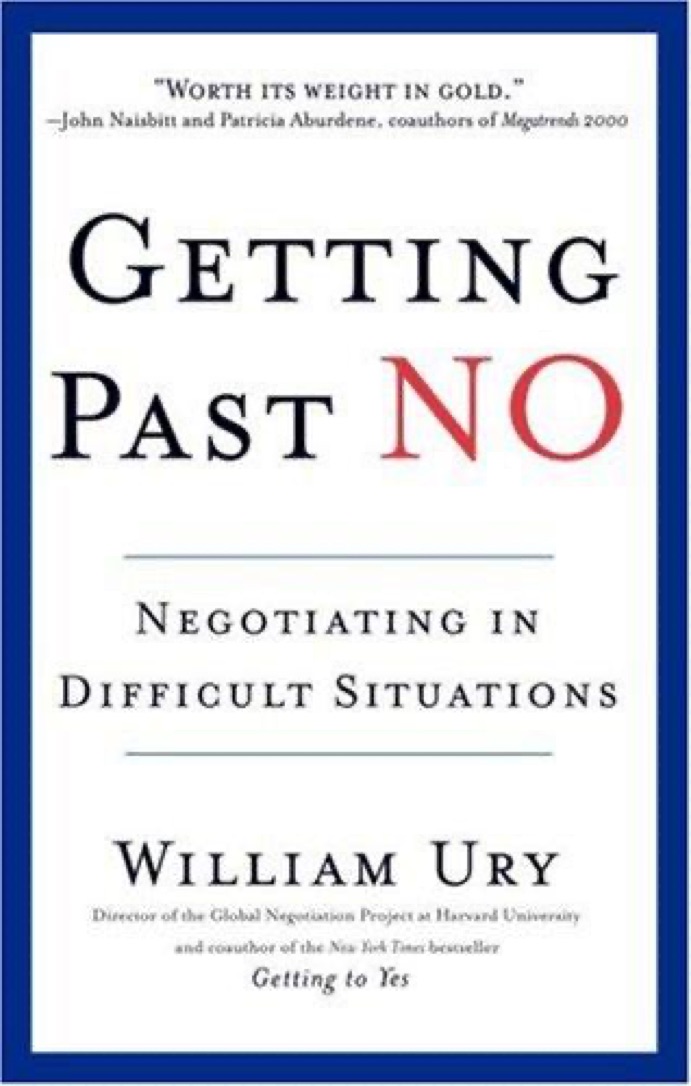
Getting Past No: Negotiating Your Way from Confrontation to Cooperation
Applying the lessons from "Getting Past No: Negotiating Your Way from Confrontation to Cooperation" by William Ury to your life can be a transformative exercise in emotional intelligence and strategic leadership. Here are some ways you might integrate these lessons:
- Mastering the Balcony in Crisis: - Whether you are facing a medical emergency in the ER or a hostile takeover in the boardroom, you must practice the discipline of the mental balcony. Train yourself to recognize your physiological triggers—the rising heat of anger or the urge to defend your ego—and intentionally step back to assess the situation from a detached, strategic perspective.
- Tactical Empathy in Patient and Legal Care: - In both medicine and law, you encounter people at their most vulnerable and defensive. Use the "stepping to their side" technique to acknowledge their pain or frustration without necessarily agreeing with their demands; this builds the trust necessary to guide them toward the best clinical or legal outcome.
- Reframing Adversarial Deals into Partnerships: - When negotiating venture capital deals or partnership agreements, you should view every "no" as an invitation to ask "why." Instead of seeing the other party as an obstacle, reframe the negotiation as a joint venture where you are both trying to solve the same puzzle of value creation.
- Aviation-Style Contingency Planning: - Just as you would never fly into a storm without a clear diversion plan, you should never enter a high-stakes negotiation without a well-defined BATNA. Knowing your best alternative gives you the internal confidence to remain calm and helps you communicate the reality of the situation to the other party without appearing threatening.
- Facilitating Face-Saving Exits: - In your role as a mentor or entrepreneur, you will often need to lead others away from a failing strategy or a bad decision. You must build them a "golden bridge" by allowing them to save face, ensuring that the shift in direction is perceived as a shared evolution rather than a personal failure.
- Educating Through Strategic Power: - When you have the upper hand in a legal or business dispute, resist the urge to crush the opposition. Instead, use your leverage to educate the other side on the mutual benefits of cooperation, ensuring that the resulting agreement is durable and does not invite future retribution.
By integrating these lessons, you will cultivate a leadership style defined by composure, strategic empathy, and a relentless focus on outcomes rather than ego. This breakthrough approach ensures that even the most confrontational encounters can be converted into opportunities for progress, reinforcing your commitment to staying both hungry for results and humble in your interactions.
What the book covers
"Getting Past No: Negotiating Your Way from Confrontation to Cooperation" by William Ury is a definitive resource for managing high-conflict negotiations where the other party is uncooperative, aggressive, or deceptive. Building on the foundational principles of interest-based negotiation, Ury introduces a "breakthrough strategy" designed to move beyond traditional bargaining into a space of collaborative problem-solving. This book serves as a tactical manual for professionals who must navigate the complexities of human emotion and ego to reach mutually beneficial agreements under pressure.
Summary:
- Don’t React: Go to the Balcony: - The first barrier to a successful negotiation is your own natural reaction to strike back, give in, or break off relations. Ury suggests "going to the balcony," a mental state of detachment where you can view the conflict from a distance, keeping your eyes on the ultimate goal while staying calm under fire. - By pausing and regaining your composure, you avoid the trap of escalating a conflict based on ego or adrenaline. This technique allows you to evaluate the situation objectively and choose a response that serves your long-term interests rather than your immediate emotions.
- Disarm Them: Step to Their Side: - To get the other person to listen to you, you must first listen to them and acknowledge their concerns. Stepping to their side involves active listening, paraphrasing their points, and even apologizing for past misunderstandings to lower their defensive walls. - This counter-intuitive move disarms the opponent because it removes the resistance they expected to encounter. By creating a climate of professional respect, you transform the dynamic from a face-to-face confrontation into a side-by-side search for a solution.
- Change the Game: Don’t Reject, Reframe: - Instead of rejecting the other party's position or attacking their logic, Ury advises reframing their statements as an attempt to address the problem. You should ask open-ended "problem-solving questions" like "Why?" or "What if?" to probe the interests lying beneath their rigid demands. - Reframing allows you to redirect the energy of the negotiation away from positions and toward mutual interests. This shift encourages the other party to join you in brainstorming solutions that satisfy both sides' underlying needs without either party feeling defeated.
- Make It Easy to Say Yes: Build a Golden Bridge: - Often, negotiations stall because the other side is afraid of losing face or feels overwhelmed by the proposal. You must "build a golden bridge" across the chasm between their interests and yours, making it easy for them to retreat from their current position toward a new agreement. - This involves involving them in the solution so it feels like their idea, offering them a face-saving way out, and moving slowly to ensure they feel comfortable. A successful negotiator guides the counterpart toward a conclusion that they can present as a victory to their own stakeholders.
- Make It Hard to Say No: Bring Them to Their Senses: - If the other side continues to resist, you must use your power not to escalate but to educate. Rather than trying to win, you demonstrate the consequences of failing to reach an agreement, specifically by highlighting your Best Alternative to a Negotiated Agreement (BATNA). - You aim to bring them to their senses, not their knees, by showing them that the "golden bridge" is a better alternative than the "cliff" of no agreement. The goal is to exercise power in a way that leads back to the negotiating table rather than into a protracted war.
"Getting Past No" remains a cornerstone of conflict resolution literature because it acknowledges the messy, emotional reality of human interaction. Ury provides a repeatable framework for maintaining professional integrity and strategic focus even when faced with the most difficult adversaries, making it an essential read for anyone in a leadership or high-stakes role.