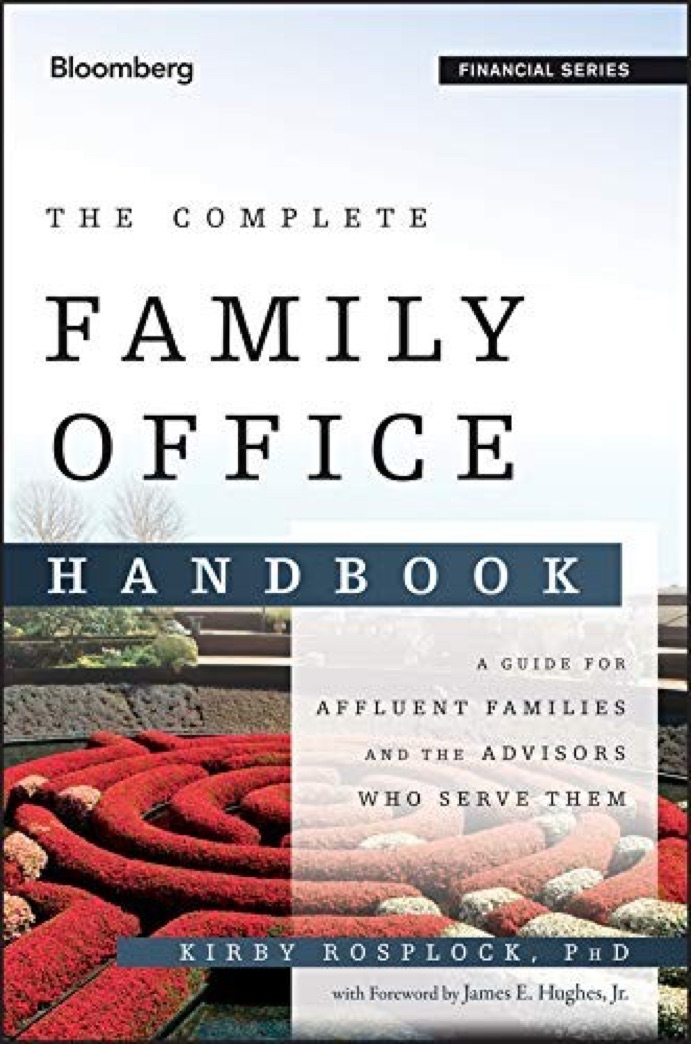
The Complete Family Office Handbook: A Guide for Affluent Families and the Advisors Who Serve Them
Applying the lessons from "The Complete Family Office Handbook: A Guide for Affluent Families and the Advisors Who Serve Them" by Kirby Rosplock to your life can be a transformative step in professionalizing your legacy and ensuring your family's values endure as long as your ventures. Here are some ways you might integrate these lessons:
- Operationalizing Your Legacy: - Just as you have scaled healthcare startups and VC firms, you should treat your family’s long-term sustainability as a professional enterprise. This means moving beyond informal arrangements and establishing clear governance structures, whether through a formal family office or a dedicated wealth management strategy that mirrors a corporate board.
- Applying the Aviation and ER Safety Mindset to Risk: - You can integrate your background in emergency medicine and aviation by conducting regular "pre-flight" risk assessments for your estate. This involves identifying potential single points of failure—be they legal vulnerabilities, cybersecurity gaps, or a lack of succession planning—and creating redundant systems to protect your family’s assets and reputation.
- Developing Next-Generation "Hungry and Humble" Leaders: - Use the book’s framework for family education to mentor the next generation. By involving your heirs in the decision-making processes of your investments or philanthropic endeavors, you teach them the weight of responsibility while instilling the "Stay Hungry, Stay Humble" mantra through practical experience and stewardship.
- Utilizing Your Legal and MBA Background in Governance: - Leverage your interdisciplinary expertise to draft a family constitution that defines your mission and values. Applying a legal lens to family disputes and an MBA lens to operational efficiency ensures that your family office functions as a high-performing team rather than a source of friction.
- Strategic Philanthropy as a Mission-Driven Venture: - View your charitable contributions through the same lens as your venture capital investments: look for high-impact opportunities where your capital can act as a catalyst for change. This transforms giving from a passive activity into a strategic mission that reinforces your family’s identity and provides a shared purpose.
- Lifelong Learning in Wealth Technology: - As a lifelong learner, you should stay ahead of the curve regarding the "FinTech" and "WealthTech" tools mentioned by Rosplock. Embracing modern reporting and security platforms will allow you to maintain the transparency and agility needed to manage a complex, multi-faceted life across medicine, law, and business.
By integrating these lessons, you ensure that your diverse professional successes—from the ER to the boardroom—are matched by a stable and enduring family legacy that survives the complexities of the modern wealth landscape.
What the book covers
"The Complete Family Office Handbook: A Guide for Affluent Families and the Advisors Who Serve Them" by Kirby Rosplock is a comprehensive roadmap for navigating the complexities of high-net-worth wealth management and the preservation of family legacy. It serves as both a practical manual for establishing a family office and a strategic framework for sustaining multi-generational prosperity. Rosplock provides deep insights into the operational, financial, and emotional dimensions of managing a private family organization, ensuring that wealth serves as a tool for unity rather than a source of conflict.
Summary:
- The Evolution and Definition of the Family Office: - Rosplock traces the historical roots of the family office from the private offices of the Rockefellers and Morgans to the modern, tech-enabled versions of today. She defines the family office as a unique entity designed to centralize the management of a family’s financial and personal affairs, distinguishing between the Single Family Office (SFO) and the Multi-Family Office (MFO). - The text outlines why a family might choose one structure over the other, focusing on variables such as the size of assets under management, the complexity of family needs, and the desired level of privacy and control.
- Structuring and Operations: - This section provides a granular look at the mechanics of setting up a family office, including legal structures, tax considerations, and the recruitment of professional staff. Rosplock emphasizes the importance of professionalizing the "back office" to handle everything from concierge services to complex financial reporting. - The author argues that a well-structured office must have clear reporting lines and standardized processes to avoid the common pitfalls of informal, "kitchen table" management styles that often fail as wealth scales.
- Investment Philosophy and Management: - The handbook explores the unique investment horizon of family offices, which often focus on "patient capital" and long-term growth. Rosplock details the creation of an Investment Policy Statement (IPS) and the importance of diversifying across traditional and alternative asset classes, including private equity and venture capital. - She highlights the role of the Chief Investment Officer (CIO) in balancing the family’s risk appetite with the necessity of preserving purchasing power for future generations.
- Family Governance and Education: - Central to the book is the concept of governance as a means of managing the "human capital" within a family. Rosplock discusses the creation of family constitutions, councils, and missions to foster communication and resolve conflicts before they threaten the family’s stability. - A significant emphasis is placed on the financial education of the next generation, ensuring that heirs are prepared for the responsibilities of wealth through structured mentorship and involvement in the family's decision-making processes.
- Risk Management and Security: - Beyond financial risk, the book addresses the multifaceted threats facing affluent families, including physical security, cybersecurity, and reputational risk. Rosplock provides frameworks for auditing vulnerabilities and implementing robust protection protocols. - This includes the management of domestic staff, travel security, and the protection of digital footprints, which are increasingly targeted in the modern era.
- Philanthropy and Social Impact: - The author posits that philanthropy is often the "glue" that holds a wealthy family together. She provides a guide for strategic giving, moving from reactive charity to impact-driven philanthropy that aligns with the family’s core values. - The section covers the various vehicles for giving, such as private foundations and donor-advised funds, and how to involve children in charitable work to instill a sense of purpose and stewardship.
The significance of this work lies in its holistic approach to wealth, treating it not merely as a balance sheet but as an ecosystem of values, people, and responsibilities. By providing a clear architecture for the family office, Rosplock empowers families to transition from accidental wealth owners to intentional legacy builders.