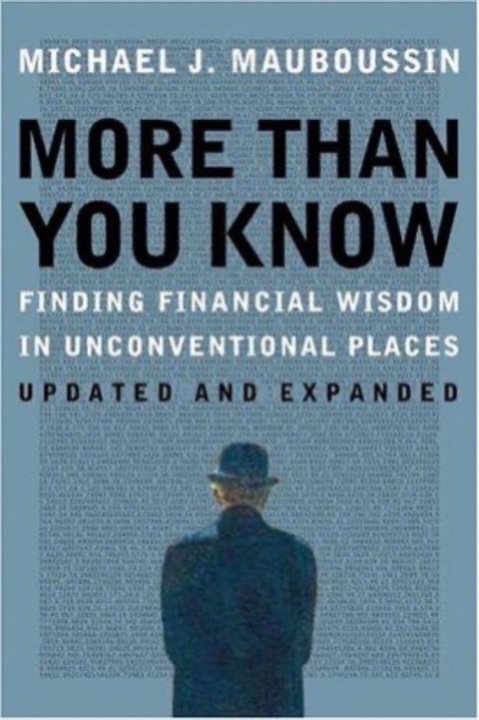
More Than You Know: Finding Financial Wisdom in Unconventional Places
Applying the lessons from "More Than You Know: Finding Financial Wisdom in Unconventional Places" by Michael J. Mauboussin to your life can be a rewarding endeavor, given your diverse experiences and interests. Here’s how you might integrate some of the book's key themes and concepts into your personal and professional life:
-
Complex Adaptive Systems: - Recognize that life, like financial markets, is a complex adaptive system. Your experiences, such as surviving plane crashes, demonstrate the unpredictable nature of life. Embrace adaptability and resilience, qualities you already possess, to navigate life's complexities.
-
Behavioral Finance: - Reflect on your decision-making processes, especially in high-stress situations like emergency medicine or flying. Being aware of cognitive biases can help you make more rational decisions. Your humor and self-awareness can be tools to counteract biases like overconfidence or anchoring.
-
The Role of Luck and Skill: - Acknowledge the role of luck in your life, such as surviving near-death experiences. Focus on honing your skills and maintaining a strong process in your professional and personal endeavors, knowing that outcomes are not always within your control.
-
Decision-Making Under Uncertainty: - Continue to apply probabilistic thinking and scenario analysis in your decision-making. Your approach of gathering information and relying on past experiences aligns well with this strategy. Embrace uncertainty as an opportunity for growth and learning.
-
The Importance of Diverse Perspectives: - Leverage your wide range of interests and experiences to gain diverse perspectives. Whether it's through reading, traveling, or engaging with different cultures, continue to seek insights from various fields to enrich your understanding and approach to life.
-
Feedback Loops and Adaptation: - Use feedback from your daily evaluations of wins and losses to adapt and improve. Your ability to learn from failures and grow from them is a testament to your adaptability. Encourage this mindset in others, such as your children and colleagues.
-
The Power of Incentives: - Align your actions and decisions with your core values of kindness and empathy. Ensure that your incentives, whether personal or professional, support long-term goals and ethical standards.
Practical Applications:
-
Multidisciplinary Approach: Continue to draw from various disciplines, such as psychology and philosophy, to inform your worldview and decision-making. This aligns with your appreciation for thinkers like Marcus Aurelius and Socrates.
-
Focus on Process: Maintain your disciplined approach to life, focusing on the process rather than just outcomes. This is evident in your daily routine and your commitment to personal growth.
-
Recognize and Mitigate Biases: Use your humor and self-awareness to recognize and mitigate biases in yourself and others. This can enhance your interactions and decision-making.
-
Adaptability: Embrace change and uncertainty as opportunities for growth. Your resilience and persistence are key strengths in adapting to life's challenges.
-
Value of Diverse Perspectives: Encourage diverse viewpoints in your personal and professional circles. This can lead to more robust solutions and a deeper understanding of complex issues.
By integrating these lessons into your life, you can continue to grow and thrive, leveraging your unique experiences and perspectives to make informed decisions and positively impact those around you.
What the book covers
"More Than You Know: Finding Financial Wisdom in Unconventional Places" by Michael J. Mauboussin is a thought-provoking exploration of the intersection between finance, psychology, and decision-making. The book is structured around the idea that insights from various disciplines can enhance our understanding of financial markets and improve investment strategies. Mauboussin draws on a wide range of sources, including psychology, biology, and philosophy, to offer a multidisciplinary approach to investing.
Key Themes and Concepts:
-
Complex Adaptive Systems: - Mauboussin emphasizes that financial markets are complex adaptive systems, where numerous agents interact, adapt, and evolve. Understanding these systems requires insights from fields like biology and ecology, which study similar complex systems.
-
Behavioral Finance: - The book delves into behavioral finance, highlighting how cognitive biases and emotional responses can lead to irrational decision-making. Mauboussin discusses biases such as overconfidence, anchoring, and herd behavior, and their impact on market dynamics.
-
The Role of Luck and Skill: - Mauboussin explores the balance between luck and skill in investing. He argues that distinguishing between the two is crucial for evaluating performance and making informed decisions. The book suggests that investors should focus on process over outcomes to mitigate the influence of luck.
-
Decision-Making Under Uncertainty: - The author discusses strategies for making decisions in uncertain environments. He advocates for probabilistic thinking and scenario analysis as tools to better navigate uncertainty and improve investment outcomes.
-
The Importance of Diverse Perspectives: - Mauboussin underscores the value of incorporating diverse perspectives and interdisciplinary knowledge into investment analysis. He suggests that insights from fields like psychology, sociology, and even sports can provide valuable lessons for investors.
-
Feedback Loops and Adaptation: - The book examines the role of feedback loops in markets and how they can lead to self-reinforcing trends or corrections. Understanding these dynamics is key to anticipating market movements and adapting strategies accordingly.
-
The Power of Incentives: - Mauboussin discusses how incentives shape behavior and decision-making in financial markets. He emphasizes the need for aligning incentives with long-term goals to foster sustainable investment practices.
Key Takeaways and Lessons:
-
Embrace a Multidisciplinary Approach: Investors can gain a competitive edge by drawing insights from various fields beyond traditional finance.
-
Focus on Process, Not Outcomes: Given the role of luck in investing, a strong, disciplined process is more important than short-term results.
-
Recognize and Mitigate Biases: Awareness of cognitive biases can help investors make more rational decisions and avoid common pitfalls.
-
Adaptability is Crucial: In a constantly changing market environment, the ability to adapt and learn from feedback is essential for long-term success.
-
Probabilistic Thinking: Embracing uncertainty and thinking in probabilities can lead to better decision-making and risk management.
-
Value of Diverse Perspectives: Incorporating diverse viewpoints can lead to more robust analysis and innovative solutions.
Overall, "More Than You Know" encourages readers to think beyond conventional financial wisdom and to seek insights from a broad array of disciplines to enhance their understanding of markets and improve their investment strategies.