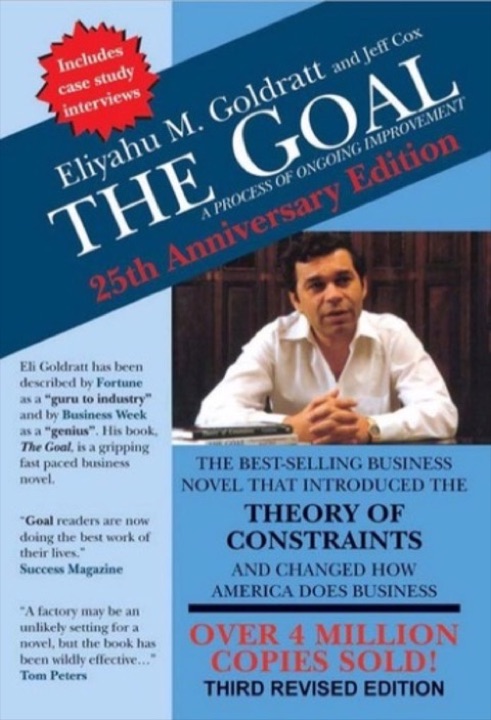
The Goal
Applying the lessons from "The Goal" by Eliyahu Goldratt to your life can be a transformative process, both personally and professionally. Here are some ways you might integrate the key concepts from the book into your life:
-
Identify Personal Constraints: - Just as Alex Rogo identifies constraints in his manufacturing plant, you can identify personal or professional bottlenecks that limit your performance or happiness. This could be a habit, a mindset, or a specific task that consistently slows you down or causes stress.
-
Focus on Your Primary Goal: - Define what your primary goal is, whether it's related to personal growth, career advancement, or family life. Ensure that your daily actions align with this goal, much like how the book emphasizes aligning efforts with the goal of making money in business.
-
Optimize Throughput in Your Activities: - Consider how you can increase the "throughput" of your daily activities. This could mean prioritizing tasks that have the most significant impact on your goals or finding ways to be more efficient in your routines, such as your morning workout and work schedule.
-
Reduce Personal "Inventory" and "Operational Expenses": - Reflect on areas where you might be investing time or resources without sufficient return. This could be unnecessary commitments or habits that don't contribute to your well-being or goals. Streamlining these can free up energy for more meaningful pursuits.
-
Continuous Improvement: - Embrace a mindset of continuous improvement. Once you've addressed one constraint, look for the next area to optimize. This aligns with your philosophy of being in a constant state of beta and lifelong learning.
-
Involve Others in Problem-Solving: - Just as Alex involves his team, engage your family, friends, or colleagues in identifying and solving challenges. This can lead to better solutions and strengthen your relationships.
-
Balance Work and Personal Life: - The book highlights the importance of balancing professional success with personal well-being. Continue to nurture your relationships and hobbies, like spending time with your grandchild, flying, and cooking, to maintain a fulfilling life.
-
Challenge Assumptions: - Regularly question your assumptions and be open to new perspectives. This can lead to innovative solutions and personal growth, much like how Alex challenges existing processes in the plant.
-
Simplify Metrics for Success: - Define a few key metrics that matter most to you, such as time spent with family, personal health, or professional achievements, and use these to guide your decisions.
-
Resilience and Humor:
- Use your strengths of resilience and humor to navigate challenges, just as Alex uses creativity and teamwork to overcome obstacles in the plant.
By applying these principles, you can enhance your personal and professional life, ensuring that you are continually moving towards your goals and living a balanced, fulfilling life.
What the book covers
"The Goal" by Eliyahu M. Goldratt is a business novel that introduces the Theory of Constraints (TOC), a management philosophy aimed at improving organizational performance. The book is structured as a narrative, following the protagonist, Alex Rogo, a plant manager who is struggling to improve the performance of his manufacturing plant.
Summary:
Plot Overview: Alex Rogo is a manager at a manufacturing plant owned by UniCo. The plant is underperforming, and Alex is given a three-month ultimatum by his division vice president, Bill Peach, to turn things around or face closure. Alex's personal life is also strained, as his demanding job affects his relationship with his wife, Julie.
Introduction to the Theory of Constraints: Alex reconnects with his former physics professor, Jonah, who becomes his mentor. Jonah introduces Alex to the Theory of Constraints, which posits that every system has a bottleneck or constraint that limits its performance. By identifying and addressing this constraint, overall system performance can be improved.
Key Concepts: 1. The Goal: The primary goal of any business is to make money. All efforts should align with this goal. 2. Throughput, Inventory, and Operational Expense: Jonah explains these three metrics: - Throughput: The rate at which the system generates money through sales. - Inventory: All the money invested in purchasing things the system intends to sell. - Operational Expense: The money spent to turn inventory into throughput.
Implementing TOC: Alex and his team work to identify the plant's constraints. They discover that certain machines and processes are bottlenecks. By focusing on these constraints, they make several changes: - Prioritizing work that flows through the bottlenecks. - Reducing batch sizes to improve flow. - Implementing buffer stocks before bottlenecks to ensure they are always working.
Results: As a result of these changes, the plant's performance improves significantly. Alex's team increases throughput, reduces inventory, and lowers operational expenses. The plant not only meets its targets but becomes a model of efficiency within the company.
Personal Growth: Throughout the process, Alex learns to balance his work and personal life better. He involves his team in problem-solving, fostering a collaborative environment. His relationship with Julie also improves as he becomes more attentive and supportive.
Key Takeaways and Lessons:
-
Identify the Constraint: Every system has a constraint that limits its performance. Identifying and addressing this constraint is crucial for improvement.
-
Focus on Throughput: Increasing throughput should be the primary focus, as it directly impacts the bottom line.
-
Continuous Improvement: The process of identifying and addressing constraints is ongoing. Once a constraint is resolved, another will emerge.
-
Team Involvement: Engaging the team in problem-solving leads to better solutions and a more motivated workforce.
-
Balance Work and Personal Life: Success in business should not come at the expense of personal relationships.
-
Simplify Metrics: Focus on a few key metrics (throughput, inventory, operational expense) to drive decision-making.
-
Challenge Assumptions: Question existing processes and assumptions to find innovative solutions.
"The Goal" emphasizes the importance of viewing an organization as a system and focusing on the constraints that limit its performance. By applying the Theory of Constraints, businesses can achieve significant improvements in efficiency and profitability.