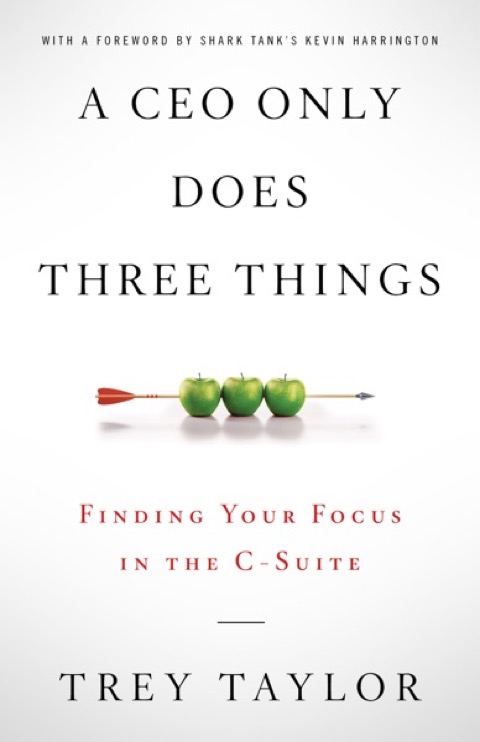
A CEO Only Does Three Things: Finding Your Focus in the C-Suite
Applying the lessons from "A CEO Only Does Three Things: Finding Your Focus in the C-Suite" by Trey Taylor to your life can be a transformative step toward becoming a more disciplined and effective leader. Here are some ways you might integrate these lessons:
-
Curate Your Executive Focus: - You must ruthlessly audit your daily calendar to identify tasks that fall outside the realms of culture, people, and numbers, delegating them to trusted team members immediately. Whether you are managing a medical practice or a venture capital fund, your value lies in high-level strategy and vision, not in the minutiae of administrative paperwork or low-stakes troubleshooting.
-
Engineer a Resilient Culture: - You should treat your organization’s culture with the same precision a pilot uses for a pre-flight checklist, ensuring that every value is clearly defined and consistently reinforced. By modeling the "Stay Humble" mantra in your interactions, you set a standard that attracts high-integrity talent and fosters an environment where excellence is the default behavior.
-
Optimize Your Human Capital Assets: - In both medicine and entrepreneurship, the quality of your outcomes is directly tied to the quality of your team; therefore, you must prioritize the recruitment and mentorship of "A-players" who align with your core mission. You should view yourself as a coach whose primary job is to remove obstacles for your staff, allowing them to perform at the top of their licenses or professional capabilities.
-
Maintain Financial Vigilance through Key Metrics: - You need to identify the specific "vital signs" of your business ventures—the key performance indicators that truly reflect health and growth—and monitor them with clinical accuracy. By focusing on these critical numbers, you can make objective decisions about where to deploy capital and when to pivot, avoiding the emotional traps common in high-stakes investing and serial entrepreneurship.
-
Adopt a Mindset of Stewardship: - You should approach your various roles as an attorney, physician, and leader through the lens of stewardship, focusing on the legacy and long-term sustainability of the institutions you build. This means planning for succession and building systems that ensure your companies can serve their patients, clients, and stakeholders even when you are not at the helm.
By integrating these lessons, you can move beyond the exhaustion of being a "doer" and embrace the true calling of a leader, creating organizations that are as disciplined, efficient, and impactful as the varied disciplines you have mastered throughout your career.
What the book covers
"A CEO Only Does Three Things: Finding Your Focus in the C-Suite" by Trey Taylor is a strategic guide designed to help executives and entrepreneurs strip away the distractions of daily operations to focus on the high-level responsibilities that actually drive organizational success. Taylor argues that the primary cause of CEO burnout and company stagnation is "decision fatigue" caused by leaders involving themselves in tasks that should be delegated. By narrowing the executive mandate to three specific pillars—Culture, People, and Numbers—the book provides a scalable framework for leadership that fosters clarity, accountability, and long-term growth.
Summary:
-
The Myth of the All-Powerful Executive: - Taylor begins by deconstructing the image of the CEO as a multitasker who must have a hand in every department, suggesting instead that the most effective leaders are those who do the least amount of varied work. He identifies the "founder's trap," where a leader’s inability to relinquish control over technical or administrative tasks eventually becomes the primary bottleneck for the company’s expansion.
-
Pillar One: Culture as the Foundation: - The author asserts that the CEO is the ultimate architect and protector of the company’s culture, which is defined as the collective behavior of the organization when the leader isn't in the room. He emphasizes that culture is not a set of posters on a wall but a series of intentional choices regarding values, mission, and the "vibe" that dictates how employees interact with one another and with customers.
-
Pillar Two: The People Strategy: - This section focuses on the CEO’s role as the chief talent officer, responsible for ensuring that the right individuals are in the right seats to execute the company’s vision. Taylor provides frameworks for hiring for cultural fit over raw skill, coaching high-potential employees, and the difficult but necessary task of removing individuals who toxify the environment or fail to meet performance standards.
-
Pillar Three: The Mastery of Numbers: - Taylor argues that while the CEO does not need to be an accountant, they must have a fundamental grasp of the financial levers that drive the business, such as cash flow, profit margins, and unit economics. He encourages leaders to identify a few "critical numbers" that serve as early warning signs or indicators of success, allowing them to make data-driven decisions rather than relying on intuition alone.
-
The Art of Strategic Delegation: - A significant portion of the book is dedicated to the process of letting go, teaching leaders how to empower their teams to handle the "how" so the CEO can focus on the "why" and "what." By creating clear lines of authority and accountability, the CEO ensures that the organization can function autonomously, which is essential for scaling a business or preparing it for acquisition.
-
The CEO as a Steward: - The concluding chapters shift toward the mindset of stewardship, where the leader views their role as a temporary caretaker of the organization’s health and legacy. Taylor discusses the importance of long-term thinking and the need for the CEO to manage their own energy and focus, ensuring they remain a source of inspiration rather than a source of stress for their workforce.
Ultimately, Taylor’s work serves as a corrective for the modern executive, offering a disciplined approach to leadership that prioritizes essentialism over activity. By mastering culture, people, and numbers, a CEO creates a self-sustaining ecosystem that can thrive independently of their constant intervention.