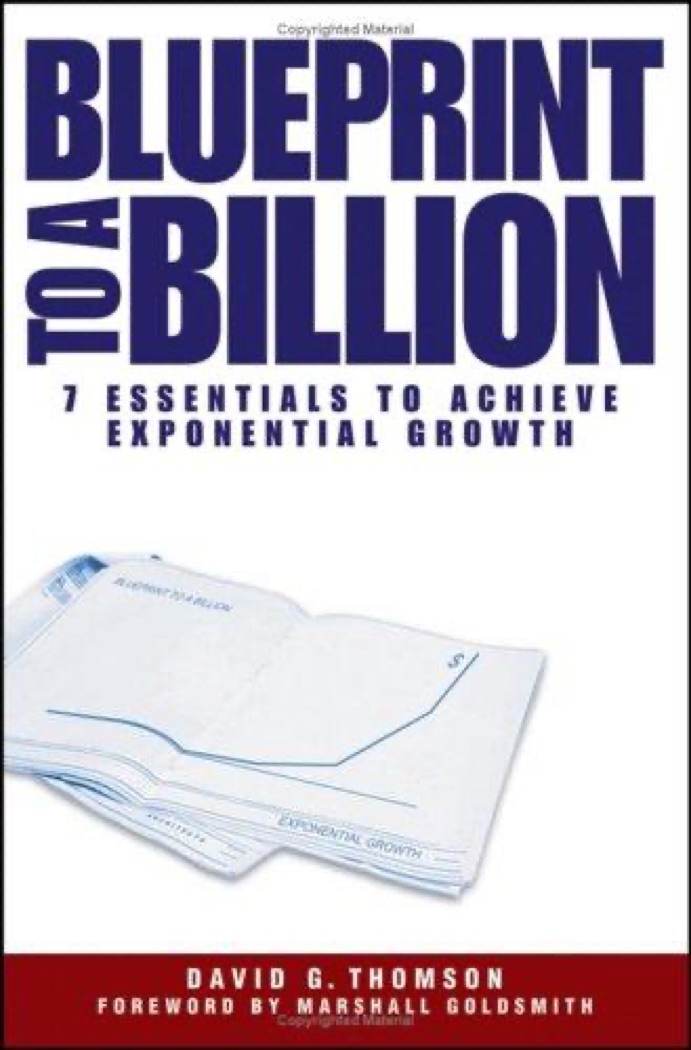
Blueprint to a Billion: 7 Essentials to Achieve Exponential Growth
Applying the lessons from "Blueprint to a Billion" by David G. Thomson to your life can be a powerful catalyst for shifting your focus from managing complexity to driving massive, systemic impact across your various professional and personal endeavors. Here are some ways you might integrate these lessons:
-
Select High-Yield Environments: - Whether you are investing in a new healthcare venture or choosing a legal specialization, apply the "Exponential Market" rule. Ask yourself if the field you are entering has the inherent capacity for 10x growth, or if you are fighting for scraps in a saturated, low-ceiling environment. Your time is your most precious asset; invest it only where the potential return is truly significant.
-
Pursue the 10x Standard in Practice: - In both medicine and business, avoid the trap of incrementalism. If you are developing a new telehealth platform or an urgent care model, strive for a breakthrough value proposition that makes the previous standard feel obsolete. Aim to provide a level of care or efficiency that is ten times better than the current status quo, ensuring your projects become the "obvious choice."
-
Leverage Strategic Partnerships: - Recognize that you don't have to build every bridge alone. Just as Blueprint companies use "Big Brother Alliances," look for established institutions—major health systems, large law firms, or aerospace giants—that can serve as force multipliers for your initiatives. A single strategic partnership can often provide the distribution and credibility that would take decades to build independently.
-
Recruit for the Destination, Not the Current State: - As you build your venture capital team or lead your companies, hire "A-Players" who have already reached the milestones you are currently aiming for. In the cockpit of a business, just as in the cockpit of an aircraft, you want a crew that has navigated through high-stakes, high-velocity environments. Don't just hire for the tasks of today; hire for the complexities of the billion-dollar entity you intend to become.
-
Transform Governance into Strategy: - Re-evaluate the boards and advisory groups you sit on or lead. Move beyond the checklists of compliance and law to demand strategic contribution. Ensure that every person around the table is there because they provide a specific, high-level capability—be it capital access, technical expertise, or industry connections—that moves the needle on growth.
-
Build Repeatable Systems for Success: - Whether it is a sales engine or a medical protocol, your systems must be scalable and independent of your personal presence. As an entrepreneur and pilot, you understand the value of a perfect checklist; apply this to your business growth. If a process cannot be replicated by others without your direct intervention, it is a bottleneck that will prevent you from ever achieving true scale.
By integrating these lessons, you transition from a high-achieving individual to an architect of exponential systems. This shift allows you to maintain your "Stay Hungry" drive while utilizing the "Stay Humble" realization that the greatest achievements are the result of choosing the right markets, building the right teams, and leveraging the right partnerships.
What the book covers
"Blueprint to a Billion: 7 Essentials to Achieve Exponential Growth" by David G. Thomson is a data-driven analysis of the rare set of companies that have successfully scaled to $1 billion in annual revenue. Thomson conducted extensive research on "Blueprint Companies"—businesses that went public after 1980 and achieved the billion-dollar milestone—to identify the common DNA that separates exponential winners from the merely successful. The book provides a strategic framework designed to help entrepreneurs and executives move beyond incremental improvements and toward massive, sustainable growth by replicating these proven patterns.
Summary:
-
Exponential Market Opportunities: - Success begins with the selection of a market that is not only large but possesses the potential for explosive growth. Blueprint companies do not just enter existing markets; they often create or redefine them, ensuring that their growth is propelled by the natural momentum of the industry itself. - Thomson argues that working in a stagnant or small market provides a low ceiling for even the best operators, whereas an exponential market provides the "tailwind" necessary for a company to reach the billion-dollar mark.
-
The Breakthrough Value Proposition: - A central tenet of the book is that marginal improvements are insufficient for exponential growth; companies must offer a value proposition that is at least ten times better than the competition. This breakthrough creates a competitive moat that makes the choice obvious for the customer. - This value is often derived from radical innovation in technology, service delivery, or business model, allowing the company to dominate the early adopters and quickly move into the mainstream market.
-
Exploiting High-Growth Segments: - Within large markets, successful companies identify and dominate specific high-growth niches. By focusing resources on these segments first, the company can establish a leadership position and achieve profitability before expanding into broader, more competitive areas. - This focus allows for more efficient marketing and sales spend, as the product-market fit is highly tuned to the specific needs of an underserved or rapidly evolving group of customers.
-
Building Big Brother Alliances: - Thomson highlights the importance of partnering with established industry giants, which he calls "Big Brothers." These alliances provide the smaller, growing company with instant credibility, access to massive distribution networks, and the capital necessary to scale quickly. - Rather than trying to build every internal capability from scratch, Blueprint companies leverage the infrastructure of larger partners to accelerate their market penetration and validate their value proposition to the broader market.
-
The A-Player Management Team: - Scaling to a billion dollars requires a management team that has experienced that level of growth before. Thomson emphasizes the need for "A-Players"—leaders who possess the specific skill sets required for high-velocity environments and who can manage the increasing complexity of a global organization. - These teams are characterized by a lack of ego and a commitment to the mission, ensuring that the company’s internal culture remains focused on execution and innovation rather than bureaucracy.
-
A Scalable Sales and Marketing Engine: - To achieve exponential revenue, a company must move beyond the founder-led sales model and build a predictable, repeatable, and scalable sales engine. This involves standardized processes, clear metrics, and a recruitment strategy that can consistently produce top-performing sales talent. - The book details how Blueprint companies align their marketing efforts with their sales goals to ensure a constant pipeline of high-quality leads that the sales team can convert with high efficiency.
-
The Board as a Strategic Asset: - Unlike many companies that view the board of directors as a necessary evil for governance, Blueprint companies treat their board as a powerful strategic asset. They populate the board with individuals who bring specific expertise, high-level connections, and the ability to mentor the CEO. - This proactive board plays a crucial role in shaping strategy, navigating complex regulatory environments, and facilitating the key alliances mentioned earlier, acting as a force multiplier for the executive team.
"Blueprint to a Billion" is significant because it moves the discussion of business growth from the realm of anecdote to empirical science. By identifying the specific, repeatable behaviors of the world's most successful growth companies, Thomson provides a high-level roadmap that is both aspirational and deeply practical for any leader looking to build a legacy of scale.