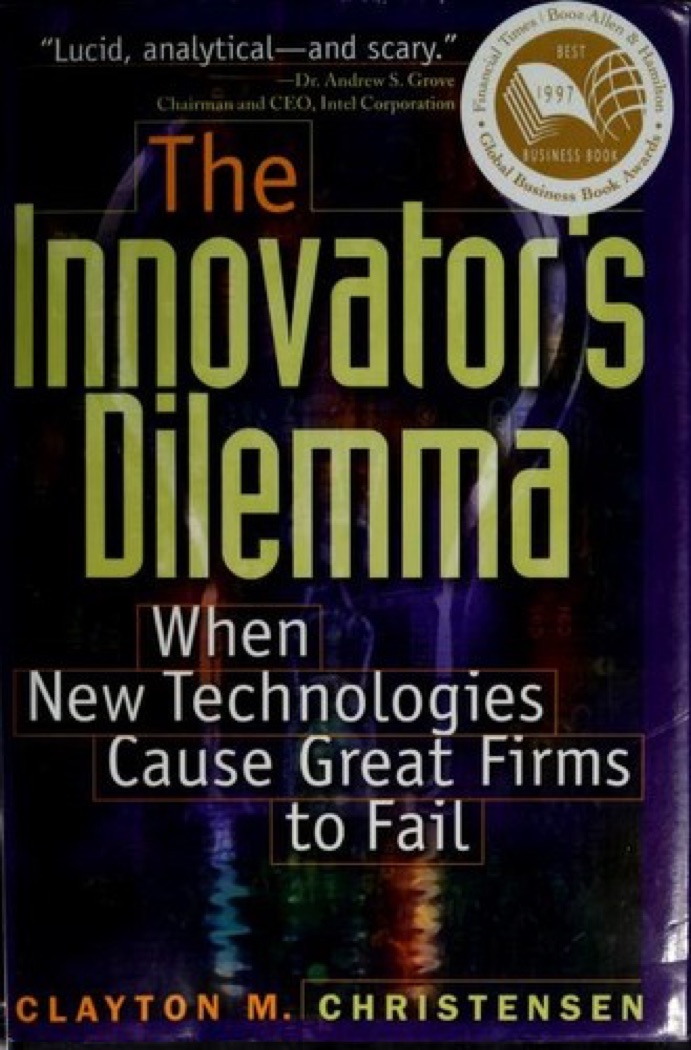
The Innovator's Dilemma: When New Technologies Cause Great Firms to Fail
Applying the lessons from "The Innovator's Dilemma: When New Technologies Cause Great Firms to Fail" by Clayton M. Christensen to your life can be a transformative exercise in strategic foresight and organizational leadership. Here are some ways you might integrate these lessons:
- Adopt a "Skunkworks" Mentality for New Ventures: - If you are leading a large healthcare system or a venture firm, you must recognize that your core organization is built to protect its current revenue streams. When you identify a potentially disruptive healthcare technology—like AI-driven diagnostics that might initially seem less "accurate" than a human doctor—you should house that project in a completely separate entity with its own P&L, allowing it to celebrate small wins and survive on lower margins.
- Look for "Good Enough" Solutions in Under-Served Markets: - In your role as an entrepreneur, pay close attention to products that mainstream competitors mock as "low-end." Just as urgent care centers once disrupted traditional hospitals by being "good enough" for minor ailments at a fraction of the cost, look for the next wave of healthcare delivery that simplifies the patient experience even if it initially lacks the sophisticated features of premium services.
- Evaluate Your Personal "Value Network": - Reflect on whether your professional choices are being dictated by your "customers"—the people or entities that currently pay for your expertise—at the expense of your long-term growth. To stay hungry and humble, you must occasionally step out of your established value network and experiment with new skills or industries where you are a novice, ensuring you do not become a "legacy product" yourself.
- Differentiate Between Sustaining and Disruptive Growth: - Use the pilot’s mindset of situational awareness to categorize the projects on your desk. Are you merely making incremental improvements to an existing process, or are you building something that could eventually make your current business model obsolete? Balance your portfolio to ensure you are not just refining the past but also investing in the future.
- Prioritize Agility Over Expert Forecasting: - In both law and medicine, we are trained to rely on data and precedent. However, for true innovation, you must accept that data for non-existent markets does not exist. Practice "discovery-driven planning" by setting small, measurable milestones for your startups, allowing for pivots based on real-world feedback rather than sticking to a rigid, five-year business plan.
- Identify Your Organizational Disabilities: - Candidly assess the processes and values within your firms. Understand that the very systems that make your current operations efficient—such as strict billing protocols or quality control—might be the very things preventing you from adopting a new, faster-moving business model. Be willing to break your own rules in a controlled environment to foster creativity.
By integrating these lessons, you ensure that your ventures remain at the forefront of the industry rather than becoming casualties of its evolution. Embracing the discomfort of low-margin, high-risk beginnings is the only way to safeguard against the inevitable march of disruption. True leadership requires the courage to compete against yourself today so that you can lead the market tomorrow.
What the book covers
"The Innovator's Dilemma: When New Technologies Cause Great Firms to Fail" by Clayton M. Christensen is a seminal business text that investigates the paradoxical reasons why market-leading companies often lose their dominance when faced with technological shifts. Christensen argues that the very management practices that lead to success—listening to customers, investing in high-performing products, and seeking higher margins—are precisely what cause firms to miss out on the next wave of innovation. By distinguishing between sustaining and disruptive technologies, the book offers a structural explanation for industry upheaval and provides a roadmap for how organizations can survive the transition to new competitive landscapes.
Summary:
- Sustaining vs. Disruptive Technologies: - Christensen divides technological progress into two categories: sustaining and disruptive innovations. Sustaining innovations improve the performance of established products along the dimensions that mainstream customers already value, such as making a computer faster or a medical device more precise. In contrast, disruptive innovations bring to market a very different value proposition, typically appearing as cheaper, simpler, and more convenient versions of existing products that initially appeal only to a fringe or lower-tier market.
- The Failure of Good Management: - The book posits that "good" management is the primary reason why great firms fail. Because established companies are beholden to their most profitable customers, they prioritize sustaining innovations that satisfy current needs and provide immediate returns. They often ignore disruptive technologies because the initial markets are too small, the profit margins are too thin, and the existing customer base does not yet want the new, albeit inferior, product.
- Value Networks and Cost Structures: - Every firm operates within a "value network," a context where its competitive strategy and cost structure are defined. A company’s organizational structure and resource allocation processes are tuned to thrive in its specific network. When a disruptive technology emerges, it usually belongs to a different value network with lower overhead requirements, making it nearly impossible for a large incumbent to compete effectively without fundamentally changing its internal DNA.
- The Upward Migration of Disruption: - Disruptive technologies do not stay in the margins forever. As they improve through iterative development, their performance eventually meets the minimum requirements of the mainstream market. By the time the disruptive technology is "good enough" for the incumbent's customers, the newcomer has already established a low-cost structure and an efficient production model, allowing them to rapidly displace the old leaders who are trapped by their own high-cost requirements.
- The Dilemma of Resource Dependence: - Christensen highlights that it is not the managers but the customers and investors who truly control where money is spent. Managers find it difficult to justify investing in projects that do not satisfy the firm's need for immediate growth and profit. Consequently, resources are pulled away from high-risk, low-reward disruptive projects and funneled back into the core business until it is too late to pivot.
- Capabilities as Disabilities: - An organization's capabilities reside in its processes and its values. While these factors define what a company can do well, they also define what it cannot do. A process designed to manufacture high-volume, high-quality equipment is a "disability" when the market shifts toward low-cost, disposable alternatives. Overcoming this requires recognizing that people are flexible, but organizational processes and values are remarkably rigid.
- Discovery-Driven Planning: - Because markets for disruptive technologies are initially unknowable, Christensen suggests that traditional market research is ineffective. Instead, firms must engage in "discovery-driven planning," where they operate under the assumption that their initial forecasts are wrong. This involves small-scale experimentation and "failing fast" to find the true market application for a new technology before the capital runs out.
Ultimately, Christensen’s work serves as a warning that past success is no guarantee of future stability. It highlights the necessity of creating autonomous organizations to pursue disruptive paths, as the internal pressures of a large firm will almost always stifle true innovation. The book remains a cornerstone of strategic thinking, teaching leaders to look beyond their current horizons to identify the subtle shifts that will eventually reshape their industries.