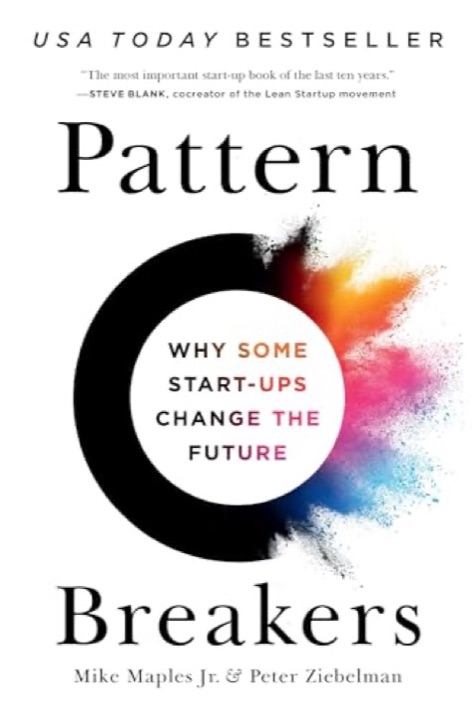
Pattern Breakers: Why Some Start-Ups Change the Future
Applying the lessons from "Pattern Breakers: Why Some Start-Ups Change the Future" by Mike Maples Jr. and Peter Ziebelman to your life can be a transformative exercise in identifying hidden opportunities and challenging the status quo. Here are some ways you might integrate these lessons:
-
Search for Inflections in Healthcare and Law: - Just as technological shifts create startup opportunities, look for regulatory or scientific inflections in your professional fields. As an emergency physician and attorney, you can identify where new laws or medical breakthroughs create "stress points" in the current system, using these as leverage to build superior delivery models.
-
Cultivate Non-Consensus Thinking in VC: - In your role leading Xcellerant Ventures, resist the urge to follow the herd. Train yourself to be comfortable with being "wrong" in the eyes of the majority if your internal logic suggests a different truth; true alpha in investing comes from being right when others are still skeptical.
-
Adopt a "Living in the Future" Mindset: - Whether you are in the cockpit of a plane or the boardroom of a telehealth firm, always ask yourself what the world will look like in a decade. Don't wait for the future to arrive; build the tools and systems that you know will be necessary once the rest of the world catches up.
-
Bridge the Greatness Gap in Personal Projects: - Audit your current ventures to ensure you aren't just making incremental improvements. Demand "different" instead of just "better" in your leadership roles, ensuring that your mission is focused on breaking outdated patterns rather than simply optimizing inefficient ones.
-
Lead as a Movement Builder: - When starting new healthcare initiatives, focus on recruiting "true believers." Your mantra of "Stay Hungry, Stay Humble" is the perfect foundation for a movement; use your platform to articulate a vision so compelling that it attracts those who are also desperate for systemic change.
-
Focus on the Desperate Few: - When launching new services, don't try to appeal to the masses immediately. Identify the patients or entrepreneurs most underserved by the current systems and solve their problems with a pattern-breaking approach, creating a loyal base that will eventually help you scale the solution.
By integrating these lessons, you can move beyond the role of a traditional leader and become a true architect of the future. Whether you are navigating the complexities of emergency medicine or the high-stakes world of venture capital, the ability to recognize and break patterns will ensure that your impact is not just significant, but foundational to the next generation of progress.
What the book covers
"Pattern Breakers: Why Some Start-Ups Change the Future" by Mike Maples Jr. and Peter Ziebelman is a strategic exploration of how world-changing companies are built by rejecting conventional wisdom and identifying external shifts. It challenges the standard "product-market fit" narrative, arguing that breakthrough success comes from identifying "inflections" and "non-consensus insights" that create new markets rather than improving existing ones. Through rigorous analysis of Silicon Valley's biggest winners, Maples and Ziebelman provide a framework for entrepreneurs to move beyond incrementalism and define the future.
Summary:
- The Power of External Inflections: - The authors argue that breakthroughs are rarely the result of raw effort alone; rather, they are born from "inflections." These are external shifts—technological, regulatory, or societal—that fundamentally change what is possible in the world, such as the advent of the iPhone's GPS chip making Uber viable. - Identifying an inflection requires looking for "stress points" where old systems are failing. Successful pattern breakers do not just solve problems; they harness these external waves to propel their ideas forward with a force that traditional competitors cannot match.
- Developing Non-Consensus Insights: - A core premise of the book is that for an idea to be truly great, it must be both non-consensus and right. If everyone agrees an idea is good, the opportunity is likely already crowded or merely incremental, offering little room for a true breakthrough. - Developing these insights requires a level of intellectual "disagreeableness" and the courage to pursue a path that others find foolish. These insights represent a unique realization of how an inflection can be used to break a long-standing pattern in human behavior or industry.
- The Importance of Living in the Future: - The authors suggest that the best founders are often already "living in the future" and simply building what is missing for them. They do not rely on traditional market research or focus groups because those tools are optimized for the world as it currently exists, not as it will be. - By immersing themselves in the bleeding edge of change, pattern breakers develop an intuition for what is inevitable. This allows them to create products that feel like they belong ten years in the future, providing a radical alternative to the status quo.
- Bridging the Greatness Gap: - This section addresses the "Greatness Gap," the space between a merely good company and a legendary breakthrough. Many startups fail to become significant because they aim for being "better" than the competition rather than being "different." - To bridge this gap, founders must resist the urge to conform to market expectations or standard industry "best practices." The authors emphasize that being a pattern breaker involves a radical commitment to a unique vision, even when it means rejecting safety in favor of disruption.
- Building a Movement Around a Vision: - Pattern breakers do not just sell products; they lead movements. They recruit "true believers"—early employees, investors, and customers—who share a specific vision for how the world should change, creating a community of advocates. - This involves storytelling that frames the startup as an inevitable force of nature. By creating a sense of shared purpose and a clear distinction between the "old way" and the "new way," founders can overcome the massive friction inherent in changing society.
- Prioritizing Market-Product Fit: - In a departure from standard startup theory, the authors argue that "market-product fit" is often more critical than "product-market fit." This involves finding or creating a market that is uniquely ready to be disrupted by a specific inflection. - They advise founders to focus on "the desperate few" rather than the "lukewarm many." A small group of people who desperately need a pattern-breaking solution is a much stronger foundation for growth than a large group that is only mildly interested in an incremental improvement.
This book serves as a vital blueprint for anyone looking to build something that doesn't just fit into the world, but fundamentally changes its trajectory. By codifying the mechanics of true innovation, Maples and Ziebelman offer a rare look at how legendary companies are engineered from the ground up.