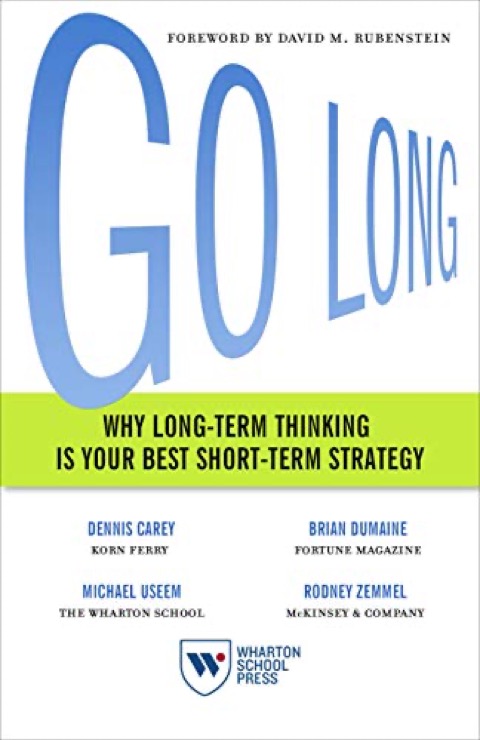
Go Long: Why Strategic Patience Pays Off
Applying the lessons from "Go Long: Why Strategic Patience Pays Off" by Dennis Carey, Brian Dumaine, Michael Useem, and Rodney Zemmel to your life can be a transformative exercise in aligning your daily actions with your ultimate professional and personal legacy. Here are some ways you might integrate these lessons:
- Resist the "Quarterly Thinking" in Medicine and Business: - Just as CEOs are pressured by quarterly earnings, medical practitioners and entrepreneurs are often pressured by immediate volume metrics or short-term ROI. You should consciously pivot your focus toward long-term patient outcomes and sustainable healthcare delivery models, even if they require higher upfront investment or slower initial growth.
- Align Your Mission with Your Actions: - Use the CVS case study as a template for your own ventures. Evaluate whether your current business practices or professional involvements align with your core values as a physician and leader; if a lucrative revenue stream compromises your mission to improve human health, have the courage to phase it out in favor of long-term integrity.
- Cultivate Strategic Patience in Venture Capital: - In your role leading a VC firm, apply the "go long" philosophy by looking past the hype cycles of Silicon Valley. Focus on investing in healthcare and technology companies that are solving foundational problems rather than those looking for a quick exit, ensuring that your capital supports enduring innovation rather than transient trends.
- Manage the Present While Investing in the Future: - Emulate David Cote’s approach by maintaining a rigorous discipline in your current operations—whether in the ER or the boardroom—while aggressively protecting your time for research, learning, and new ventures. Never let the urgency of the moment prevent you from investing in the "R&D" of your own skill sets in law, aviation, or management.
- Build a Personal Board of Advisors: - Recognize that no leader can maintain a long-term vision in isolation. Surround yourself with mentors and partners who will hold you accountable to your decade-long goals and provide the "top cover" needed when you face professional setbacks or economic downturns.
- Prioritize Legacy and Succession: - Whether you are leading a medical group or a startup, think about how the organization would function without you. Invest heavily in the development of the next generation of leaders, ensuring that your "Stay Hungry, Stay Humble" mantra is baked into the culture and persists long after your direct involvement ends.
By integrating these lessons, you will move beyond the reactive nature of professional life and into a proactive stance that prioritizes lasting impact over temporary accolades. Embracing strategic patience allows you to build a career and a series of enterprises that are not only financially successful but also fundamentally meaningful and resilient against the volatility of the modern world.
What the book covers
"Go Long: Why Strategic Patience Pays Off" by Dennis Carey, Brian Dumaine, Michael Useem, and Rodney Zemmel is a compelling manifesto for long-term leadership in an era dominated by short-term pressures. The book examines the "quarterly capitalism" trap, where leaders often sacrifice future growth to satisfy immediate investor demands, and provides a blueprint for resisting these impulses. By profiling some of the world's most successful CEOs, the authors demonstrate that prioritizing a decade-long horizon over ninety-day cycles ultimately leads to superior financial performance and organizational resilience.
Summary:
- The High Cost of Short-Termism: - The authors argue that the modern corporate environment is plagued by a "short-termism" bias that incentivizes leaders to cut research and development, reduce capital expenditures, and sacrifice employee training to meet quarterly earnings targets. This behavior creates a cycle of stagnation that leaves companies vulnerable to disruption and prevents the pursuit of transformative, long-range goals. - Data-driven evidence suggests that firms managed for the long term outperform their short-sighted peers across every significant metric, including revenue growth, earnings per share, and total shareholder return. The book establishes that strategic patience is not just a moral choice but a significant competitive advantage.
- The CVS Health Transformation: - One of the book’s central case studies focuses on Larry Merlo, the CEO of CVS Health, and his bold decision to stop selling tobacco products, which resulted in an immediate $2 billion revenue loss. Merlo recognized that selling cigarettes was fundamentally incompatible with the company's evolving mission to become a health-focused organization. - Despite the risk of shareholder backlash, Merlo’s strategic patience allowed CVS to reposition itself as a true healthcare provider, eventually leading to the acquisition of Aetna and a complete redefinition of its market position, proving that mission-alignment can drive long-term value.
- Unilever’s Sustainable Living Plan: - Paul Polman, the former CEO of Unilever, serves as a primary example of a leader who actively defied Wall Street norms by ending quarterly guidance and focusing on the Unilever Sustainable Living Plan. He argued that business must serve society to survive and that short-term speculators were not the partners the company needed for sustainable growth. - By ignoring the transient demands of the market and focusing on environmental and social goals, Polman attracted long-term institutional investors who supported his vision, ultimately delivering significant returns while building a brand that was resilient to global supply chain and ecological shifts.
- The Power of Operational Excellence at Honeywell: - David Cote’s tenure at Honeywell is used to illustrate how a leader can simultaneously manage the present and the future. Cote refused to "rob the future to pay for the present," consistently investing in new product development even during the depths of the 2008 financial crisis. - By implementing rigorous internal processes and maintaining a consistent investment strategy regardless of economic volatility, Cote transformed a struggling conglomerate into a high-performance industrial powerhouse, demonstrating that long-term strategy requires disciplined operational execution.
- Navigating Activist Investors and the Board: - The book provides a tactical guide for how CEOs can manage relationships with boards of directors and institutional investors to protect their long-term vision. It highlights the importance of the "Lead Director" and a board that is willing to provide "top cover" for the CEO when the market turns sour. - Leaders are encouraged to seek out and build relationships with major asset managers like BlackRock, who have publicly advocated for long-term value creation over short-term financial engineering, creating a defensive barrier against aggressive activist hedge funds.
- The Art of Succession Planning: - A critical component of "going long" is ensuring that a company’s strategic vision survives its current leadership. The authors discuss how effective CEOs begin planning their succession years in advance, identifying and grooming leaders who share their commitment to strategic patience. - Successful transitions at companies like 3M and Verizon show that long-term success is a relay race, requiring a culture of mentorship and a board that views leadership development as a primary strategic objective rather than a secondary human resources task.
This book is a vital resource for any leader seeking to build an organization that lasts. By providing actionable insights from the front lines of corporate governance, it serves as a powerful reminder that the most significant achievements require the courage to wait and the vision to see beyond the next fiscal report.