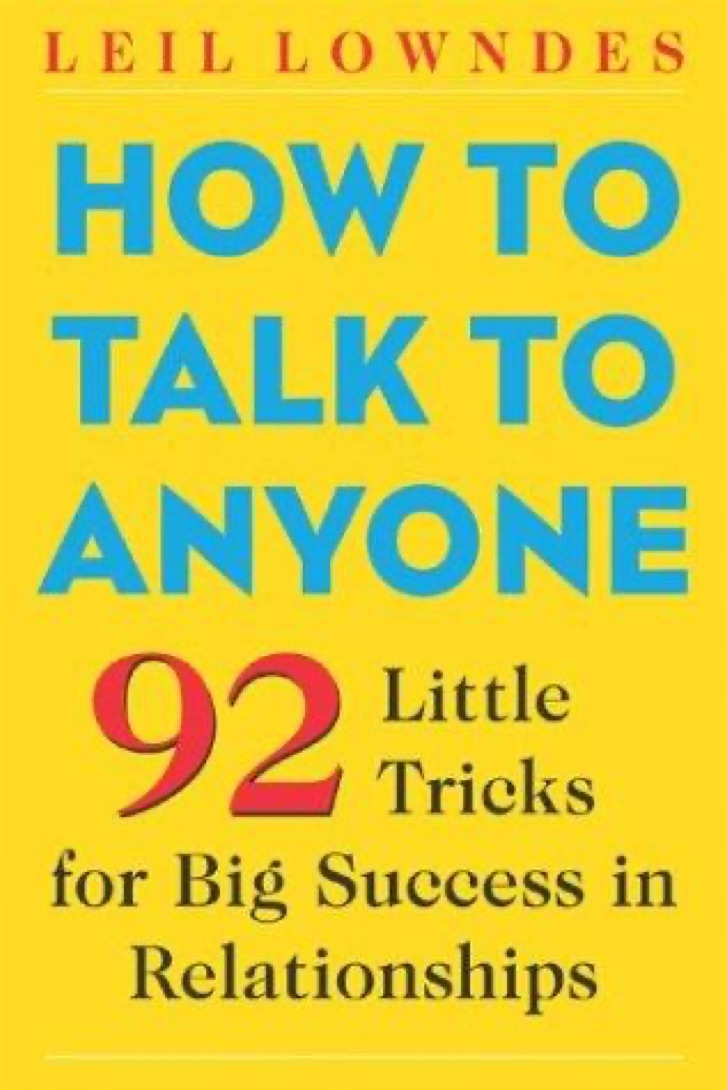
How to Talk to Anyone: 92 Little Tricks for Big Success in Relationships
Applying the lessons from "How to Talk to Anyone" by Leil Lowndes to your life can be a transformative step toward enhancing your professional efficacy and personal connections, whether you are navigating the high-pressure environment of an emergency room or the strategic landscape of venture capital. Here are some ways you might integrate these lessons:
-
Commanding Presence in Leadership: - For a leader or entrepreneur, presence is paramount. By utilizing "Sticky Eyes" and the "Flooding Smile," you can project a sense of calm authority and genuine interest. This is vital in the ER or during VC negotiations, where your non-verbal cues must communicate both competence and approachability.
-
The "Checklist" Approach to Social Interaction: - Just as an aviator relies on a pre-flight checklist, you can view Lowndes’ techniques as a mental checklist for social engagement. By treating social interaction as a skill to be refined—consistent with the "Stay Hungry" mindset—you systematically improve your ability to connect with diverse groups across different industries.
-
Enhancing Empathy in Healthcare and Law: - In medicine and law, understanding the client’s perspective is crucial. Techniques like "Echoing" allow you to speak the patient's language, fostering a level of trust and psychological safety essential for effective diagnosis. This builds the "humble" connection necessary for true service.
-
Strategic Networking for Entrepreneurs: - The "Swiveling Spotlight" and "Grapevine Glory" are essential tools. In healthcare startups and venture capital, making others feel like the most important person in the room is a superpower. By facilitating positive gossip, you build a reputation as a connector, which is vital for long-term success.
-
Nuanced Communication in High-Stress Situations: - Whether managing a medical crisis or a legal negotiation, the ability to maintain composure and use "The Broken Record" ensures your message is heard without escalating conflict. This allows for clear, concise direction when every second counts and lives or deals are on the line.
-
Fostering a Culture of Inclusion: - Using "The Premature We" can help build a sense of team unity quickly in a new venture. By using inclusive language, you bridge the gap between "me" and "them," creating a "we" culture that is foundational for any successful organizational growth and effective leadership.
By integrating these lessons, you move beyond the basics of communication into a more sophisticated realm of social mastery. Embracing these "little tricks" allows you to balance your professional expertise with a deep, human-centric approach to interaction, ensuring that you remain both hungry for new connections and humble in your approach to every individual you meet.
What the book covers
"How to Talk to Anyone: 92 Little Tricks for Big Success in Relationships" by Leil Lowndes is a comprehensive manual dedicated to the fine art of interpersonal communication and social engineering. Lowndes breaks down the complex mechanics of human interaction into 92 distinct, actionable techniques that range from body language adjustments to sophisticated conversational strategies. The book serves as a practical toolkit for anyone looking to increase their social capital, build rapport quickly, and navigate professional or social environments with greater ease and influence.
Summary:
-
The Power of First Impressions: - Lowndes emphasizes that a first impression is formed within the first few seconds of an encounter, often before a word is even spoken. Techniques like the "Flooding Smile" suggest a delayed, sincere smile rather than a quick, reflexive one, while "Sticky Eyes" encourages maintaining eye contact even after a conversation ends to signal confidence and interest.
-
Strategies for Engaging Small Talk: - The book moves beyond clichés to provide tools for meaningful small talk, such as "The Swiveling Spotlight," which focuses the conversation entirely on the other person to make them feel important. She also introduces "Parroting," a technique of repeating the last few words of a speaker’s sentence to encourage them to elaborate without requiring the listener to invent new topics.
-
Body Language and Social Presence: - Physicality plays a crucial role in how others perceive authority and warmth. Lowndes details techniques like "The Big-Baby Pivot," where you turn your entire body toward someone to give them your undivided attention, and "The Epoxy Eyes," which involves maintaining intense eye contact to build deep rapport and signal trustworthiness.
-
Advanced Rapport and Empathy: - To build deeper connections, the author suggests "Echoing," or mirroring the specific vocabulary and pacing of the person you are talking to, which subconsciously signals that you are "like them." She also discusses "The Premature We," using inclusive language early in a relationship to foster a sense of shared history and partnership.
-
Mastering the Art of Praise: - Lowndes argues that direct praise can sometimes feel sycophantic, so she suggests "Grapevine Glory," where you tell a compliment about someone to a third party so that it eventually reaches the recipient. This increases the perceived sincerity of the praise and strengthens the social bond through a secondary source.
-
Navigating High-Stakes Social Events: - For networking and parties, the book provides strategies like "The Commensality Clause," emphasizing the importance of breaking bread together, and "Rubberneck the Room," a technique for scanning a room to identify key players before making a move. These methods help individuals manage social anxiety by providing a clear tactical plan for interaction.
The book's significance lies in its granular approach to social skills, transforming abstract concepts like "charisma" into a series of repeatable behaviors. By focusing on the small, often overlooked details of communication, Lowndes provides a roadmap for achieving significant success in both personal relationships and professional endeavors.