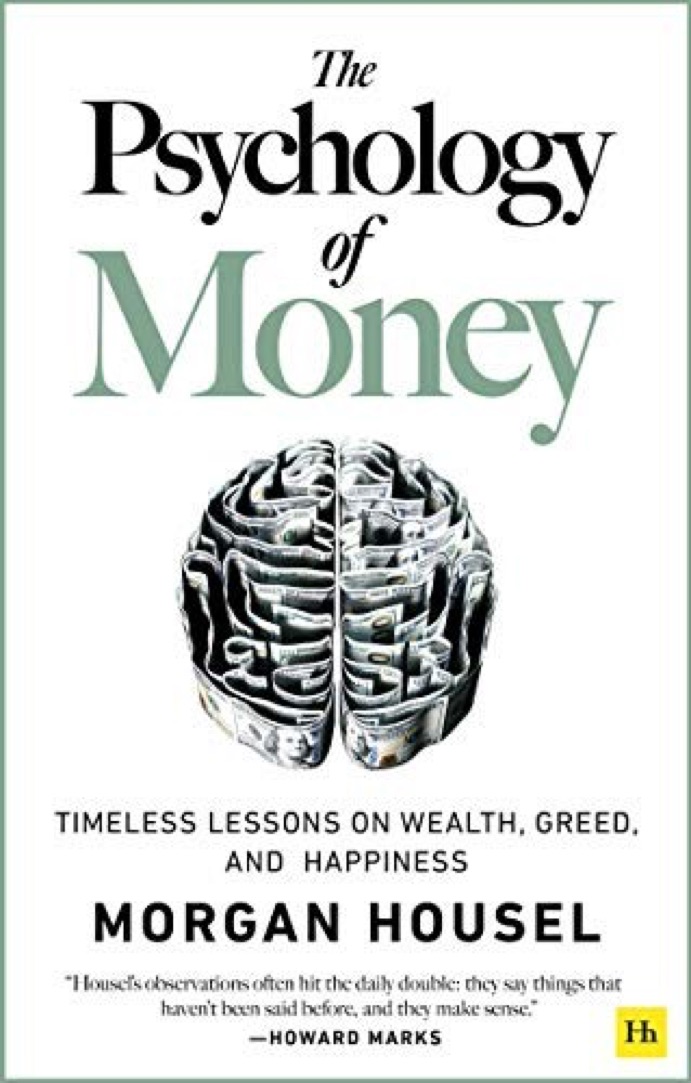
The Psychology of Money: Timeless Lessons on Wealth, Greed, and Happiness
Applying the lessons from "The Psychology of Money" by Morgan Housel to your life can be a transformative exercise in aligning your financial behavior with your true values rather than market expectations. Here are some ways you might integrate these lessons:
-
Cultivate a Survival Mindset in Leadership: - In your roles as a healthcare entrepreneur and VC leader, prioritize longevity over short-term gains by ensuring your ventures have a significant margin of safety. Whether you are navigating an emergency department crisis or a fluctuating market, remember that your ability to stay in the game is more important than any single "home run" investment or business deal.
-
Acknowledge the Role of Fortune in Success: - As you mentor the next generation of entrepreneurs, maintain your mantra of "Stay Humble" by recognizing the role of luck in your own achievements. This perspective allows you to judge others with more empathy and helps you avoid the trap of overconfidence when making high-stakes decisions in medicine, law, or aviation.
-
Prioritize Autonomy as Your Ultimate Currency: - Use your financial resources not as a tool for status, but as a mechanism to buy back your time. As a lifelong learner and pilot, the true value of your success is the freedom it grants you to pursue new intellectual interests, fly, and spend time with family without being tethered to a traditional desk or schedule.
-
Embrace the "Margin of Safety" Across Disciplines: - Apply the aviation concept of redundancy to your financial and professional life by assuming that things will go wrong. In the same way a pilot plans for engine failure, you should ensure your business models and personal finances can withstand unexpected shocks without requiring you to sell your soul or your assets.
-
Define Your "Enough": - In a world of "serial" entrepreneurship, it is easy to constantly move the goalposts of success. Actively define what a successful life looks like for you so that you don't risk what you have and need for what you don't have and don't need, ensuring your "hunger" for growth never eclipses your peace of mind.
-
Focus on Behavior Over Complexity: - Whether you are studying for a new degree or evaluating a startup, remember that simple, sustainable habits often outperform complex, fragile systems. Mastery in any field—be it law, medicine, or finance—is less about brilliance and more about the discipline to avoid catastrophic mistakes over a long period.
By integrating these lessons, you can ensure that your pursuit of excellence is matched by a grounded sense of security and a clear understanding of why you are building wealth in the first place.
What the book covers
"The Psychology of Money: Timeless Lessons on Wealth, Greed, and Happiness" by Morgan Housel is a profound exploration of the human behaviors and emotional biases that dictate financial success more than technical knowledge. Housel argues that managing money is not a math-based field where you follow a set of formulas, but rather a soft skill where how you behave is more important than what you know. Through nineteen short stories, the book illustrates that wealth is often the result of patience, humility, and the ability to manage one's own ego rather than being the smartest person in the room.
Summary:
-
The Influence of Personal History: - Housel posits that no one is crazy when it comes to money, because everyone’s financial decisions are based on their unique experiences and the era in which they were raised. Your personal history with risk and reward creates a lens through which the world of finance is viewed, meaning that what seems reckless to one person may seem perfectly logical to another based on their lived reality.
-
The Duality of Luck and Risk: - Luck and risk are described as siblings, both being the reality that every outcome in life is guided by forces other than individual effort. Housel warns that we should be careful when judging financial success—both our own and others—because it is difficult to identify how much of a result was due to a brilliant decision versus a fortunate break or a hidden risk.
-
The Power of Compounding and Time: - Using Warren Buffett as a primary example, the book explains that the vast majority of financial success is simply a byproduct of staying invested for an extraordinary amount of time. Compounding is not intuitive to the human brain, which tends to look for linear growth; however, the most effective financial strategy is often just surviving long enough to let exponential growth do the heavy lifting.
-
Getting Wealthy vs. Staying Wealthy: - Housel distinguishes between the skills required to make money—taking risks, being optimistic, and putting yourself out there—and the skills required to keep it, which require the opposite: humility, frugality, and a healthy dose of paranoia. Survival is the key to financial longevity, necessitating a "margin of safety" in every plan to account for the unknown.
-
Wealth as the Ability to Control Time: - The highest dividend money pays is the ability to control your time, which Housel identifies as the most reliable predictor of happiness. Having the flexibility to do what you want, when you want, with whom you want, is a far greater return on investment than any luxury item or status symbol, as it provides a sense of autonomy that shields against burnout.
-
The Invisible Nature of Wealth: - The book makes a sharp distinction between being "rich," which is visible through cars and houses, and being "wealthy," which is the money not spent and the assets not yet converted into stuff. Wealth provides options and flexibility, but because it is what you don't see, it requires immense self-discipline to build and maintain in a world that prizes outward displays of success.
-
Reasonable Over Rational: - Financial decisions should not strive to be perfectly cold and rational, but rather "fairly reasonable." A strategy that is mathematically perfect but emotionally agonizing will be abandoned during market volatility; therefore, choosing a path that allows you to sleep at night is often the most effective way to ensure you stick with your long-term plan.
This book is significant because it shifts the focus of financial literacy from the spreadsheet to the mirror. By acknowledging that we are emotional creatures rather than calculating machines, Housel provides a framework for building wealth that is sustainable, peaceful, and aligned with human nature.