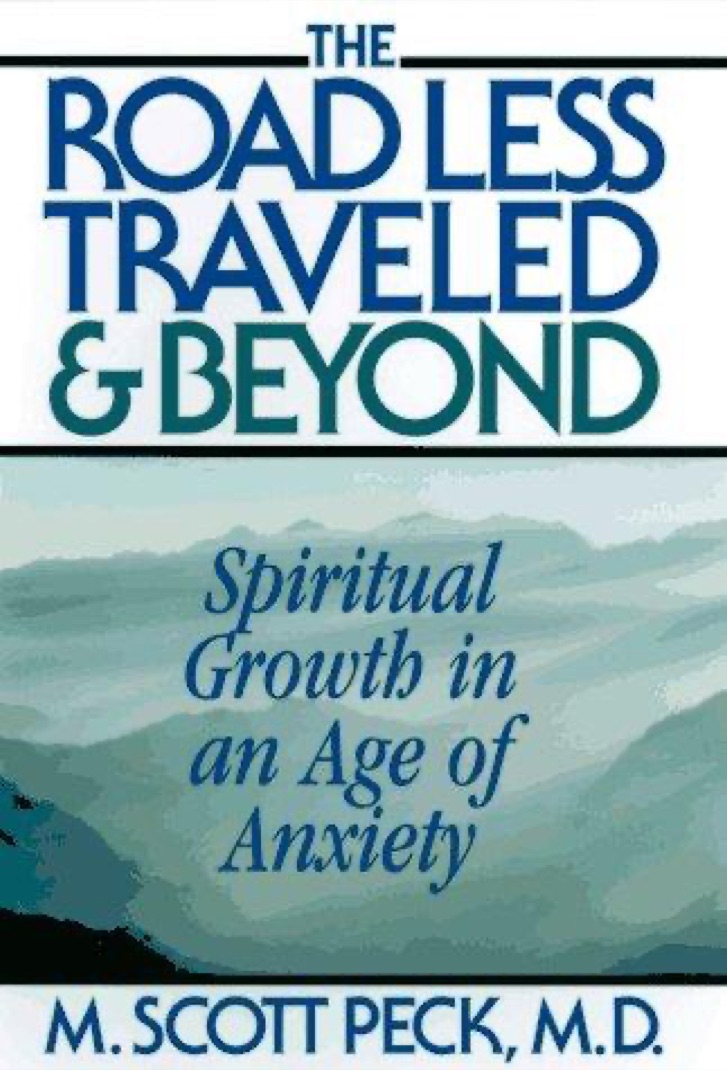
The Road Less Traveled and Beyond: Spiritual Growth in an Age of Anxiety
Applying the lessons from "The Road Less Traveled and Beyond: Spiritual Growth in an Age of Anxiety" by M. Scott Peck to your life can be a transformative exercise in radical self-honesty and intellectual discipline. Here are some ways you might integrate these lessons:
- Develop a Discipline of Thinking: In high-stakes environments like the ER or the cockpit, habitual reactions save lives, but in leadership and venture capital, you must carve out time for "slow thinking." Regularly challenge your own assumptions and seek out data that disproves your current thesis to ensure your mental map matches the actual terrain of the market or the law. - Practice being "consciously confused." When faced with a complex business problem, resist the urge to jump to a simplistic solution. Sit with the complexity until a higher-level, integrated simplicity emerges.
- Integrate Your Shadow for Authentic Leadership: As a leader and physician, you are often expected to be the "hero." However, Peck’s work suggests you must acknowledge your own limitations and ego. By being honest about your "shadow" side, you prevent it from unconsciously driving your decisions and become a more authentic, humble mentor to your team.
- Embrace the Paradox of the Serial Entrepreneur: Recognize that your greatest strengths—like your drive and self-reliance—must be balanced by their opposites, such as the ability to delegate and the humility to admit when you are out of your depth. Success in diverse fields requires the paradox of being fiercely competitive yet deeply collaborative.
- View Professional Doubt as a Catalyst: Whether in your spiritual life or your career transitions, do not fear periods of skepticism or "emptiness." Peck teaches that these are often signs of transitioning to a higher stage of maturity. Use these moments to shed outdated beliefs and "re-map" your world for your next venture.
- Guard Against Success-Induced Narcissism: The higher you climb in medicine or business, the easier it is to fall into the trap of believing your own press. Actively seek out "truth-tellers" who will challenge you and keep you grounded, ensuring your "Stay Humble" mantra is a daily practice rather than just a slogan.
- Nurture a "Wild" Spirituality: Move beyond the dogmas of your industry or background to develop a personal philosophy that sustains you. This internal compass is what allows you to remain steady during the turbulence of entrepreneurship and the pressures of legal and medical responsibility.
By integrating these lessons, you move beyond mere success toward a state of "integrated simplicity" where your diverse roles—as doctor, pilot, and investor—harmonize into a single, purposeful life. Peck’s invitation is to never stop evolving, ensuring that your hunger for growth is always balanced by the humble recognition of the vastness of what you have yet to learn.
What the book covers
"The Road Less Traveled and Beyond: Spiritual Growth in an Age of Anxiety" by M. Scott Peck is the concluding volume of his influential trilogy, distilling a lifetime of psychiatric practice and spiritual inquiry into a final guide for personal evolution. Written toward the end of his career, Peck moves beyond the foundational disciplines of his first book to address the nuanced challenges of achieving a "higher" consciousness in a chaotic, modern world. The book functions as both a philosophical treatise and a practical manual for those willing to confront the difficult truths of human nature and the inherent mystery of the divine.
Summary:
- The Journey Toward Integrated Simplicity: Peck introduces the concept of "integrated simplicity," distinguishing it from the "simplistic" avoidance of reality. He argues that true wisdom requires individuals to dive into the messy complexity of life, suffer through the confusion, and eventually emerge with a refined, simple understanding that accounts for all variables. - This process is described as a spiral rather than a circle; each time we face a new crisis, we must be willing to abandon our previous "maps" of reality. This willingness to endure confusion is presented as a prerequisite for genuine intellectual and spiritual growth.
- The Discipline of Conscious Thinking: A major theme is the rarity of true thinking in daily life. Peck contends that most individuals rely on habitual reactions, prejudices, or the opinions of others rather than engaging in the arduous, volitional work of independent thought. - He frames thinking as a moral act—a choice to focus the mind and examine evidence even when it contradicts our personal desires. For Peck, the failure to think is not just a mental lapse but a spiritual stagnation that prevents the soul from maturing.
- Confronting and Integrating the Shadow: Drawing heavily on Jungian concepts, Peck explores the "shadow"—the hidden, often darker parts of the personality. He posits that spiritual health is impossible without acknowledging our capacity for evil, selfishness, and laziness. - By bringing these hidden traits into the light of consciousness, the individual gains greater self-control and authenticity. Peck warns that those who refuse to acknowledge their shadow are the most likely to project it onto others, leading to interpersonal conflict and social evil.
- The Evolution of Religion and Spirituality: Peck makes a sharp distinction between institutional religion and individual spirituality. While religion provides a necessary structure for many, he argues that one must eventually transition from an external "potted plant" faith to an internal, "wild" spiritual experience. - He explores the stages of spiritual growth, suggesting that skepticism and even atheism are often necessary intermediate steps for those moving away from blind dogma toward a more mature, personal relationship with the transcendent.
- The Value of Paradox in Maturity: The book emphasizes that truth is often found in the tension between opposites. Peck explores paradoxes such as the need to be both independent and dependent, or the requirement to be simultaneously gentle and firm. - Mature individuals are those who can hold these contradictory truths in their minds without seeking an easy, one-sided resolution. This capacity for paradox is presented as the ultimate hallmark of a developed soul and a healthy mind.
- Narcissism as a Barrier to Growth: Peck discusses narcissism as a spiritual disease characterized by the refusal to submit to any power higher than the self. He describes it as a form of "active ignorance" where the individual protects their ego at all costs. - He provides insights into how narcissistic patterns can disrupt organizations and families, stressing that the only antidote is a commitment to humility—the willingness to be wrong and to be corrected by reality.
Peck’s final work serves as a legacy piece that challenges the "quick fix" culture of modern self-help. Its significance lies in its refusal to offer easy answers, instead providing a rigorous framework for lifelong learning and spiritual maturation that remains essential for leaders and seekers navigating an age of anxiety.