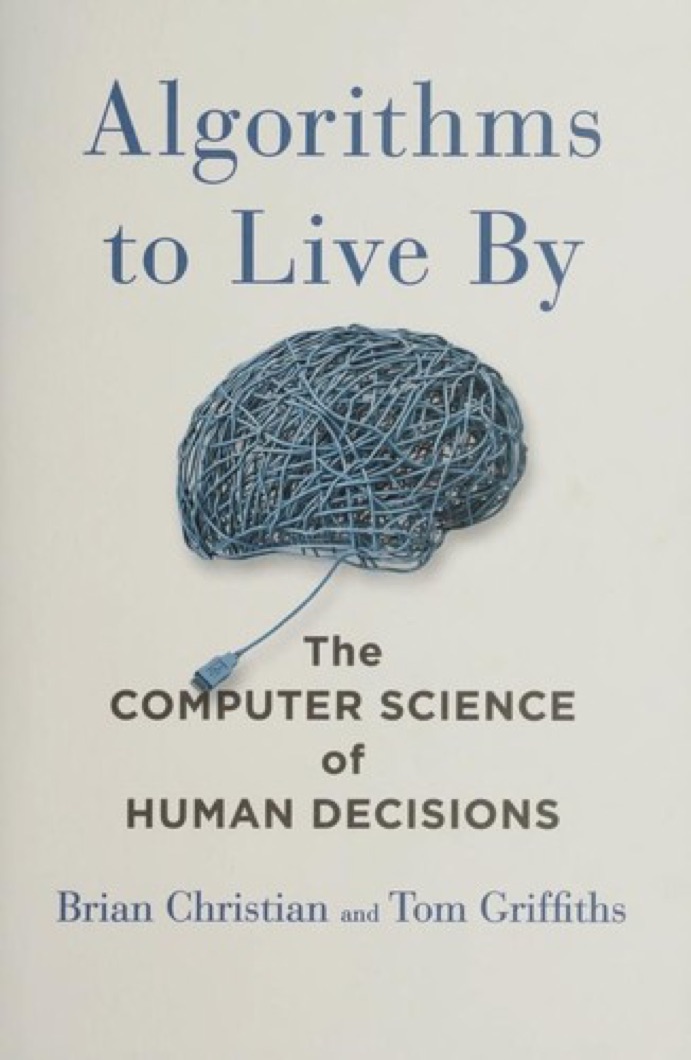
Algorithms to Live By: The Computer Science of Human Decisions
Applying the lessons from "Algorithms to Live By: The Computer Science of Human Decisions" by Brian Christian and Tom Griffiths to your life can be a transformative exercise in cognitive efficiency and clarity. Here are some ways you might integrate these lessons:
-
Optimize Your Search for Excellence: - Whether you are recruiting a new executive for Xcellerant Ventures or evaluating a potential site for a new healthcare facility, apply the 37% rule. Spend the first third of your search window establishing a benchmark without making a commitment, then select the very next candidate who exceeds that baseline. This prevents the "paralysis of choice" and ensures you don't waste time on an infinite search.
-
Balance Exploration with Exploitation: - As a serial entrepreneur, you must decide when to pivot toward a new healthcare technology and when to scale an existing success. Use the "Upper Confidence Bound" strategy: favor the unknown when you have a long time-horizon to reap the benefits, but lean into your established expertise in medicine and law when time or resources are constrained and you need a guaranteed return.
-
Manage Professional "Thrashing": - In the high-pressure environment of an ER or a VC firm, constant context-switching is a productivity killer. Implement "Interrupt Coalescing" by batching administrative tasks, legal reviews, and investment pitches into dedicated blocks. This reduces the mental "overhead" required to restart a complex task, allowing your brain to maintain a high-performance state rather than wasting energy on the transition itself.
-
Apply Caching to Physical and Mental Spaces: - Adopt a "Least Recently Used" (LRU) approach to your library, office, and digital files. Keep the tools and references you used today on the top of the pile or the front of the shelf. This self-organizing system ensures that your most vital resources are always at your fingertips, mirroring the efficiency of a computer’s high-speed cache and reducing search time.
-
Avoid Overfitting in Complex Systems: - In both medical diagnostics and venture capital, it is tempting to over-analyze data. Remember that adding more variables to a model can actually decrease its predictive power. When the future is highly uncertain, rely on "low-complexity" heuristics to avoid mistaking market noise for a sustainable trend; keep your decision-making models lean and focused.
-
Design Better Incentives through Mechanism Design: - Use mechanism design to align the goals of your healthcare startups with the needs of patients and providers. By engineering the "game" so that the path of least resistance for an employee is also the path to the best clinical or business outcome, you reduce the need for constant oversight and create self-sustaining, efficient organizations.
By integrating these lessons, you move beyond the limits of intuition and embrace a more structured, algorithmic approach to leadership and life. This scientific mindset honors the constraints of your time while maximizing the impact of your diverse expertise across medicine, law, and entrepreneurship.
What the book covers
"Algorithms to Live By: The Computer Science of Human Decisions" by Brian Christian and Tom Griffiths is a profound examination of how algorithmic thinking can solve the most common human dilemmas. By drawing parallels between the challenges faced by computer scientists—such as memory management, processing speed, and network congestion—and those faced by individuals in daily life, the book provides a mathematical foundation for making better choices. It argues that many of the stresses we attribute to character flaws or lack of discipline are actually computational problems that have already been solved by science, offering a bridge between the rigid logic of mathematics and the messy reality of human existence.
Summary:
-
Optimal Stopping and the 37% Rule: - The authors introduce the "Secretary Problem," a classic mathematical puzzle that asks when one should stop searching for the best candidate and make a commitment. The solution is the 37% Rule: spend the first 37% of your search period exploring options without committing, then choose the next option that is better than any seen so far. - This principle applies to everything from finding a parking spot to house hunting or choosing a life partner. It provides a rigorous way to balance the risk of stopping too early (missing a better option) against the risk of stopping too late (losing the best option once you have passed it).
-
The Explore/Exploit Trade-off: - This section explores the "Multi-Armed Bandit" problem, which deals with how to allocate resources between trying new things (exploration) and sticking with what you know works (exploitation). The authors suggest that the value of exploration decreases over time, meaning you should be more adventurous in your youth and more reliant on known favorites as time runs out. - They emphasize that "exploration" is inherently about gathering information, while "exploitation" is about harvesting rewards. Recognizing which phase of a project or life stage you are in helps dictate whether you should try a new restaurant or visit your favorite one to maximize total utility.
-
Sorting and the Burden of Organization: - Sorting is one of the most computationally expensive tasks for a computer, and the authors argue it is often overrated in human life. They discuss various algorithms like Bubble Sort and Mergesort, demonstrating that the effort required to keep things perfectly sorted often exceeds the benefit of being able to find them quickly later. - The book suggests that for many collections—like an email inbox or a messy physical desk—the most efficient strategy is often not to sort at all, but rather to use a search function or a simple "Least Recently Used" pile, as the cost of organization should never exceed the cost of the search it replaces.
-
Caching and Memory Management: - Computers use "caching" to keep the most relevant data close at hand for rapid access. The authors explain the "Least Recently Used" (LRU) policy, which discards the item that hasn't been touched for the longest time to make room for new data, essentially managing memory by recency. - This algorithm can be applied to physical spaces, such as organizing a closet by putting clothes back on the left side of the rack after use. Over time, the most-used items naturally migrate to the front, creating a self-organizing system that mirrors the way high-speed computer memory works to minimize retrieval time.
-
Scheduling and Time Management: - When faced with a long list of tasks, different algorithms prioritize different outcomes. "Shortest Processing Time" minimizes the length of the to-do list and provides a sense of accomplishment, while "Earliest Due Date" minimizes maximum lateness across all commitments. - The authors also address "Interrupt Coalescing," a technique used in operating systems to group similar tasks together to reduce the overhead cost of switching contexts. For humans, this means batching meetings or emails to avoid the "thrashing" that occurs when we switch tasks too frequently and spend all our time on the switch itself.
-
Bayes’ Rule and Future Prediction: - The authors discuss how to update your probabilities based on new evidence using Bayesian statistics. They introduce the Copernican Principle, which suggests that the best way to predict how long something will last is to assume you are seeing it at its midpoint, unless you have strong prior data. - By understanding "priors"—the baseline expectations we have about the world—we can more accurately interpret new data. This mathematical approach helps individuals distinguish between a passing fad and a long-term trend, allowing for better forecasting in business and personal life.
-
Overfitting and the Power of Simplicity: - Overfitting occurs when a model is so complex that it mistakes random noise for a meaningful pattern. The authors argue that in uncertain or rapidly changing environments, simpler models with fewer variables often perform better than complex ones because they are more robust. - This suggests that "thinking too much" or considering too many variables can lead to worse decisions. Sometimes, the most effective strategy is to focus on the one or two most important factors and ignore the rest, avoiding the trap of finding patterns where none exist.
-
Game Theory and Mechanism Design: - The final section moves from individual decision-making to social interactions, exploring how the rules of a "game" dictate the behavior of its players. "Mechanism Design" is the art of creating incentives that align individual interests with the collective good, rather than relying on willpower. - The authors suggest that instead of trying to change people's nature, we should change the "computational environment" or the rules of the system to make cooperation the most efficient strategy for everyone involved, thereby solving social dilemmas through structure.
By integrating these lessons, the book empowers readers to let go of the guilt of indecision or disorganization by showing that there are provably optimal ways to handle the constraints of time and space. It provides a scientific justification for when to be messy, when to be picky, and when to just start working.