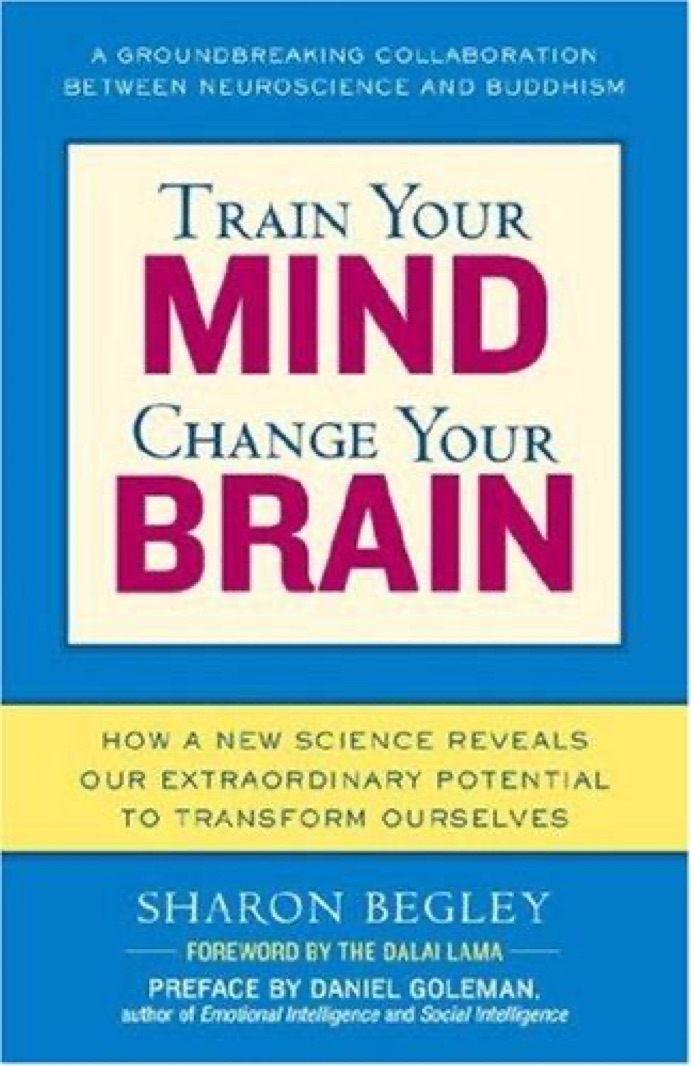
Train Your Mind, Change Your Brain: How a New Science Reveals Our Extraordinary Potential to Transform Ourselves
Applying the lessons from "Train Your Mind, Change Your Brain" by Sharon Begley to your life can be a transformative journey toward self-directed evolution and cognitive mastery. Here are some ways you might integrate these lessons:
- Adopt a Growth Mindset Toward Your Own Biology: - You should recognize that your brain is not a finished product, regardless of your age or professional stage. Whether you are navigating the complexities of a venture capital deal or learning a new medical protocol, you must operate with the conviction that your cognitive abilities and emotional resilience can be expanded through deliberate, focused effort.
- Harness Focused Attention in High-Stakes Environments: - In fields like medicine, aviation, or law, where precision is paramount, you can use the principles of neuroplasticity to improve your situational awareness. By practicing mindfulness and disciplined mental focus, you train your brain to filter out noise and strengthen the neural pathways responsible for rapid, accurate decision-making under pressure.
- Proactively Rewire Your Emotional Response to Stress: - As a leader and entrepreneur, you will inevitably face setbacks; however, you can choose to reshape your brain’s reaction to these stressors. By consciously practicing "cognitive reappraisal" during a crisis, you move activity away from the reactive amygdala and toward the analytical prefrontal cortex, turning a panic response into a strategic advantage.
- Commit to Mental Training as Rigorously as Physical Exercise: - To stay hungry and stay humble, you must treat your mind as a muscle that requires daily conditioning. Integrating even short sessions of meditation or deep cognitive work into your routine creates the physical structural changes necessary to maintain peak performance and prevent the cognitive decline often associated with chronic high-stress careers.
- Cultivate Compassion as a Strategic Leadership Skill: - You should view empathy and compassion not as "soft" traits, but as high-level cognitive skills that can be developed. By training your brain to seek the perspective of others—whether they are patients, employees, or business partners—you foster an organizational culture that is neurologically wired for better collaboration and higher ethical standards.
- Leverage Plasticity for Lifelong Learning and Adaptation: - In the rapidly evolving landscape of healthcare and technology, your ability to unlearn old patterns and master new ones is your greatest asset. You can embrace the discomfort of new challenges, knowing that the very act of struggling with a complex problem is what triggers the neurogenetic processes required to adapt and succeed.
By integrating these lessons, you move beyond the limitations of your biological inheritance and take full command of your mental development. This proactive approach to neuroplasticity ensures that as you continue to innovate and lead, your brain remains an agile, resilient, and ever-improving tool for achieving your highest potential and serving those in your care.
What the book covers
"Train Your Mind, Change Your Brain: How a New Science Reveals Our Extraordinary Potential to Transform Ourselves" by Sharon Begley is a compelling exploration of the revolutionary shift in neuroscience regarding the brain's ability to change. The book chronicles the intersection of ancient Buddhist philosophy and modern Western science, specifically highlighting a landmark 2004 meeting between the Dalai Lama and world-renowned neuroscientists. Begley details how the long-held dogma of the "fixed" adult brain has been dismantled by the discovery of neuroplasticity—the brain’s ability to physically reorganize itself in response to experience and mental training. It serves as both a scientific history and a profound testament to the power of the human will to overcome biological predispositions.
Summary:
- The Fall of the Fixed-Brain Dogma: - For decades, the scientific establishment operated under the belief that the adult brain was hardwired and incapable of generating new neurons or significant structural changes. Begley describes how early pioneers challenged this status quo, eventually proving that the brain remains plastic throughout life, responding to both external stimuli and internal thought processes.
- The 2004 Mind and Life Institute Dialogue: - A central thread of the book is the collaboration between the Dalai Lama and scientists like Richard Davidson and Michael Merzenich. This dialogue explores how meditation and mental discipline, practiced for millennia in the East, provide a practical framework for the scientific study of neuroplasticity and emotional regulation.
- Neurogenesis and Growth in the Adult Brain: - Begley explains the groundbreaking research confirming that the adult brain can indeed produce new neurons, particularly in the hippocampus, the area associated with memory and learning. This discovery shifted the focus from merely preserving existing brain cells to actively fostering an environment where the brain can grow and repair itself through intentional activity.
- Mental Training and Cortical Reorganization: - The book presents evidence that the brain's physical map is constantly being redrawn based on usage; for example, the regions of the brain responsible for finger movement expand in violinists. This principle extends beyond physical skills to the mental realm, where focused attention can enlarge the neural circuits dedicated to specific cognitive tasks.
- Rewiring the Emotional Brain: - One of the most significant sections focuses on the ability to change one's emotional temperament, such as shifting from a state of chronic anxiety or depression to one of resilience. By consciously practicing mindfulness and reappraisal, individuals can dampen the activity of the amygdala and strengthen the prefrontal cortex, effectively "unlearning" negative emotional responses.
- The Power of Compassion and Altruism: - Research into long-term Buddhist practitioners revealed that the brain's gamma wave activity—associated with high-level consciousness and empathy—can be significantly increased through meditation. This suggests that virtues like compassion are not just personality traits but skills that can be trained and physically etched into the brain’s architecture.
- Clinical Applications for Healing: - Begley highlights how neuroplasticity is being used to treat obsessive-compulsive disorder (OCD), stroke victims, and learning disabilities. By utilizing "directed mental attention," patients can bypass damaged or dysfunctional circuits and forge new pathways, demonstrating that the mind can act as an agent of change for its own physical vessel.
By synthesizing complex neurological data with philosophical insight, Begley demonstrates that we are not merely products of our genes or early childhood environments. The book’s significance lies in its message of hope and agency: that through rigorous mental training and conscious effort, we possess the biological capacity to transform our character, our intelligence, and our lives.