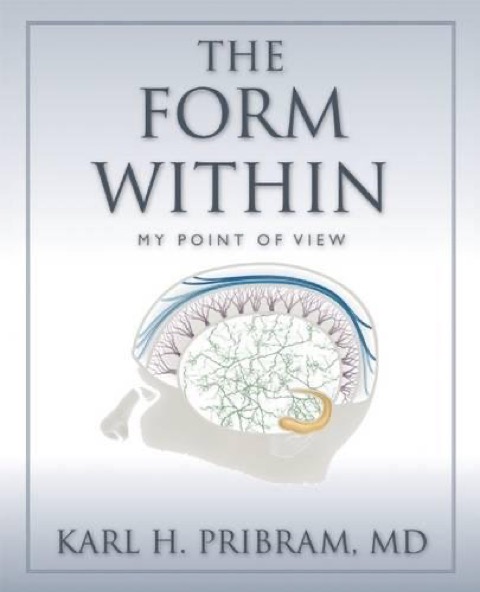
The Form Within: My Point of View
Applying the lessons from "The Form Within: My Point of View" by Karl H. Pribram to your life can be a transformative exercise in expanding your perception of reality and the underlying structures of human behavior. Here are some ways you might integrate these lessons:
- Adopt a Holonomic Perspective on Leadership: - Just as the brain distributes information across its entire network in a holographic fashion, you should view your organizations as holistic entities where the "whole" is contained in every part. In venture capital or medical practice, this means ensuring that every team member understands the core mission so thoroughly that they can act as a microcosm of the entire organization's strategy.
- Master the "Plans" of Goal Achievement: - Utilize Pribram’s concept of "Plans" and TOTE units to refine your approach to complex projects in medicine or law. Recognize that success is a result of constant feedback loops—testing your progress, operating on your environment, and re-testing until the goal is achieved—rather than following a purely linear or static path to an objective.
- Bridge Technical Disciplines for Innovation: - Emulate Pribram’s "Stay Hungry" approach by looking for insights in the gaps between fields like physics, neuroscience, and entrepreneurship. Use your multi-disciplinary background to synthesize diverse data sets, recognizing that the most profound breakthroughs often occur when the mathematical rigor of one field is applied to the creative challenges of another.
- Refine Your Perception of Complexity: - Understand that your brain is filtering a vast "frequency domain" into a simplified "space-time" reality. In high-stakes environments like emergency medicine or aviation, practice "spectral thinking" by looking past the surface-level chaos to find the underlying patterns and rhythms that dictate the situation’s deep structure, allowing for calmer and more accurate decision-making.
- Cultivate Intellectual Humility through Inquiry: - Acknowledge the "Hard Problem" in your own life—the gap between what you know and the ultimate nature of reality. By maintaining a humble stance toward the limits of human knowledge, you remain open to new evidence and unconventional theories, which is essential for a successful venture capitalist and lifelong learner seeking to understand the "form within."
By integrating these lessons, you can develop a more sophisticated mental model that honors the complexity of the human mind while providing practical frameworks for action. Pribram’s work encourages you to look within the "form" of your own experiences to find the universal principles that govern both the neural circuits of the brain and the broader systems of the world.
What the book covers
"The Form Within: My Point of View" by Karl H. Pribram is a comprehensive synthesis of a lifetime’s work in neuroscience, cognitive psychology, and theoretical physics. This massive volume serves as the magnum opus for one of the 20th century’s most influential thinkers, detailing his transition from a pioneering neurosurgeon to a philosopher of the mind. Pribram integrates his groundbreaking holonomic brain theory with quantum mechanics to propose a unified understanding of how the human brain processes information and creates reality.
Summary:
- The Evolution of Holonomic Brain Theory: - Pribram details the development of his theory that the brain functions similarly to a hologram, storing and processing information as interference patterns. He explains how the dendritic structures of neurons perform spectral analysis, using Gabor wavelets and Fourier transforms to convert sensory input into the "holoscape" of conscious experience.
- Bridging the Gap with Quantum Physics: - A significant portion of the work explores Pribram’s collaboration with physicist David Bohm, suggesting that the brain's internal mathematical processes mirror the underlying quantum structure of the universe. This "holonomic" perspective argues that the mind and the physical world are different manifestations of the same underlying informational order.
- The Microstructure of Behavior and Plans: - Revisiting his earlier seminal work on "Plans and the Structure of Behavior," Pribram discusses the hierarchical nature of human action and cognitive processing. He argues that behavior is not just a series of reflexes but is governed by complex feedback loops—specifically TOTE units (Test-Operate-Test-Exit)—that allow for sophisticated, goal-oriented planning.
- Addressing the Hard Problem of Consciousness: - Pribram tackles the classic philosophical dilemma of how subjective experience arises from physical matter. He posits a form of "Neutral Monism," suggesting that both mind and matter are derived from a common substrate of information, which is articulated through the mathematical language of frequency and wave-forms rather than just physical particles.
- The Role of Language and Logic in Neural Systems: - The book examines how the brain transitions from the "deep structure" of holographic-like processing to the "surface structure" of linear thought and language. Pribram explores how different regions of the brain, such as the prefrontal cortex and the limbic system, manage the tension between raw sensory data and structured symbolic representation.
- Historical Context and Intellectual Influences: - Throughout the narrative, Pribram recounts his interactions with legendary figures like Wolfgang Köhler, B.F. Skinner, and Karl Lashley. These anecdotes provide a rich history of cognitive science, illustrating how Pribram’s ideas were shaped by, and often challenged, the prevailing behaviorist and localizationist paradigms of the mid-to-late 20th century.
This work stands as a monument to intellectual synthesis, challenging reductionist views of the brain by offering a sophisticated mathematical and philosophical framework. By positioning the brain as an informational processor that interacts with a frequency-based reality, Pribram provides a visionary bridge between the biological sciences and the fundamental laws of physics.