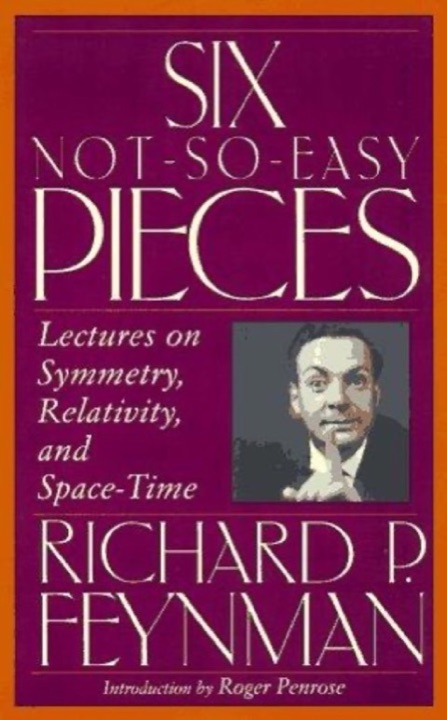
Six Not so Easy Pieces
Applying the lessons from Richard Feynman's "Six Not-So-Easy Pieces" to your life can be a rewarding endeavor, especially given your background and interests. Here are some ways you might integrate these lessons:
-
Embrace Interconnectedness: - Just as Feynman emphasizes the interconnected nature of physical concepts, you can apply this to your life by recognizing the interconnectedness of your experiences, values, and relationships. Your near-death experiences, career in medicine, and personal philosophy are all part of a cohesive narrative that shapes who you are.
-
Appreciate Relativity: - The concept of relativity can remind you to view situations from multiple perspectives. In your interactions, whether in your professional life or personal relationships, consider how others might perceive the same situation differently. This can enhance empathy and understanding, aligning with your core values of kindness and empathy.
-
Leverage Symmetry: - Symmetry in physics often leads to simplification and understanding. In your life, seek balance and symmetry in your daily routines, relationships, and personal growth. This might involve balancing your professional commitments with personal time or ensuring that your actions align with your values.
-
Explore Curved Space: - The idea of curved space as a precursor to understanding gravity can inspire you to think about how unseen forces shape your life. Reflect on how your past experiences, beliefs, and values influence your current path and decisions, much like gravity influences the trajectory of objects in space.
-
Apply the Principle of Least Action: - This principle suggests that nature follows the path of least resistance. In your life, consider how you can achieve your goals efficiently and effectively. This might involve prioritizing tasks, making decisions that align with your long-term aspirations, or finding ways to simplify complex challenges.
-
Cultivate Curiosity and Exploration: - Feynman's lectures encourage curiosity and exploration, which resonate with your desire to be a lifelong learner. Continue to seek new experiences, whether it's trying skydiving, exploring new hobbies, or engaging with new ideas and perspectives.
-
Communicate with Clarity: - Feynman's ability to convey complex ideas with clarity can inspire you to communicate effectively in your personal and professional life. Use your direct and humorous communication style to engage others, share your insights, and foster meaningful connections.
By integrating these lessons into your life, you can continue to grow, learn, and make a positive impact on those around you, all while staying true to your values and aspirations.
What the book covers
"Six Not-So-Easy Pieces: Einstein's Relativity, Symmetry, and Space-Time" is a collection of six lectures by the renowned physicist Richard Feynman, originally part of his famous "Lectures on Physics" series delivered at the California Institute of Technology in the early 1960s. These lectures focus on some of the more challenging concepts in physics, particularly those related to Einstein's theory of relativity and the nature of space and time. Here is a summary of the key topics and takeaways from the book:
Summary of Key Topics:
-
Vectors and Symmetry: - Feynman begins by discussing vectors and their importance in physics. He explores how vectors are used to describe physical quantities that have both magnitude and direction, such as force and velocity. - The concept of symmetry is introduced, emphasizing its fundamental role in the laws of physics. Symmetry principles help simplify complex problems and reveal underlying patterns in nature.
-
Special Relativity: - Feynman delves into Einstein's theory of special relativity, explaining its revolutionary implications for our understanding of space and time. - Key concepts include the constancy of the speed of light, time dilation, length contraction, and the relativity of simultaneity. - The famous equation (E=mc^2) is discussed, highlighting the equivalence of mass and energy.
-
Relativistic Energy and Momentum: - The lectures cover how energy and momentum are redefined in the context of relativity. - Feynman explains how these quantities are conserved in relativistic systems and how they differ from classical mechanics.
-
Curved Space: - Feynman introduces the idea of curved space, a precursor to understanding general relativity. - He explains how gravity can be thought of as the curvature of space-time caused by mass, rather than a traditional force.
-
Symmetry in Physical Laws: - The concept of symmetry is revisited with a focus on its application to physical laws. - Feynman discusses how symmetries lead to conservation laws, such as the conservation of energy and momentum.
-
The Principle of Least Action: - The principle of least action is explored as a unifying concept in physics. - Feynman illustrates how this principle can be used to derive the equations of motion for various physical systems.
Key Takeaways and Lessons:
-
Interconnectedness of Concepts: Feynman emphasizes the interconnected nature of physical concepts, showing how ideas like symmetry and relativity are deeply linked and provide a cohesive understanding of the universe.
-
Importance of Relativity: The book highlights the profound impact of Einstein's theory of relativity on modern physics, reshaping our understanding of space, time, and energy.
-
Role of Symmetry: Symmetry is presented as a powerful tool in physics, offering insights into the fundamental laws governing the universe and leading to the discovery of conservation laws.
-
Curiosity and Exploration: Feynman's lectures encourage a spirit of curiosity and exploration, urging readers to question assumptions and seek deeper understanding.
-
Clarity in Complexity: Despite the complexity of the topics, Feynman's clear and engaging style makes challenging concepts accessible, demonstrating the importance of effective communication in science.
Overall, "Six Not-So-Easy Pieces" serves as both an introduction to advanced topics in physics and a testament to Feynman's ability to convey complex ideas with clarity and enthusiasm.