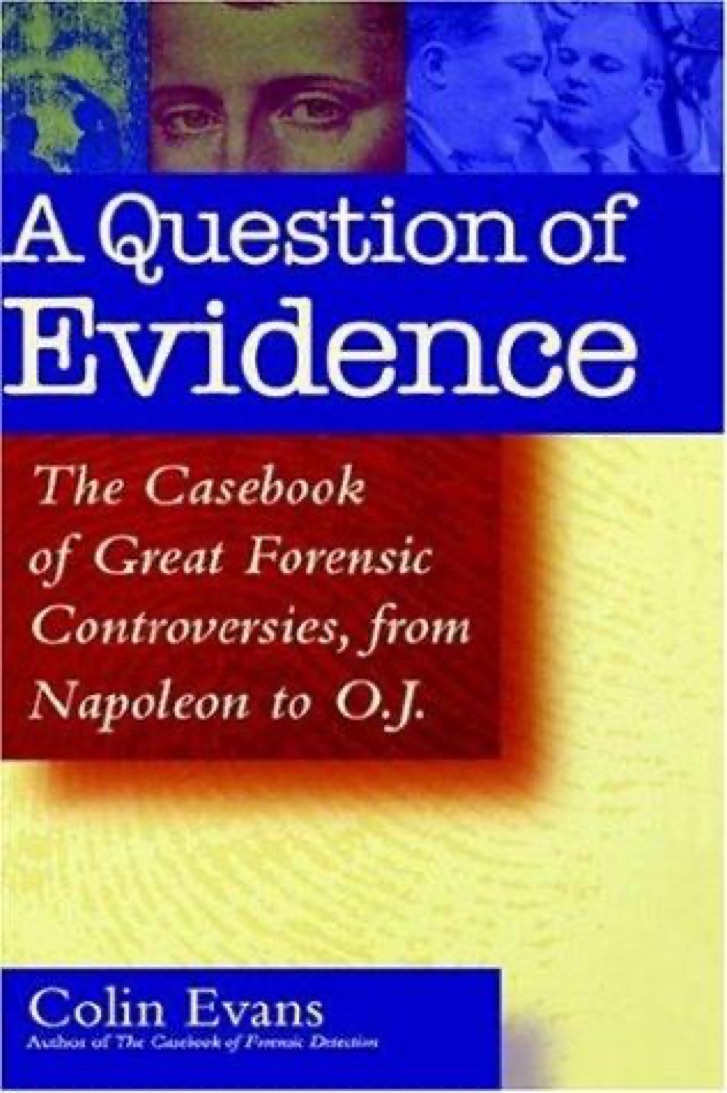
A Question of Evidence: The Casebook of Great Forensic Controversies, from Napoleon to O.J.
Applying the lessons from "A Question of Evidence" by Colin Evans to your life can be an exercise in understanding the critical importance of objective data and the systems required to protect its integrity. Here are some ways you might integrate these lessons:
-
Prioritize Objective Data Over Intuition: - In both medicine and entrepreneurship, rely on hard evidence rather than a compelling narrative. Just as forensic science moved from subjective witness accounts to empirical data like DNA, you should base your strategic decisions on measurable metrics to protect yourself from the emotional volatility of a crisis.
-
Uphold the Integrity of the Chain of Custody: - Whether you are managing legal documents, healthcare data, or business contracts, the integrity of the process is as important as the final result. You must audit your internal processes to ensure that your "evidence"—be it financial records or patient data—is beyond reproach and free from the possibility of tampering or mismanagement.
-
Maintain a Healthy Skepticism of Expert Hubris: - As a leader who operates at the intersection of law and medicine, you must remain critical of "expert" testimony or authoritative opinions. Evans shows how early forensic techniques were often overstated; you should always dig into the underlying methodology of a proposal to ensure the conclusions are supported by data rather than just reputation.
-
Adopt an Evolutionary Mindset Toward Truth: - Acknowledge that what is considered "fact" today may be revised tomorrow as new tools and data become available. As a lifelong learner, maintain the humility to update your clinical or business practices when better information surfaces, just as the retrospective analysis of Napoleon’s hair overturned centuries of medical assumptions.
-
Master the Art of Communicating Complexity: - Success in the courtroom, the cockpit, or the boardroom requires translating high-level technical complexity into actionable insights. Refine your ability to distill complex scientific or legal concepts into clear, persuasive narratives that stakeholders can grasp without losing the underlying accuracy of the science.
-
Actively Mitigate Your Confirmation Bias: - The most dangerous errors in the cases Evans presents stemmed from investigators trying to make the facts fit a preconceived suspect. In your leadership roles, actively seek out evidence that disproves your hypothesis to avoid the tunnel vision that leads to catastrophic failures in diagnosis or investment.
By integrating these lessons, you will cultivate a mindset that values rigorous verification over easy answers, ensuring that your leadership is defined by a relentless pursuit of truth and a profound respect for the systems that preserve it.
What the book covers
"A Question of Evidence: The Casebook of Great Forensic Controversies, from Napoleon to O.J." by Colin Evans is a meticulous examination of how the evolution of forensic science has shaped some of history's most famous legal outcomes. Evans explores fifteen distinct cases, ranging from the 19th-century suspicion of Napoleon's poisoning to the 20th-century spectacle of the O.J. Simpson trial. The book serves as both a history of criminology and a critical look at the reliability of evidence, highlighting the intersection of scientific discovery, legal strategy, and public perception.
Summary:
-
The Evolution of Toxicology and Historical Inquiry: - Evans begins with the mystery of Napoleon Bonaparte’s death on St. Helena, using it to illustrate the birth of toxicology. He discusses how hair samples were later analyzed using neutron activation analysis to suggest arsenic poisoning, demonstrating how retrospective science can challenge established historical narratives and traditional autopsy findings.
-
Ballistics and the Influence of Political Bias: - The case of Sacco and Vanzetti is used to highlight the early days of ballistics and the dangers of primitive methodology. Evans explores how the state of the science, combined with intense political pressure and societal prejudice, led to a conviction that remains a point of contention among legal scholars and forensic historians.
-
Xylotomy and the Power of Physical Trace Evidence: - In the Lindbergh kidnapping case, Evans details the groundbreaking work of Arthur Koehler, a wood expert. By tracing the specific lumber used in the kidnapper’s ladder back to a single mill and even specific tools, Koehler provided a precursor to modern forensic botany, proving that even mundane materials can hold the key to a conviction when analyzed with expert precision.
-
Bloodstain Pattern Analysis and Wrongful Conviction: - Through the trial of Dr. Sam Sheppard, the author explains the development of blood spatter interpretation. He illustrates how the failure to properly analyze the crime scene led to a high-profile wrongful conviction, and how the subsequent involvement of forensic pioneer Paul Kirk eventually helped exonerate Sheppard by proving a third person was present through blood dynamics.
-
Microscopic Fiber Analysis and the MacDonald Case: - The case of Jeffrey MacDonald, the Green Beret doctor accused of murdering his family, focuses on the role of microscopic fibers. Evans details how the FBI matched specific blue threads from MacDonald’s pajama top to the crime scene, demonstrating the transition from relying on eyewitness testimony to the undeniable weight of physical trace evidence in modern trials.
-
Forensic Odontology and the Identification of a Serial Killer: - The prosecution of Ted Bundy showcased the emergence of bite mark analysis as a legitimate forensic tool. Evans describes how forensic dentists matched Bundy’s unique dentition to impressions left on a victim, a pivotal moment that secured his conviction and helped the public understand the power of biological signatures.
-
The DNA Revolution and the Chain of Custody: - The book concludes with the O.J. Simpson trial, contrasting the absolute power of DNA technology with the failures of evidence handling. Evans argues that while the science itself was sound, the breakdown in the "chain of custody" and the defense's ability to sow doubt about the collection process ultimately dictated the verdict, serving as a cautionary tale for the forensic community.
Evans concludes that forensic science is a double-edged sword: it offers unprecedented clarity in the search for truth, but its effectiveness is entirely dependent on the integrity of the individuals who collect, analyze, and present it. This collection reminds us that while science can be exact, the humans who interpret it are often fallible.