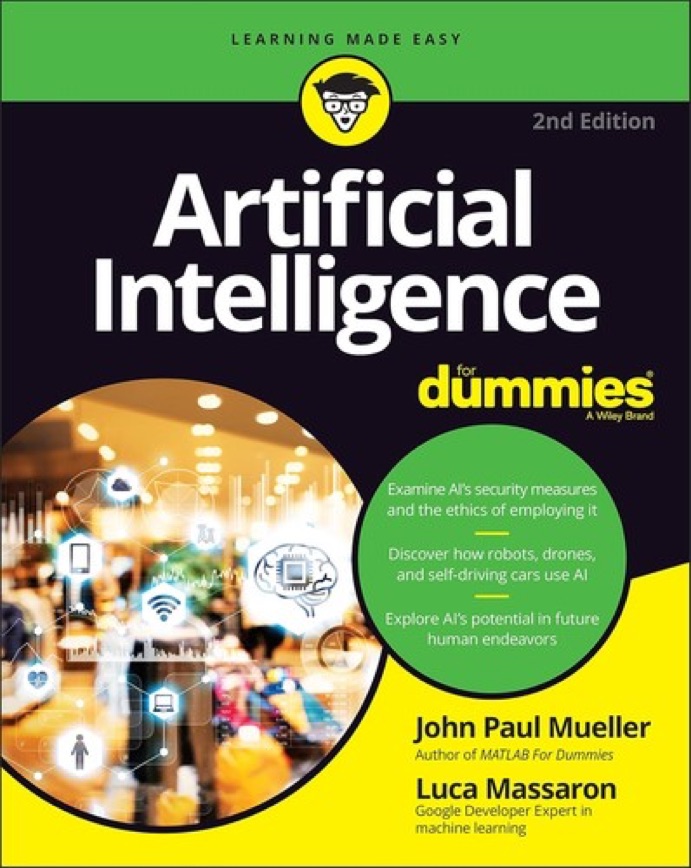
Artificial Intelligence For Dummies
Applying the lessons from "Artificial Intelligence For Dummies" by John Mueller and Luca Massaron to your life can be a transformative experience that prepares you for a technology-driven future. Here are some ways you might integrate these lessons:
-
Embrace Data-Driven Entrepreneurship: - Use the book’s insights on machine learning to refine your business strategies by identifying hidden patterns in customer behavior or market trends. For a serial healthcare entrepreneur, understanding how to leverage predictive analytics can be the difference between a successful pivot and a missed opportunity in a competitive landscape.
-
Augment Clinical and Diagnostic Precision: - In your medical practice, treat AI as a sophisticated "second opinion" rather than a replacement for clinical intuition. By understanding the basics of how diagnostic algorithms are trained, you can better evaluate the reliability of new telehealth tools and ensure that machine-driven insights are used to enhance patient safety.
-
Navigate Legal and Ethical Complexities: - As an attorney, recognize that AI introduces new layers of liability regarding data privacy and algorithmic bias. Applying these lessons means staying ahead of the curve in understanding how transparency affects due process and advocating for ethical standards in how AI is deployed in the corporate sector.
-
Maintain Pilot-Like Situational Awareness: - Just as in aviation, where automated systems assist but do not absolve the pilot of responsibility, use AI to manage your cognitive load while maintaining ultimate control. Learn to identify the "edge cases" where AI might fail, ensuring you retain the critical thinking and manual skills necessary to step in when the technology reaches its limits.
-
Adopt a Lifelong Learner’s Tech Mindset: - Stay hungry for knowledge by viewing AI as a tool for personal growth and organizational efficiency. By mastering the basics of how these systems work, you can automate routine administrative tasks in your professional life, freeing up time to focus on high-level venture capital strategy and mentorship.
-
Lead with Humility in the Machine Age: - Stay humble by acknowledging the inherent limitations of both human and machine intelligence. As a leader, foster a culture where AI is used to empower your team rather than replace them, ensuring that the human element remains central to your mission even as you adopt cutting-edge technical innovations.
By integrating these lessons, you will not only stay competitive in a rapidly evolving professional landscape but also ensure that your leadership remains grounded in both technical competence and human values. Embracing the synergy between human intuition and machine efficiency is the key to navigating the complex, multi-disciplinary world you inhabit.
What the book covers
"Artificial Intelligence For Dummies" by John Mueller and Luca Massaron is a comprehensive primer designed to demystify the complex world of computer intelligence for a general audience. The book traces the evolution of AI from its theoretical roots to its modern applications in machine learning, data science, and autonomous systems. It serves as an essential roadmap for understanding how algorithms shape contemporary life and what the ethical implications of these technologies mean for the future of society.
Summary:
-
Defining AI and its Historical Context: - Mueller and Massaron begin by clarifying what AI actually is—and isn't—moving past the science-fiction tropes to define it as the simulation of human intelligence by machines. They chart the history of the field from early symbolic logic and the development of the first programmable computers to the modern "connectionist" approach that mimics the human brain's neural structures.
-
Machine Learning and Data Science Foundations: - The authors explain that machine learning is the engine behind modern AI, focusing on how systems learn from data patterns rather than following static, hard-coded rules. They detail various learning styles, such as supervised, unsupervised, and reinforcement learning, explaining how these methods allow computers to improve their performance over time without explicit programming.
-
The Power of Deep Learning and Neural Networks: - This section delves into neural networks, the technology responsible for breakthroughs in image recognition and natural language processing. The book describes how layers of mathematical nodes process information hierarchically, enabling machines to perform complex tasks like identifying medical anomalies or translating languages with high accuracy.
-
AI in Practical Industry Applications: - The text explores how AI is already integrated into industries like healthcare, finance, and manufacturing to improve efficiency and decision-making. It highlights specific use cases, such as predictive analytics in patient outcomes and automated fraud detection in banking, showing the technology's tangible value in professional environments.
-
The Necessity of Hardware and Software Ecosystems: - AI requires more than just sophisticated code; the authors discuss the necessity of specialized hardware like GPUs and TPUs to handle massive computational loads. They also introduce the software tools, including Python and various open-source libraries, that allow developers to build and deploy intelligent systems across different platforms.
-
Ethics, Privacy, and the Security Landscape: - A significant portion of the book is dedicated to the risks of AI, including algorithmic bias, the "black box" problem of decision-making, and the potential for job displacement. The authors argue for a human-centric approach to AI development that prioritizes transparency and security to prevent the misuse of personal data.
-
Dispelling Common AI Myths and Future Realities: - Mueller and Massaron address the fear that AI will inevitably lead to a "singularity" where machines overtake humans, grounding the discussion in current technical limitations. They emphasize that while AI is incredibly powerful at specific tasks, artificial general intelligence—the ability to reason across diverse domains—remains a distant and complex goal.
"Artificial Intelligence For Dummies" is a vital resource for anyone seeking to transition from a passive consumer of technology to an informed participant in the digital age. By breaking down technical barriers, it empowers readers to understand the tools that are reshaping every facet of human endeavor, from medicine to legal practice.