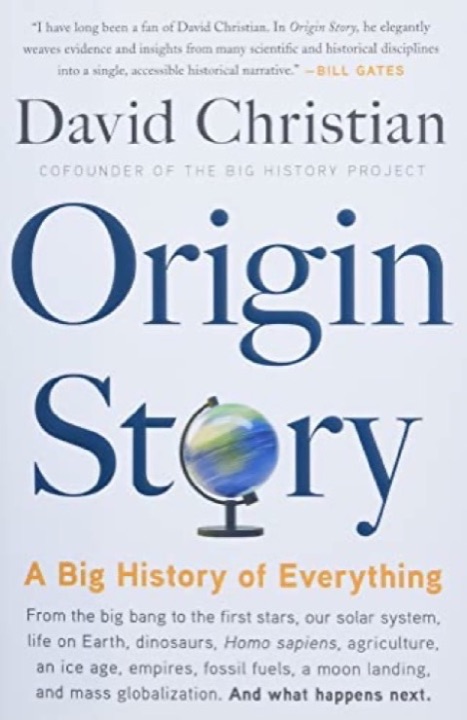
Origin Story: A Big History of Everything
Applying the lessons from "Origin Story: A Big History of Everything" by David Christian to your life can provide a broader perspective and deeper understanding of your place in the universe. Here are some ways you might integrate these lessons:
-
Interconnectedness of Knowledge: - Embrace interdisciplinary thinking in your pursuits. Whether in your medical career, activism, or personal interests, draw insights from various fields to gain a more comprehensive understanding of complex issues. This approach can enhance your problem-solving skills and creativity.
-
Collective Learning: - Leverage your experiences and knowledge to contribute to collective learning. Share your insights and lessons with others, whether through mentoring, teaching, or writing. This can help foster a culture of knowledge-sharing and continuous improvement in your community.
-
Sustainability and Responsibility: - Reflect on your impact on the planet and consider ways to promote sustainability in your daily life. This could involve advocating for environmental causes, reducing your carbon footprint, or supporting sustainable practices in your personal and professional life.
-
Perspective on Time and Scale: - Use the grand scale of history to cultivate humility and patience. Recognize that your actions, while significant, are part of a much larger narrative. This perspective can help you remain grounded and focused on long-term goals, such as your aspirations for societal progress and personal growth.
-
The Power of Storytelling: - Harness the power of storytelling to communicate your values and experiences. Whether through writing, speaking, or casual conversations, use narratives to inspire and engage others. Your unique life experiences, such as surviving plane crashes and your journey in medicine, can serve as powerful stories that motivate and educate.
-
Embrace Change and Adaptation: - Recognize the importance of adaptation and resilience, as highlighted in the book's exploration of evolution and human history. Continue to embrace change and view challenges as opportunities for growth. Your resilience and persistence are already strengths, and this mindset can further empower you to navigate life's uncertainties.
-
Focus on the Future: - Consider how you can contribute to shaping a better future, both personally and societally. This might involve supporting technological advancements that align with your values, advocating for social justice, or working towards your personal goals, such as living in the moment and achieving a balanced life.
By integrating these lessons into your life, you can deepen your understanding of the world and your role within it, while also inspiring others through your actions and insights.
What the book covers
"Origin Story: A Big History of Everything" by David Christian is an ambitious work that seeks to provide a comprehensive narrative of the universe's history, from the Big Bang to the present day. Christian, a historian and scholar, is a pioneer in the field of Big History, which integrates insights from various disciplines to create a unified account of the past.
Summary:
-
The Big Bang and the Formation of the Universe: - The book begins with the Big Bang, approximately 13.8 billion years ago, which marks the origin of the universe. Christian explains the formation of fundamental particles and the emergence of simple atoms. - Over time, gravity led to the formation of stars and galaxies. The life cycles of stars eventually produced heavier elements necessary for the formation of planets and life.
-
The Emergence of Life: - Christian explores the conditions that allowed life to emerge on Earth around 3.8 billion years ago. He discusses the role of complex chemistry and the formation of simple life forms. - The narrative covers the evolution of life, highlighting key transitions such as the development of photosynthesis, multicellularity, and the Cambrian explosion.
-
The Rise of Homo Sapiens: - The book delves into the evolution of humans, focusing on the development of cognitive abilities that set Homo sapiens apart from other species. - Christian emphasizes the significance of collective learning, which allowed humans to share and accumulate knowledge across generations, leading to rapid advancements.
-
Agricultural and Civilizational Developments: - The transition from foraging to agriculture around 10,000 years ago is portrayed as a pivotal moment in human history. This shift enabled the growth of complex societies and the rise of civilizations. - Christian examines the development of social structures, trade, writing, and the emergence of states and empires.
-
The Modern Era and the Anthropocene: - The narrative moves into the modern era, highlighting the scientific and industrial revolutions that transformed human societies and the planet. - Christian introduces the concept of the Anthropocene, a proposed epoch that marks the significant impact of human activity on Earth's geology and ecosystems.
-
The Future: - The book concludes with reflections on the future of humanity and the planet. Christian discusses the challenges posed by climate change, technological advancements, and the need for sustainable development.
Key Takeaways and Lessons:
- Interconnectedness of Knowledge:
-
Christian's approach underscores the importance of interdisciplinary thinking. Understanding the past requires integrating insights from physics, chemistry, biology, history, and other fields.
-
Collective Learning:
-
The ability of humans to share and build upon knowledge is a central theme. This collective learning has driven human progress and is crucial for addressing future challenges.
-
Sustainability and Responsibility:
-
The book highlights the impact of human activity on the planet, emphasizing the need for responsible stewardship of Earth's resources to ensure a sustainable future.
-
Perspective on Time and Scale:
-
By presenting history on a grand scale, Christian encourages readers to appreciate the vastness of time and the relatively brief existence of humans. This perspective can foster a sense of humility and responsibility.
-
The Power of Storytelling:
- Christian demonstrates the power of storytelling in making complex scientific and historical concepts accessible and engaging. Narratives can help people understand their place in the universe and inspire action.
Overall, "Origin Story" offers a sweeping narrative that not only informs but also inspires readers to think critically about the past, present, and future of humanity and the universe.