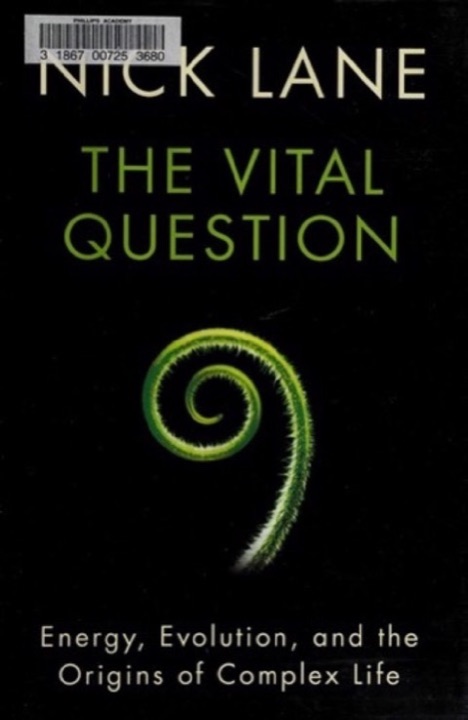
The Vital Question: Energy, Evolution, and the Origins of Complex Life
Applying the lessons from "The Vital Question" by Nick Lane to your life can be an enriching experience, especially given your interests and values. Here are a few ways you might integrate the book's insights:
-
Energy Management: Just as energy is central to the evolution of complex life, it is also crucial in our daily lives. You already have a structured routine that includes exercise and self-care, which is excellent for managing your personal energy. Consider exploring how you can optimize your energy further, perhaps by experimenting with different forms of exercise, meditation, or nutrition to enhance your physical and mental well-being.
-
Interdisciplinary Approach: Lane's work emphasizes the value of integrating insights from various fields. You can apply this by continuing to explore diverse interests and hobbies, such as flying, reading, and cooking. This approach can lead to new perspectives and innovations in your personal and professional life.
-
Resilience and Adaptation: The book highlights how energy efficiency and adaptation are key to complexity and survival. Your life experiences, such as surviving plane crashes and overcoming personal challenges, demonstrate resilience. Continue to embrace change and adapt to new situations, using your past experiences as a foundation for growth.
-
Reevaluating Priorities: Lane challenges conventional views, which can inspire you to reassess your own beliefs and priorities. Reflect on areas where you might be holding onto outdated ideas or practices and consider how you can align them more closely with your current values and goals.
-
Focus on Core Values: Just as mitochondria are central to cellular energy, your core values of kindness and empathy are central to your life. Continue to let these values guide your actions and decisions, ensuring that your energy is directed towards meaningful and fulfilling pursuits.
-
Exploration and Curiosity: Lane's exploration of life's origins can inspire you to remain curious and open-minded. Whether it's finally trying skydiving or delving into new areas of knowledge, maintain a sense of wonder and exploration in your life.
-
Impact on Society: The book's implications for life on other planets can parallel your hopes for societal progress. Use your passion for social issues and technology to contribute positively to society, leveraging your skills and experiences to make a difference.
By applying these lessons, you can continue to live a life that is not only rich in experiences but also aligned with your values and aspirations.
What the book covers
"The Vital Question: Energy, Evolution, and the Origins of Complex Life" by Nick Lane is a thought-provoking exploration of one of biology's most profound mysteries: how complex life evolved from simple, single-celled organisms. Lane, a biochemist and writer, delves into the intricate relationship between energy and evolution, proposing that energy is the driving force behind the emergence of complex life forms.
Summary:
-
The Central Thesis: Lane argues that the key to understanding the evolution of complex life lies in the way cells generate and use energy. He emphasizes the role of mitochondria, the energy-producing organelles in eukaryotic cells, as central to this process. The book posits that the acquisition of mitochondria by ancestral eukaryotic cells was a pivotal event that enabled the evolution of complex multicellular organisms.
-
The Origin of Eukaryotes: Lane explores the endosymbiotic theory, which suggests that eukaryotic cells originated through a symbiotic relationship between different species of prokaryotes. He discusses how the engulfment of a bacterium by an archaeon led to the formation of mitochondria, providing the host cell with a more efficient way to produce energy.
-
Energy and Complexity: The book highlights the importance of energy efficiency in the evolution of complexity. Lane explains how the energy produced by mitochondria allowed eukaryotic cells to support larger genomes and more complex cellular structures, which in turn facilitated the development of diverse life forms.
-
The Role of Bioenergetics: Lane delves into bioenergetics, the study of how organisms manage their energy resources. He examines how the energy constraints faced by early life forms influenced evolutionary pathways and led to the diversity of life we see today.
-
Implications for the Origin of Life: Lane also addresses the broader implications of his thesis for understanding the origin of life itself. He suggests that the conditions necessary for life to arise are closely linked to the availability and management of energy, offering insights into the potential for life on other planets.
-
Challenging Conventional Views: Throughout the book, Lane challenges traditional views on evolution, particularly the emphasis on genetic mutations as the primary drivers of evolutionary change. He argues that energy constraints and bioenergetic processes play a more fundamental role in shaping the course of evolution.
Key Takeaways and Lessons:
-
Energy as a Central Theme: The book underscores the importance of energy in biological processes, suggesting that energy management is a critical factor in the evolution of complexity.
-
Mitochondria's Role: Understanding the role of mitochondria provides insights into the evolution of eukaryotic cells and the development of complex life forms.
-
Interdisciplinary Approach: Lane's work highlights the value of integrating insights from biochemistry, evolutionary biology, and bioenergetics to address fundamental questions about life's origins.
-
Reevaluating Evolutionary Drivers: The book encourages readers to reconsider the traditional focus on genetic mutations and natural selection, emphasizing the role of energy constraints in shaping evolutionary outcomes.
-
Implications for Astrobiology: Lane's ideas have implications for the search for extraterrestrial life, suggesting that the presence of energy sources could be a key indicator of potential life on other planets.
Overall, "The Vital Question" offers a compelling narrative that challenges conventional wisdom and provides a fresh perspective on the origins and evolution of complex life. Lane's emphasis on energy as a driving force in evolution invites readers to rethink the fundamental processes that have shaped life on Earth.