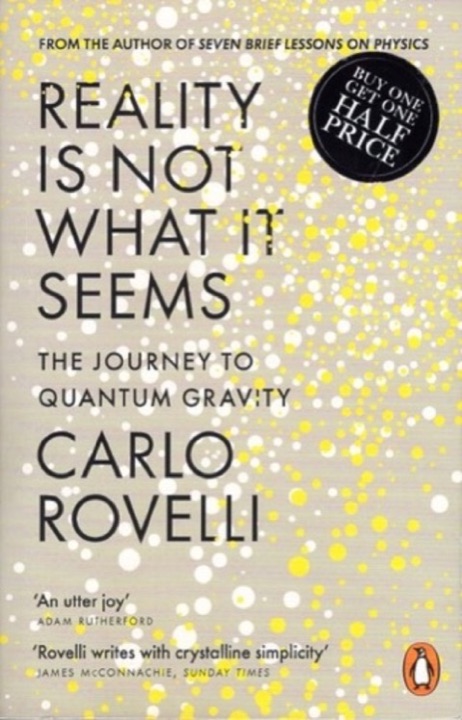
Reality Is Not What It Seems: The Journey to Quantum Gravity
Carlo Rovelli's "Reality Is Not What It Seems: The Journey to Quantum Gravity" offers several profound insights that can be applied to your life, given your experiences, beliefs, and values. Here are some ways you might integrate the lessons from the book:
-
Embrace Uncertainty and Complexity: - Just as quantum mechanics challenges our classical intuitions, you can embrace the uncertainties and complexities in your life. Your experiences, such as surviving plane crashes and your belief in reincarnation, already reflect an acceptance of life's unpredictability. Continue to approach life's mysteries with curiosity and openness, recognizing that not everything needs to be fully understood or controlled.
-
Interconnectedness of Knowledge: - Rovelli emphasizes the interconnectedness of scientific progress. Similarly, you can view your diverse interests and experiences—flying, reading, cooking, and your medical career—as interconnected parts of your personal growth. Each aspect of your life contributes to a broader understanding of yourself and the world.
-
Reevaluate Fundamental Concepts: - The book invites readers to reconsider concepts like space, time, and matter. In your life, this could mean reevaluating your perspectives on success, happiness, and relationships. For instance, your aspiration to live in the moment aligns with the idea of seeing life as a dynamic process rather than a series of fixed achievements.
-
Philosophical Implications: - Rovelli's exploration of quantum gravity has philosophical implications about existence and knowledge. Reflect on how your spiritual beliefs, such as reincarnation and the value of kindness, shape your understanding of reality. Consider how these beliefs guide your actions and interactions with others.
-
Curiosity and Wonder: - Your life philosophy already celebrates curiosity and wonder, as seen in your diverse hobbies and desire to try skydiving. Continue to nurture this sense of wonder by exploring new experiences and learning opportunities, whether through travel, reading, or engaging with new ideas.
-
Dynamic Process of Reality: - Rovelli suggests that reality is a network of events rather than static objects. Apply this perspective by focusing on the relationships and interactions in your life. Your emphasis on kindness and empathy aligns with the idea that our connections with others shape our reality.
-
Embrace Change and Growth: - Just as scientific theories evolve, allow yourself to grow and change. Your commitment to lifelong learning and personal development reflects this principle. Continue to evaluate your actions and beliefs, adapting as you gain new insights and experiences.
By integrating these lessons from Rovelli's book, you can deepen your understanding of yourself and the world, fostering a life rich in curiosity, connection, and growth.
What the book covers
"Reality Is Not What It Seems: The Journey to Quantum Gravity" by Carlo Rovelli is a profound exploration of the nature of reality through the lens of modern physics, particularly focusing on quantum gravity. Rovelli, a renowned theoretical physicist, takes readers on a historical and conceptual journey, examining how our understanding of the universe has evolved from ancient Greek philosophy to contemporary scientific theories.
Summary:
-
Historical Context and Philosophical Foundations: - Rovelli begins by tracing the roots of scientific thought back to ancient Greece, highlighting the contributions of philosophers like Democritus, who proposed the idea of atoms, and Pythagoras, who emphasized the importance of mathematics in understanding the world. - He discusses the transition from the geocentric models of the universe to the heliocentric model proposed by Copernicus, setting the stage for the scientific revolution.
-
Classical Physics and Relativity: - The book delves into the development of classical physics, focusing on the work of Isaac Newton and the laws of motion and gravity. - Rovelli then transitions to the revolutionary ideas of Albert Einstein, explaining the concepts of special and general relativity and how they reshaped our understanding of space and time.
-
Quantum Mechanics: - Rovelli introduces the strange and counterintuitive world of quantum mechanics, discussing the contributions of pioneers like Max Planck, Niels Bohr, and Werner Heisenberg. - He explains key concepts such as wave-particle duality, uncertainty principle, and quantum entanglement, emphasizing how these ideas challenge classical intuitions about reality.
-
Quantum Gravity: - The core of the book is Rovelli's exploration of quantum gravity, an attempt to reconcile general relativity with quantum mechanics. - He discusses various approaches to quantum gravity, including string theory and loop quantum gravity, the latter being the field in which Rovelli himself has made significant contributions. - Rovelli explains how loop quantum gravity suggests that space is not continuous but composed of discrete loops, fundamentally altering our understanding of the fabric of the universe.
-
The Nature of Reality: - Throughout the book, Rovelli emphasizes the idea that reality is not a fixed entity but a dynamic process shaped by interactions and relationships. - He argues that the universe is a network of events rather than a collection of objects, challenging traditional notions of substance and permanence.
Key Takeaways and Lessons:
-
Interconnectedness of Knowledge: Rovelli illustrates how scientific progress is built upon the foundations laid by previous thinkers, highlighting the interconnectedness of different fields of knowledge.
-
Embrace of Uncertainty: The book encourages readers to embrace uncertainty and complexity, recognizing that our understanding of reality is constantly evolving and that mystery is an inherent part of the scientific endeavor.
-
Reevaluation of Concepts: Rovelli invites readers to reevaluate fundamental concepts such as space, time, and matter, urging a shift from seeing them as absolute entities to understanding them as relational and dynamic.
-
Philosophical Implications: The exploration of quantum gravity has profound philosophical implications, prompting questions about the nature of existence, the limits of human knowledge, and the role of observation in shaping reality.
-
Curiosity and Wonder: Ultimately, Rovelli's work is a celebration of curiosity and wonder, encouraging readers to remain open-minded and inquisitive about the mysteries of the universe.
"Reality Is Not What It Seems" is both an accessible introduction to complex scientific ideas and a thought-provoking meditation on the nature of reality, making it a valuable read for anyone interested in the intersection of science and philosophy.