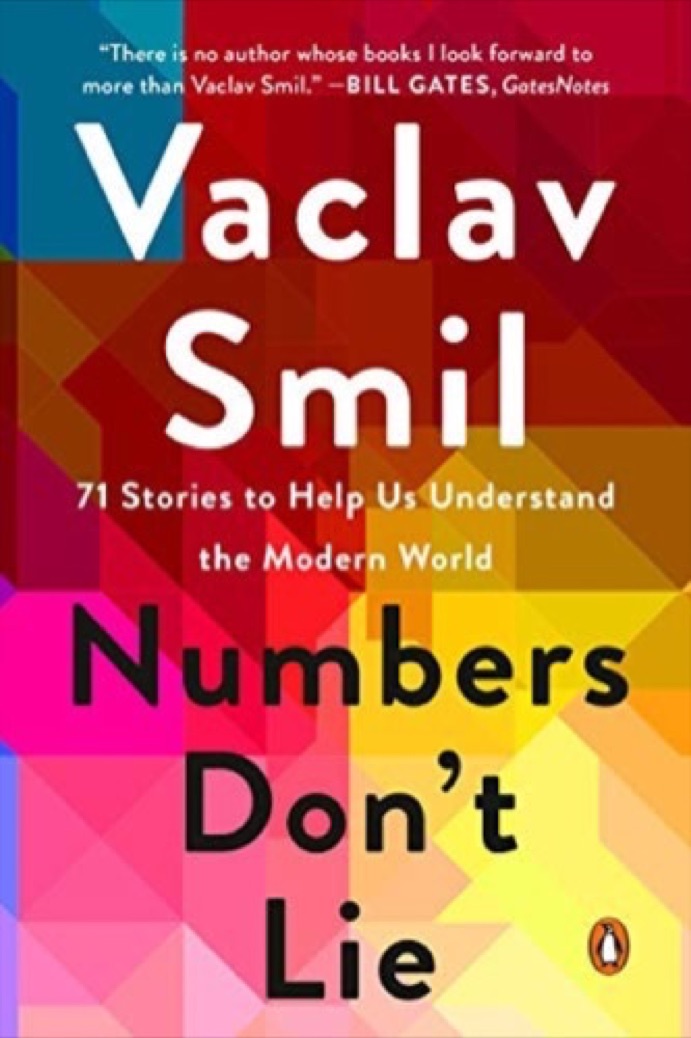
Numbers Don't Lie: 71 Things You Need to Know About the World
Applying the lessons from "Numbers Don't Lie" by Vaclav Smil to your life can be a transformative exercise in intellectual honesty and operational pragmatism. For a leader who balances the precision of medicine, the risks of aviation, and the strategic demands of venture capital, Smil’s data-driven worldview offers a template for making better decisions by understanding the physical and mathematical foundations of progress. Here are some ways you might integrate these lessons:
-
Cultivate Extreme Intellectual Humility: - In your roles as a physician and attorney, you understand that facts are often obscured by narratives. You should apply Smil’s "Stay Humble" approach by constantly questioning the "consensus" on new trends, especially in healthcare technology, and insisting on seeing the raw data before committing capital or trust.
-
Understand the Inertia of Large Systems: - As an entrepreneur, it is tempting to believe that a great idea can change an industry overnight. You must recognize, however, that infrastructure-heavy sectors like healthcare and energy have massive inertia; use this knowledge to set realistic timelines for your ventures and avoid the trap of over-promising on the speed of disruption.
-
Prioritize Physical Realities Over Digital Hype: - In the VC world, there is a heavy focus on software and apps, but Smil reminds us that the world is built on material science. You can differentiate your investment strategy by looking for innovations that solve fundamental physical problems—such as logistics, medical hardware, or energy efficiency—which often have higher barriers to entry and more lasting impact.
-
Apply Risk Management Through the Lens of Scale: - Whether you are in the cockpit of a plane or the boardroom of a startup, scale changes everything. You should evaluate risks not just on their local impact but on how they compound when scaled; a small inefficiency in a single clinic becomes a catastrophic failure when applied to a national network of urgent care centers.
-
Focus on Efficiency Gains in Personal and Professional Life: - Just as Smil tracks the thermal efficiency of engines, you can track the "input vs. output" of your own life. Analyze your time and resource allocation with the same rigor Smil uses for global energy, ensuring that your efforts are concentrated on the few high-impact activities that drive the majority of your results.
-
Balance Optimism with Thermodynamics: - Maintain your "Stay Hungry" drive while acknowledging the physical limits of what is possible. In leadership, this means being the "realist in the room" who supports visionary goals but insists on a viable, evidence-based roadmap to achieve them, ensuring that your team's energy is never wasted on impossible physics.
By integrating these lessons, you will develop a more resilient and sophisticated framework for evaluating both global trends and personal ventures. Smil’s work encourages a shift from emotional reaction to analytical action, allowing you to lead with a clarity that is grounded in the immutable laws of science and the sober reality of the numbers.
What the book covers
"Numbers Don't Lie: 71 Things You Need to Know About the World" by Vaclav Smil is an illuminating, data-driven exploration of the hidden realities governing our modern civilization. Smil, a prolific interdisciplinary scientist, utilizes rigorous statistical analysis to debunk popular myths and provide a clear-eyed perspective on energy, food, environment, and technology. The book serves as a compendium of short, evidence-based essays designed to replace emotional rhetoric with hard facts about how the world actually functions. Through its diverse range of topics, Smil challenges the reader to look beyond headlines and understand the physical and mathematical constraints of our global systems.
Summary:
-
Human Demographics and Health: - Smil examines the profound shifts in global populations, highlighting that while we are living longer, the rate of progress is slowing in developed nations. He provides a grounded look at the "demographic transition," explaining how birth rates and longevity interact to reshape the economic potential of superpowers like China and the United States. - He further explores human biology through the lens of performance and nutrition, noting that while our heights have reached a biological plateau, our caloric intake and dietary choices continue to have outsized impacts on global health and resource allocation.
-
The Reality of Global Energy: - A core theme of the book is the massive scale of our energy infrastructure and the inherent difficulty of transitioning away from fossil fuels. Smil argues that energy transitions are historically slow processes, often taking generations rather than years, due to the immense density and reliability of traditional energy sources. - He provides a sobering look at renewable energy, emphasizing that while progress is being made, the physical realities of storage, transport, and material requirements mean that a carbon-free world is a monumental engineering challenge rather than a simple policy choice.
-
Agricultural Efficiency and Food Production: - This section analyzes how the world feeds eight billion people, focusing on the environmental costs of various protein sources. Smil famously compares the efficiency of chicken, pork, and beef, demonstrating the massive discrepancy in water and grain required for each. - He also discusses the vital role of synthetic fertilizers and the "Green Revolution," arguing that modern civilization is literally built on the ability to fix nitrogen, a process that sustains half of the world's population today.
-
Technical Progress and Material Constraints: - Smil critiques the modern obsession with digital innovation, reminding readers that our world is still built on four "pillars of civilization": steel, cement, ammonia, and plastics. He argues that software cannot replace the physical materials required for shelter, sanitation, and transport. - The book examines the history of technical breakthroughs, such as the jet engine and the gas turbine, showing that the most impactful inventions often involve thermal efficiency and mechanical reliability rather than just computing power.
-
The Environment and Climate Change: - While acknowledging the reality of anthropogenic climate change, Smil provides a pragmatic assessment of carbon emissions. He details the specific challenges of decarbonizing heavy industries like shipping and long-haul aviation, which lack the easy electrification pathways available to passenger cars. - He emphasizes that solving environmental issues requires a deep understanding of scale, noting that small-scale successes do not always translate to global solutions without massive investment and physical innovation.
-
Transportation and Modern Mobility: - Smil takes a deep dive into the history and future of how we move, from the dominance of the bicycle in urban history to the physics of modern flight. He highlights the incredible efficiency gains in jet engines over the decades while explaining the physical limits that prevent us from seeing similar gains in the near future. - He also addresses the hype surrounding electric vehicles, providing a nuanced view that considers the total life-cycle emissions and the infrastructure requirements for a global fleet.
"Numbers Don't Lie" is a vital work of realistic inquiry that equips readers with the tools to navigate a world increasingly filled with misinformation. By grounding his analysis in the laws of thermodynamics and the realities of global logistics, Smil provides a necessary corrective to both extreme pessimism and blind techno-optimism.