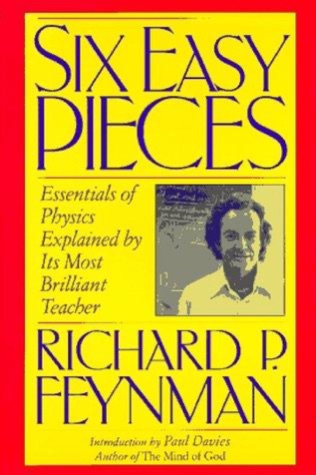
Six Easy Pieces: Essentials of Physics Explained by Its Most Brilliant Teacher
Applying the lessons from "Six Easy Pieces" by Richard P. Feynman to your life can be both enriching and transformative, given your diverse experiences and interests. Here are some ways you might integrate the book's insights into your personal and professional life:
-
Embrace Simplicity and Elegance: - Just as Feynman emphasizes the beauty of fundamental physical laws, you can strive to find simplicity and elegance in your daily routines and decision-making processes. This might involve streamlining your activities or focusing on what truly matters, aligning with your belief that "very little actually matters."
-
Foster Interconnectedness: - Recognize the interconnectedness of different aspects of your life, much like how physics relates to other sciences. This can enhance your interdisciplinary thinking, whether in your medical career, activism, or personal relationships. Your involvement in social issues like equality and anti-human trafficking can benefit from this holistic perspective.
-
Cultivate Curiosity and Inquiry: - Feynman's approach encourages curiosity and a desire to ask questions. You can apply this mindset by exploring new hobbies, such as skydiving, or delving deeper into your interests, like flying and reading. This aligns with your aspiration to be a lifelong learner and remain in a constant state of beta.
-
Understand Conservation Principles: - The concept of energy conservation can be metaphorically applied to your life by managing your physical and emotional energy wisely. This might involve balancing your rigorous daily routine with moments of rest and reflection, ensuring you have the energy to pursue your passions and support your family.
-
Embrace Quantum Mechanics' Lessons: - The counterintuitive nature of quantum mechanics can inspire you to think beyond conventional boundaries and embrace uncertainty. This perspective can help you navigate life's unpredictability, such as your near-death experiences and your belief in reincarnation.
-
Enhance Teaching and Communication: - Feynman's ability to convey complex ideas with clarity and enthusiasm can serve as a model for your communication style. Whether interacting with patients, colleagues, or family, you can strive to be direct, warm, and humorous, ensuring your message is understood and appreciated.
By integrating these lessons into your life, you can continue to grow personally and professionally, while maintaining your core values of kindness, empathy, and resilience.
What the book covers
"Six Easy Pieces: Essentials of Physics Explained by Its Most Brilliant Teacher" is a compilation of lectures by the renowned physicist Richard P. Feynman. These lectures were originally part of the introductory physics course at the California Institute of Technology and were selected for their accessibility to a general audience. The book distills complex physical concepts into understandable terms, reflecting Feynman's unique ability to communicate science with clarity and enthusiasm.
Summary:
-
Atoms in Motion: - Feynman begins by discussing the atomic hypothesis, which states that all things are made of atoms—tiny particles in perpetual motion. He explains how this simple idea forms the basis for understanding a wide range of physical phenomena, from the behavior of gases to the properties of solids and liquids.
-
Basic Physics: - This section covers the fundamental principles of physics, emphasizing the importance of conservation laws, such as the conservation of energy. Feynman illustrates how these principles apply universally, providing a framework for understanding the natural world.
-
The Relation of Physics to Other Sciences: - Feynman explores the interconnectedness of physics with other scientific disciplines. He highlights how physics underpins chemistry, biology, and even the social sciences, demonstrating the universality and foundational nature of physical laws.
-
Conservation of Energy: - A deeper dive into the concept of energy conservation, Feynman explains how energy can neither be created nor destroyed, only transformed from one form to another. He uses practical examples to show how this principle is observed in everyday life and scientific experiments.
-
The Theory of Gravitation: - Feynman discusses the historical development of gravitational theory, from Newton's law of universal gravitation to Einstein's general theory of relativity. He explains how gravity is a fundamental force that governs the motion of celestial bodies and affects the structure of the universe.
-
Quantum Behavior: - The final piece introduces the strange and counterintuitive world of quantum mechanics. Feynman explains key concepts such as wave-particle duality, uncertainty, and the probabilistic nature of quantum events, highlighting the revolutionary impact of quantum theory on our understanding of reality.
Key Takeaways and Lessons:
-
Simplicity and Elegance: Feynman emphasizes the beauty and simplicity of fundamental physical laws, encouraging readers to appreciate the elegance of scientific explanations.
-
Interconnectedness: The book illustrates how physics is deeply connected to other sciences, underscoring the importance of interdisciplinary thinking in scientific inquiry.
-
Curiosity and Inquiry: Feynman's approach encourages a sense of curiosity and a desire to ask questions, fostering a mindset that values exploration and understanding.
-
Conservation Principles: Understanding conservation laws, such as energy conservation, is crucial for grasping how physical systems operate and interact.
-
Quantum Mechanics: The introduction to quantum mechanics challenges readers to think beyond classical intuitions, opening up a new perspective on the nature of reality.
-
Teaching and Communication: Feynman's ability to convey complex ideas in an accessible manner serves as a model for effective science communication, highlighting the importance of clarity and enthusiasm in teaching.
Overall, "Six Easy Pieces" serves as an engaging introduction to key concepts in physics, offering insights that are both intellectually stimulating and broadly applicable.