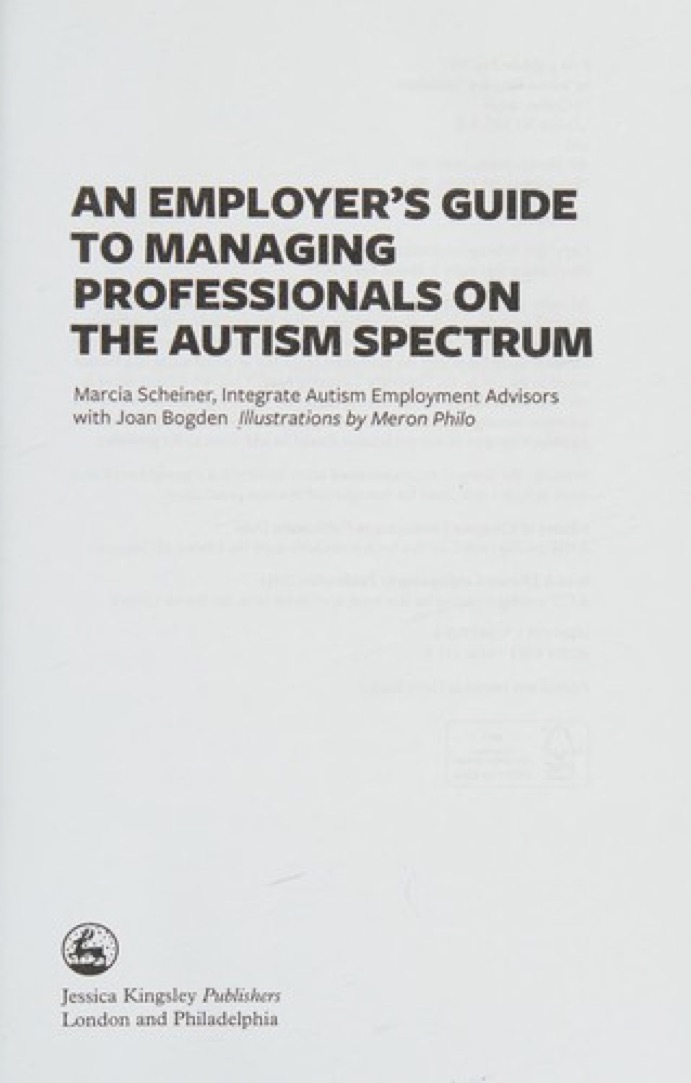
An Employer's Guide to Managing Professionals on the Autism Spectrum
Applying the lessons from "An Employer's Guide to Managing Professionals on the Autism Spectrum" by Marcia Scheiner and Joan Bogden to your life can be a powerful catalyst for evolving your leadership style from one of intuition to one of intentionality. Here are some ways you might integrate these lessons:
-
Optimize Your Talent Acquisition Systems: - In your ventures, you should audit your hiring processes to ensure you aren't inadvertently screening out high-functioning talent based on social polish. Shift toward competency-based assessments that mirror the actual tasks of the role, ensuring you find the best "engine" for the job rather than the best conversationalist.
-
Adopt Precision Communication: - Whether in the ER, the cockpit, or the boardroom, you should strive for the literal clarity advocated by Scheiner. Eliminate ambiguity by providing clear, written directives and specific feedback, which reduces cognitive load for your team and ensures that mission-critical tasks are executed without the interference of misinterpretation.
-
Manage the Sensory and Physical Environment: - Just as a cockpit is designed for ergonomic efficiency, you should evaluate your work environments for sensory friction. By identifying and mitigating distractions like excessive noise or poor lighting, you create a high-performance zone that benefits neurodivergent and neurotypical employees alike, maximizing collective focus.
-
Lead with Radical Objectivity: - You can improve your management by separating "personality fit" from "performance excellence." Focus your evaluations on data-driven results and specific behaviors rather than nebulous social metrics, allowing you to retain and promote brilliant contributors who may not participate in traditional office socializing.
-
Provide a "Social Translator" or Navigator: - Implement a mentorship structure within your organizations where new hires have a designated person to explain the unwritten rules of the culture. This is particularly valuable in complex fields like law or medicine, where the hidden curriculum of the workplace can be as challenging to navigate as the technical work itself.
-
Foster a Culture of Directness: - Encourage a culture where direct, honest communication is the norm. By removing the need for employees to "read between the lines," you reduce organizational anxiety and speed up the decision-making process, allowing your teams to operate with the efficiency of a well-oiled machine.
By integrating these lessons, you will build more resilient, innovative, and inclusive organizations that respect individual differences while demanding excellence. This approach not only fulfills a commitment to true diversity but also creates a competitive edge by accessing a pool of dedicated, high-ability professionals who are often overlooked in the traditional business landscape.
What the book covers
"An Employer's Guide to Managing Professionals on the Autism Spectrum" by Marcia Scheiner and Joan Bogden is a practical roadmap for corporate leaders seeking to leverage the unique talents of neurodivergent individuals. The book addresses the chronic unemployment and underemployment of professionals on the autism spectrum by providing actionable management strategies that bridge the gap between neurotypical expectations and autistic communication styles. It functions as both a call to action for diversity and inclusion and a tactical manual for day-to-day operations in a white-collar environment.
Summary:
-
The Business Case for Neurodiversity: - Scheiner argues that hiring professionals on the autism spectrum is not an act of charity but a strategic business advantage. Autistic individuals often possess high levels of technical competence, intense focus, reliability, and an ability to see patterns that others miss, which can drive innovation and productivity in data-heavy or detail-oriented fields.
-
Recruiting and Interviewing Alternatives: - The authors highlight how traditional interview processes, which heavily weigh social cues and rapport, often filter out highly qualified autistic candidates. They recommend shifting toward work-sample tests and structured interviews that focus on skills rather than the ability to maintain eye contact or engage in small talk.
-
Structured Onboarding and Clear Expectations: - Successful integration begins with a highly structured onboarding process that removes ambiguity. The book emphasizes the importance of providing written protocols for office culture and specific job duties, as many autistic professionals struggle with "unwritten rules" or implied social hierarchies that neurotypical managers take for granted.
-
Communication and Social Interaction Management: - A core component of the guide is teaching managers how to communicate with precision. This involves avoiding idioms, sarcasm, or abstract instructions; instead, managers are encouraged to provide direct, literal feedback and clear deadlines to ensure the employee understands exactly what is required and why.
-
Environmental and Sensory Considerations: - The book explains how the physical workspace—such as fluorescent lighting, open-office noise, or specific smells—can impact the performance of someone with sensory sensitivities. Simple, low-cost accommodations like noise-canceling headphones or modified seating arrangements can significantly increase an employee's comfort and output.
-
Performance Management and Feedback Loops: - Traditional annual reviews are often ineffective for neurodivergent staff; the authors advocate for frequent, objective, and specific feedback. By focusing on measurable outcomes rather than subjective "soft skills," managers can help autistic professionals excel without the anxiety associated with vague performance metrics.
-
The Role of the Job Coach and Mentorship: - Scheiner introduces the concept of using internal or external job coaches to help navigate the interpersonal dynamics of the office. These mentors act as "translators" between the employee and the management team, ensuring that minor misunderstandings do not escalate into performance issues.
This work is significant because it moves beyond the theoretical benefits of diversity to provide a granular, step-by-step guide for middle and senior management. By focusing on the professional tier of the workforce, Scheiner and Bogden challenge stereotypes and demonstrate how minor adjustments in management style can unlock immense human potential while creating a more efficient workplace for everyone.