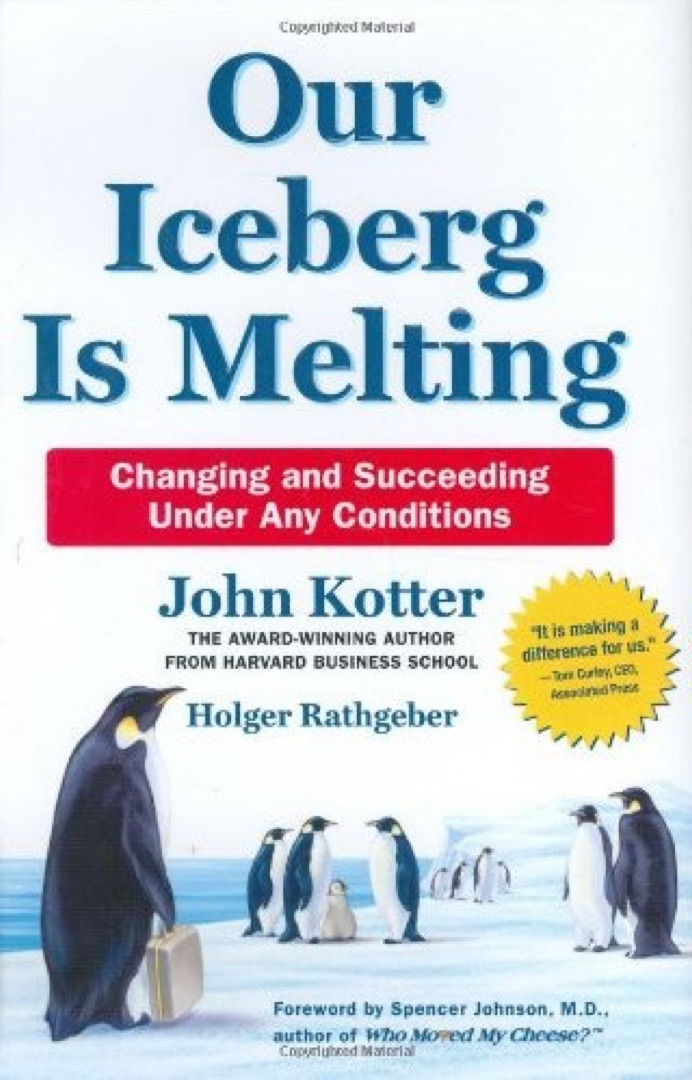
Our Iceberg Is Melting: Changing and Succeeding Under Any Conditions
Applying the lessons from "Our Iceberg Is Melting" by John Kotter and Holger Rathgeber to your life can be a transformative exercise in developing professional resilience and organizational agility. Here are some ways you might integrate these lessons:
-
Maintain Constant Situational Awareness: - In both medicine and aviation, the environment can shift in seconds; you must constantly scan for "cracks in the ice." Whether you are monitoring a patient’s vitals or the health of a VC portfolio, never let success breed a complacency that prevents you from seeing the next looming disruption.
-
Assemble Your Diverse Guiding Coalition: - When launching a new healthcare venture or a legal strategy, you should not surround yourself with echoes of your own perspective. Seek out your own versions of Fred, Alice, and the Professor—individuals who bring data-driven logic, operational excellence, and the ability to communicate across different levels of the organization.
-
Simplify the Vision for Broad Alignment: - As a leader in high-stakes environments, you must distill complex strategic shifts into clear, actionable visions. Much like a pilot briefing a crew, ensure everyone knows the "why" behind the change so they can act autonomously when the "how" becomes difficult or unpredictable.
-
Neutralize Resistance with Transparency: - You will inevitably encounter "NoNos" who fear the unknown or protect the status quo. Address these skeptics not with force, but with transparent data and by empowering the rest of the team to move forward, effectively making resistance an unattractive and isolated position.
-
Engineer and Celebrate Incremental Success: - Entrepreneurs often focus so heavily on the exit that they ignore the importance of the journey. You should deliberately structure your projects to produce early, visible wins that build the momentum necessary to sustain long-term, difficult transitions in business or personal development.
-
Institutionalize a Culture of Agility: - Your ultimate goal as a lifelong learner and leader is to make change part of your personal and professional DNA. Don’t just move to a new iceberg; become a nomad who is always ready to scout for the next opportunity, ensuring your organizations are built for evolution rather than just survival.
By integrating these lessons, you move beyond mere management and into the realm of true leadership, where the goal is not to preserve the past but to fearlessly navigate toward the future. Embracing the discomfort of change ensures that you remain both hungry for growth and humble enough to acknowledge when the ground beneath you is shifting.
What the book covers
"Our Iceberg Is Melting: Changing and Succeeding Under Any Conditions" by John Kotter and Holger Rathgeber is a business fable that uses the story of an Antarctic penguin colony to illustrate the complexities of change management. The book translates John Kotter’s renowned Eight-Step Process for Leading Change into a relatable narrative, demonstrating how organizations can identify threats and adapt to new environments. By personifying leadership archetypes and common obstacles, the authors provide a framework for navigating uncertainty and fostering a culture of agility in a rapidly shifting world.
Summary:
-
The Discovery of the Crisis: - The story begins with Fred, an observant penguin who discovers that the colony’s iceberg is melting and at risk of shattering. Despite his low status, Fred gathers data and presents his findings to Alice, a member of the Leadership Council, realizing that he must overcome the colony's complacency to ensure their survival.
-
Creating a Sense of Urgency: - Alice helps Fred present the evidence to the entire Council through a dramatic demonstration. By making the abstract threat visible and urgent, they overcome the initial denial of the leaders, highlighting the necessity of convincing a critical mass of people that the status quo is no longer sustainable.
-
Building the Guiding Coalition: - A diverse team is formed to lead the change: Louis (the wise Head Penguin), Alice (the practical leader), Fred (the innovator), Buddy (the trusted communicator), and Jordan (the logical Professor). This coalition represents the varied skill sets required to navigate a crisis, combining authority, expertise, and emotional intelligence.
-
Developing and Communicating the Vision: - The coalition realizes that they cannot fix the iceberg; instead, they must adopt a nomadic lifestyle. They communicate this vision of being "free-movers" to the colony using simple metaphors and constant reminders, ensuring every penguin understands that their identity is not tied to a specific piece of ice but to their ability to adapt.
-
Empowering Others and Removing Obstacles: - The leaders face resistance from NoNo, a skeptic who uses fear-mongering to stop the transition. The coalition empowers others by enlisting "scouts" to find new icebergs and manages the naysayers by keeping the focus on the vision, thereby removing the psychological and structural barriers to movement.
-
Generating Short-Term Wins: - To maintain morale, the leaders celebrate the return of the first scouts and the discovery of potential new homes. These visible, early successes prove that the new strategy is working, silencing critics and providing the colony with the necessary confidence to undertake the difficult migration.
-
Consolidating Gains and Anchoring Change: - After finding a suitable new iceberg, the colony does not stop; they continue to refine their scouting processes. They eventually weave the nomadic philosophy into the colony’s culture, ensuring that the ability to change is no longer a one-time event but a permanent trait passed down to future generations.
This brief but impactful fable serves as a powerful reminder that the greatest threat to any organization is not the external environment, but internal resistance to change. By breaking down the psychology of transition into actionable steps, Kotter and Rathgeber provide a timeless roadmap for leaders looking to steer their teams through the inevitable "melting icebergs" of the modern economy.