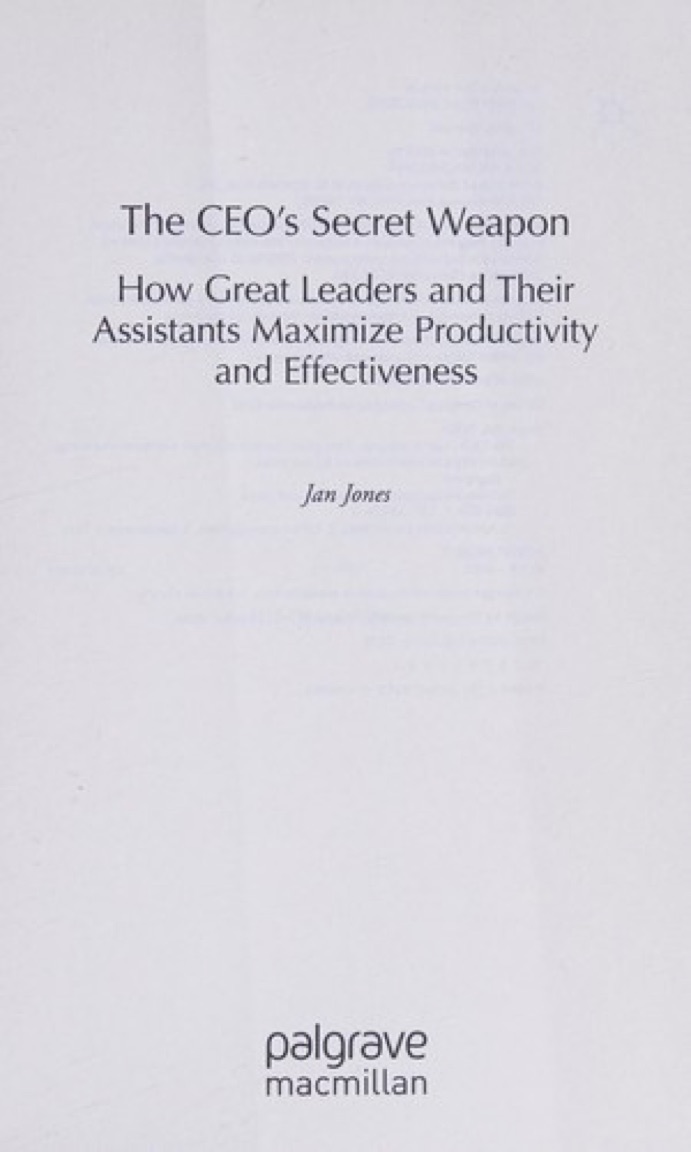
The CEO's Secret Weapon: How Great Leaders and Their Assistants Maximize Productivity and Effectiveness
Applying the lessons from "The CEO's Secret Weapon: How Great Leaders and Their Assistants Maximize Productivity and Effectiveness" by Jan Jones to your life can be a transformative step toward achieving operational excellence and reclaiming your most precious resource: time. Here are some ways you might integrate these lessons:
-
Audit Your Delegation Habits: - Evaluate whether you are delegating tasks or delegating authority; to truly leverage an assistant or a team member, you must empower them to make decisions within their domain. In your entrepreneurial or medical ventures, identify the cognitive loads you currently carry that could be managed by a trusted partner if they had sufficient context.
-
Cultivate a Strategic Extension of Yourself: - Treat your assistant as a partner who needs to understand your philosophy and "voice" as a leader, whether in the clinic or the boardroom. By sharing your strategic intent and long-term vision, you enable them to act on your behalf with the same nuance and discretion you would apply yourself.
-
Institutionalize Proactivity and Anticipation: - Encourage a culture where your support staff is trained to look ahead for potential bottlenecks in your schedule or projects. Whether you are managing a complex legal case or planning a flight, having a partner who anticipates "what’s next" allows you to stay focused on the immediate high-stakes task at hand.
-
Protect Your Deep Work Time: - Use the gatekeeping principles outlined by Jones to create structured boundaries around your time for thinking, writing, and strategy. A well-trained assistant should be your first line of defense, filtering out the noise and ensuring that you only spend energy on issues that truly require your unique expertise.
-
Invest in Emotional Intelligence Alignment: - When hiring or training staff, prioritize emotional intelligence and the ability to read interpersonal dynamics over rote technical proficiency. Especially in high-stress fields like emergency medicine or venture capital, the ability of your team to manage stakeholders' emotions is just as critical as their ability to manage a spreadsheet.
-
Maintain High-Frequency Feedback Loops: - Establish a rhythm of brief, high-impact check-ins to ensure your team is aligned with your evolving priorities. These sessions should be less about status updates and more about clearing roadblocks and ensuring that your "secret weapons" have the information they need to be effective.
By integrating these lessons, you can build a support structure that functions as a force multiplier for your various professional roles. Embracing the strategic potential of your team allows you to stay hungry for new challenges and humble in your approach, while ensuring that your operational foundation remains unshakable.
What the book covers
"The CEO's Secret Weapon: How Great Leaders and Their Assistants Maximize Productivity and Effectiveness" by Jan Jones is a definitive guide on how to transform the relationship between an executive and their assistant into a strategic powerhouse. Drawing from her experience as an assistant to high-profile figures like Tony Robbins, Jones argues that a top-tier Executive Assistant (EA) is not a clerical worker but a force multiplier who can dramatically increase a leader's output and impact. The book provides a roadmap for CEOs to identify, train, and empower their assistants to operate as a true extension of their office.
Summary:
-
Redefining the Executive Assistant Role: - Jones argues that the modern EA is a strategic business partner rather than a simple administrator, functioning as a chief of staff who manages the executive's most precious resource: time. This shift requires the leader to stop viewing the assistant as a luxury and start viewing them as a critical component of their operational infrastructure.
-
The Foundations of a High-Trust Partnership: - The success of the partnership hinges on absolute trust and mutual respect, allowing the assistant to handle sensitive communications and make decisions on the leader’s behalf. When trust is established, the assistant becomes a gatekeeper who protects the leader from distractions while ensuring that essential priorities are addressed without delay.
-
Mastering the Art of Proactive Support: - A "secret weapon" assistant anticipates needs before they are voiced, requiring a deep understanding of the leader's goals, preferences, and personality. Jones highlights that the best assistants are those who can read the room, handle crises with composure, and keep the executive’s schedule aligned with their long-term strategic objectives.
-
Effective Communication and the Feedback Loop: - Constant, transparent communication is essential to keep the partnership synchronized, necessitating regular briefings where the leader shares context rather than just tasks. By providing the assistant with the "why" behind certain decisions, the executive empowers them to represent the office accurately and handle external stakeholders with authority.
-
Recruitment and Cultural Alignment: - Finding the right assistant involves looking beyond technical skills to evaluate temperament, emotional intelligence, and cultural fit with the executive. Jones provides practical advice on interviewing and vetting candidates to ensure they possess the resilience and discretion required to thrive in high-pressure corporate environments.
-
The Executive’s Responsibility in the Partnership: - The book emphasizes that a great assistant is made, not just found, and it is the leader’s responsibility to invest in their assistant’s professional development. If a CEO fails to delegate effectively or micromanages their assistant, they stifle the potential of the role and ultimately limit their own productivity.
-
Measuring the Return on Investment: - Jones provides a framework for quantifying the value of an elite assistant, illustrating how their presence can free up hundreds of hours of a CEO's time for high-level strategy and revenue-generating activities. This ROI is realized when the assistant manages the "human element" of the office, smoothing over conflicts and maintaining organizational health.
"The CEO's Secret Weapon" is a significant contribution to leadership literature because it addresses a frequently overlooked aspect of organizational success: the power of the executive-assistant dyad. By elevating the EA role from a support function to a strategic asset, Jones offers a blueprint for leaders who want to scale their influence and maintain peak performance in an increasingly complex business world.