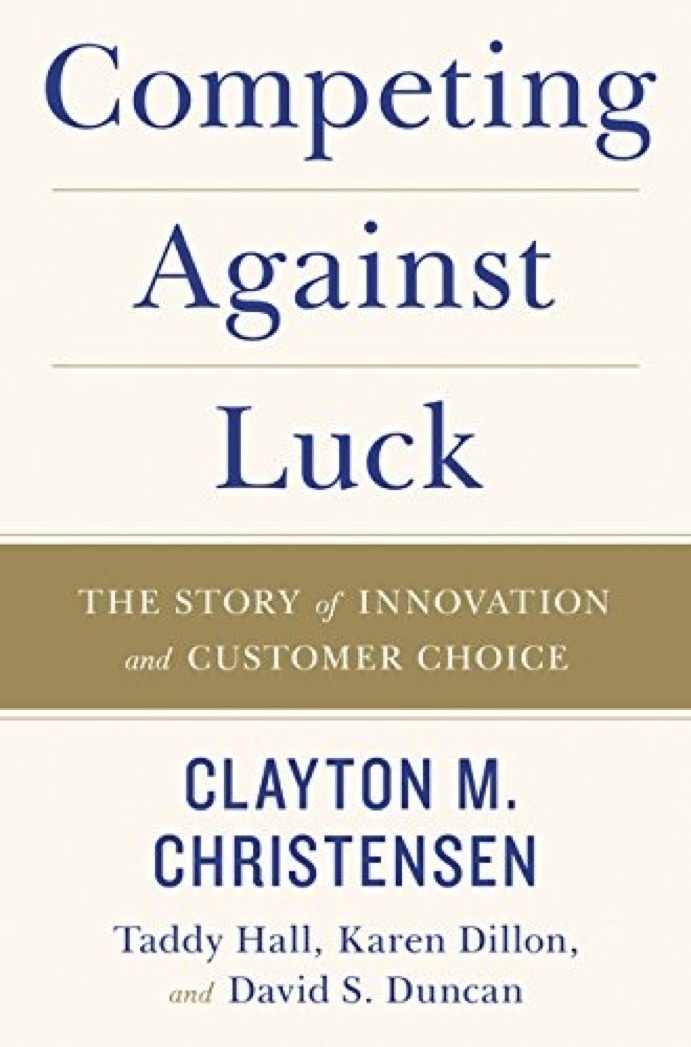
Competing Against Luck: The Story of Innovation and Customer Choice
Applying the lessons from "Competing Against Luck" by Clayton M. Christensen, Taddy Hall, Karen Dillon, and David S. Duncan to your life can be a transformative exercise in empathy and strategic clarity. Here are some ways you might integrate these lessons:
- Reframing Patient Care: - In the medical field, you must realize that patients don't just "hire" a doctor for a clinical diagnosis. They may be hiring a telehealth service for the emotional job of gaining peace of mind or an urgent care center for the functional job of minimizing time away from work. By identifying these underlying motivations, you can tailor the healthcare experience to address the patient's holistic needs, leading to higher compliance and satisfaction.
- Evaluating Venture Opportunities: - As a VC leading Xcellerant Ventures, use the JTBD framework to vet startups. Look past the technical specifications and ask: "What is the specific struggle this product resolves, and what will the customer have to 'fire' to hire this solution?" A startup is much more likely to succeed if it targets a well-defined, underserved job rather than just offering a marginal improvement on a current product.
- Enhancing Professional Services: - In your legal and consulting work, understand that clients often seek counsel to navigate complex emotional transitions or to mitigate specific fears. If you identify the social and emotional progress they are seeking—such as the need to feel protected or the desire for institutional stability—you can provide advice that feels more valuable and resonant than a purely technical legal opinion.
- Operational Excellence in Aviation and Leadership: - Apply the concept of "organizing around the job" to your leadership roles and pilot duties. Ensure that every checklist and process is designed with the ultimate "job" in mind—safety, efficiency, and mission success. When the objective is clear, you can eliminate bureaucratic friction that doesn't contribute to the primary goal.
- Personal Growth and Lifelong Learning: - Use JTBD to audit your own habits and educational pursuits. Ask yourself what job you are hiring a new book, a new degree, or a new project to do for you. This clarity ensures that your "Stay Hungry" mantra is directed toward activities that provide real progress toward your long-term vision rather than just filling time.
- Entrepreneurial Marketing and Branding: - For your healthcare ventures, stop marketing to demographics and start marketing to moments of struggle. Use your branding to communicate that you understand the specific circumstances of your customers. When you speak directly to the job they are trying to do, your solution becomes the obvious and only choice for their progress.
By integrating these lessons, you move from a mindset of guesswork to one of causal precision in both your professional ventures and personal development. Understanding the "why" behind every human interaction—whether it’s a patient in the ER, a founder in a pitch meeting, or a client in your law office—allows you to build more meaningful, effective, and enduring solutions. This focus on the "job" ensures that you remain humble enough to listen to the customer’s true needs while staying hungry enough to innovate the perfect solution for them.
What the book covers
"Competing Against Luck: The Story of Innovation and Customer Choice" by Clayton M. Christensen, Taddy Hall, Karen Dillon, and David S. Duncan is a seminal business text that challenges the traditional, data-heavy approach to innovation. It introduces the "Jobs to Be Done" (JTBD) theory, which posits that customers do not simply buy products; they "hire" them to perform a specific "job" or make progress in a particular circumstance. By shifting the focus from consumer demographics and product attributes to the causal drivers of consumer choice, the book provides a rigorous framework for creating successful products and services. The authors argue that when companies understand the deep-seated needs and struggles of their customers, innovation becomes a predictable science rather than a game of chance.
Summary:
- The Theory of Jobs to Be Done: - Innovation often fails because companies focus on correlations—such as age, gender, or past purchasing behavior—rather than the causal mechanism of a sale. The Jobs to Be Done theory suggests that every purchase is motivated by a desire for progress in a specific context. - By identifying the "job" a person is trying to do, a business can move beyond luck and design solutions that perfectly align with the customer’s struggle. This reframing allows leaders to see competition not just from direct product rivals, but from any alternative a customer might "hire" to get that job done.
- The Milkshake Dilemma: - The authors use a now-famous case study of a fast-food chain trying to improve milkshake sales. Traditional market research based on demographics and flavor preferences yielded no results, but observing the "job" revealed two distinct use cases: commuters hiring a thick, long-lasting snack for a boring drive, and parents hiring a quick treat for their children. - Each job required a different solution (a thicker shake with a thin straw for commuters vs. a smaller, thinner shake for kids), proving that the product's success depended entirely on the specific circumstance of the user.
- The Three Dimensions of a Job: - A job is rarely just about functional utility; it almost always includes emotional and social dimensions. For instance, a person might hire a luxury car not just for transportation (functional), but to feel successful (emotional) or to signal status to their peers (social). - Successful innovators must account for all three dimensions to create a "Big Hire." If a product solves the functional problem but ignores the social or emotional friction, the customer will eventually look for a better alternative.
- Identifying Unmet Needs and Non-Consumption: - Some of the most lucrative opportunities for innovation lie in "non-consumption," where potential customers have a job to do but find existing solutions too expensive, complex, or inaccessible. - By observing how people "hack" existing products or create workarounds to solve their problems, entrepreneurs can identify the underlying jobs that the market is currently failing to address.
- Designing the Customer Experience: - Once the job is identified, the entire organization must focus on the customer's journey, from the moment they realize they have a problem to the final resolution. This involves identifying the "push" of the current situation and the "pull" of the new solution, as well as the anxieties and habits that hold the customer back. - Every touchpoint should be designed to reduce friction and reinforce the customer's belief that the product is the best possible hire for their specific need.
- Organizing Around the Job: - To sustain growth, companies must reorganize their internal structures around the jobs they serve rather than around functional departments or product lines. When everyone from R&D to customer service understands the job, they can make autonomous decisions that support the customer's progress. - This alignment creates a "Job-Specfic Culture" where the mission is clear and the metrics for success are directly tied to how well the customer's job was performed.
- The Perils of Data-Driven Blindness: - While big data can tell a company what happened, it rarely explains why. The authors warn against "passive data," which tracks transactions but misses the context and the "why" behind the hire. - Leaders must remain focused on "active data"—the rich, qualitative insights gained from observing customers in the wild—to ensure they don't lose sight of the job as the company scales.
"Competing Against Luck" is a transformative guide for any leader seeking to build a resilient, customer-centric organization. By moving beyond the randomness of traditional innovation, it provides a blueprint for creating products that are not just better, but truly indispensable to the people who hire them.