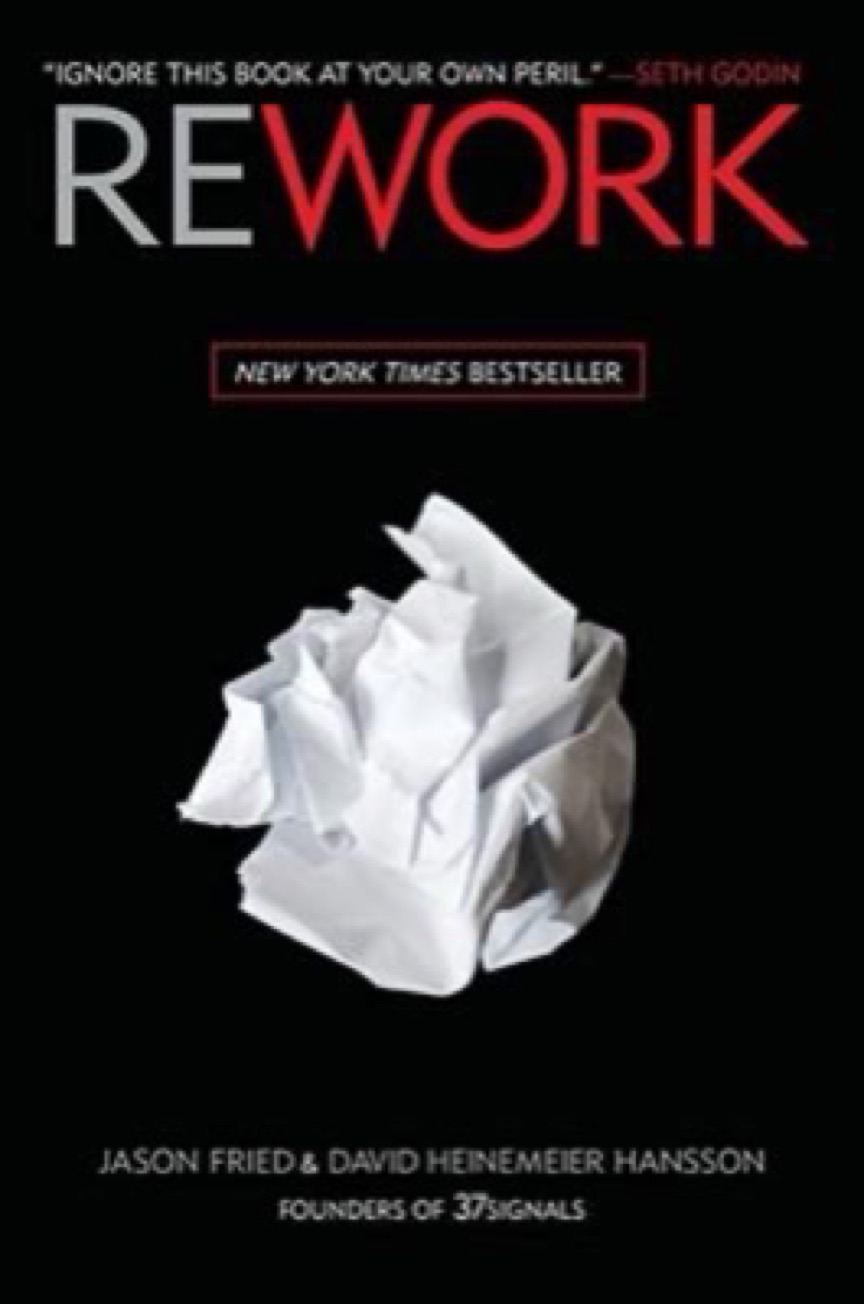
Rework: Change the Way You Work Forever
Applying the lessons from "Rework: Change the Way You Work Forever" by Jason Fried and David Heinemeier Hansson to your life can be a transformative exercise in reclaiming your time and refocusing your professional energy. Here are some ways you might integrate these lessons:
-
Prune the Non-Essential: - Whether you are managing an urgent care clinic or a venture capital fund, you must ruthlessly identify and eliminate the "dead wood" in your processes. Ask yourself what tasks are being done out of habit rather than necessity, and stop doing them to create space for high-impact innovation.
-
Value Agility Over Certainty: - In medicine, law, and business, we often crave the security of a perfect plan, but you must learn to embrace the "guess." Treat your long-term strategies as flexible outlines and focus your intensity on the immediate 24-hour horizon where you have the most influence and data.
-
Protect Your Deep Work: - As a leader with multiple high-stakes responsibilities, your focus is your most valuable asset. Establish "no-interruption zones" in your schedule—similar to a pilot’s sterile cockpit—where you can engage in the deep, concentrated thinking required for complex legal analysis or strategic investment decisions without the noise of emails and meetings.
-
Adopt a "Manager of One" Mentality: - In your personal growth and when evaluating potential partners or employees, look for the ability to self-direct. You should strive to be someone who doesn't need a heavy infrastructure of oversight, and you should seek to invest in entrepreneurs who demonstrate that same level of independent execution and accountability.
-
Teach to Lead: - Use your platform as an author and physician to share your internal "secret sauce." By teaching others the lessons you've learned in the ER and the boardroom, you don't just build a brand; you create a community of trust that serves as a much stronger competitive moat than any traditional marketing strategy.
-
The Workaholism Trap: - Reject the badge of honor often associated with staying late in the lab or the office. Recognize that workaholism often creates more problems than it solves through burnout and diminished returns; instead, aim for a sustainable pace that allows you to stay hungry and humble over a multi-decade career.
By integrating these lessons, you can strip away the artificial complexities of modern professional life and return to a state of high-output simplicity. This approach ensures that your ventures—whether in healthcare, aviation, or finance—remain lean, profitable, and, most importantly, aligned with your personal values of efficiency and lifelong learning.
What the book covers
"Rework: Change the Way You Work Forever" by Jason Fried and David Heinemeier Hansson is a provocative and disruptive manifesto that challenges the traditional tenets of business management and entrepreneurship. Drawing from their success with 37signals (now Basecamp), the authors argue that many conventional practices—such as long-term planning, outside investment, and large-scale hiring—are often unnecessary or even detrimental to success. The book provides a lean, efficient, and highly practical framework for building a sustainable business in the modern age, emphasizing simplicity, agility, and profitability over growth for growth’s sake.
Summary:
-
The Fallacy of Traditional Planning: - The authors argue that long-term business plans are essentially fantasies because there are too many variables outside of an entrepreneur's control. Instead of following a rigid five-year plan, they suggest making "guesses" and focusing on the immediate next steps to maintain flexibility and responsiveness. - Planning for the distant future leads to a false sense of security; by abandoning the need for extensive documentation, a business can pivot more quickly when market conditions or customer needs change unexpectedly.
-
The Beauty of Constraints: - Rather than lamenting a lack of resources, entrepreneurs should embrace constraints as a source of innovation. Limited time, money, and manpower force a team to focus on the most essential features of a product, leading to a more elegant and functional solution. - The authors advocate for building "half a product, not a half-assed product," suggesting that it is better to do a few things exceptionally well than to offer a bloated feature set that performs mediocrely across the board.
-
Productivity and the Interruption Tax: - Meetings are described as "toxic" and a major drain on organizational resources because they break up the workday into small, unproductive increments. The book suggests that the most meaningful work happens during long stretches of uninterrupted "alone time." - To protect productivity, teams should minimize passive communication and foster a culture where workers are allowed to disappear into their tasks without the constant distraction of notifications, status updates, or unnecessary face-to-face check-ins.
-
Rethinking Growth and Hiring: - Growth is not always the goal; staying small can be a significant competitive advantage. The authors suggest that you should only hire "when it hurts" and when you can no longer handle the workload yourself, ensuring that every new addition to the team is absolutely vital. - When hiring, the book emphasizes looking for "managers of one"—people who are capable of setting their own goals and executing them without constant oversight—and prioritizing strong writing skills, as clear writing reflects clear thinking.
-
Marketing and Competition: - Instead of trying to outspend or out-advertise larger competitors, small businesses should "out-teach" them. By sharing knowledge and being transparent about their processes, companies can build a loyal audience and establish authority without a massive marketing budget. - The authors advise against obsessively tracking competitors, as it leads to derivative work. Instead, businesses should focus on making their product unique by injecting their own personality and values into it, making it harder for others to copy.
-
The Culture of Action: - Decisions should be made quickly to maintain momentum, even if they aren't perfect. The cost of standing still is often higher than the cost of making a small mistake that can be corrected later; the authors encourage a "just get it out there" mentality. - True business culture isn't created by mission statements or office perks; it is the byproduct of consistent behavior and the way a team handles real-world challenges over time.
"Rework" serves as a vital correction to the bureaucratic bloat that often plagues established companies and the over-complicated strategies that hinder new ventures. By stripping away the "business speak" and focusing on the core value of the work itself, it provides a roadmap for anyone looking to build something meaningful, profitable, and lasting without losing their sanity in the process.