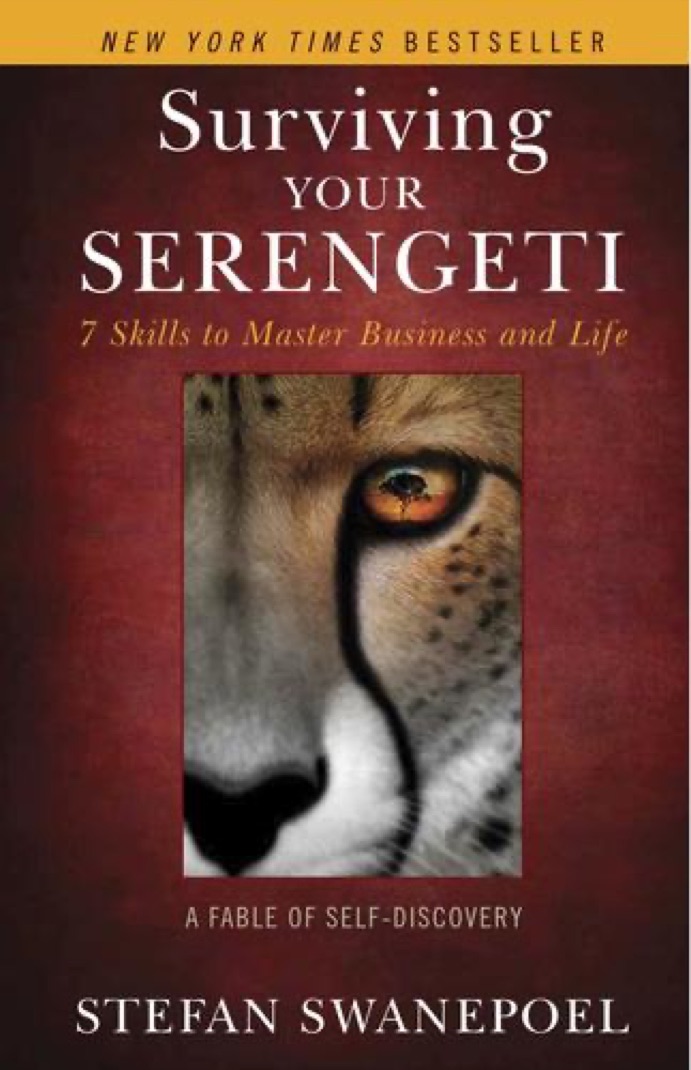
Surviving Your Serengeti: 7 Skills to Master Business and Life
Applying the lessons from "Surviving Your Serengeti" by Stefan Swanepoel to your life can be a transformative exercise in aligning your natural instincts with your professional ambitions. Here are some ways you might integrate these lessons:
- Identify Your Primary Instinct: - You must first recognize which animal archetype best describes your current approach to leadership and problem-solving, whether it is the strategic Lion or the visionary Giraffe. Once you identify your baseline, you can intentionally seek out partners—in your medical practice, law firm, or VC ventures—who possess the complementary survival traits you lack, ensuring a balanced and resilient ecosystem.
- Cultivate Giraffe-Like Vision: - In the complex worlds of healthcare and venture capital, it is easy to get bogged down in the immediate "tall grass" of daily operations. You should practice elevating your perspective to spot industry shifts and technological disruptions years in advance, allowing you to position your organizations long before the rest of the herd realizes the landscape has changed.
- Embrace Mongoose-Level Risk Management: - Whether you are in the cockpit or the boardroom, risk is an inherent constant. You should apply the lesson of the mongoose by moving from a state of fear-based hesitation to one of calculated, courageous action, recognizing that the greatest danger often lies in the paralysis of indecision rather than the risk itself.
- Harness Cheetah-Style Efficiency: - High-performance environments like the emergency room require the ability to prioritize and execute with maximum speed. You can integrate this by identifying the "critical few" tasks that yield the most significant results and focusing your resources on these high-impact moments, while avoiding the exhaustion that comes from perpetual, unfocused sprinting.
- Foster Wildebeest Synergy: - True leadership in multidisciplinary fields requires keeping every member of the team synchronized. You should focus on enhancing communication protocols within your organizations to ensure that, despite diverse backgrounds in medicine, law, or business, the entire group moves as a single unit toward a common objective.
- Adopt the Crocodile’s Enterprising Patience: - In entrepreneurship and investing, timing is often more important than the idea itself. You can refine your enterprising spirit by developing the discipline to wait for the right market conditions, maintaining a state of readiness so that when a "Walmart-sized" opportunity crosses your path, you are prepared to act with total commitment.
By integrating these lessons, you move beyond mere survival and begin to master the environment around you, transforming the challenges of a complex career into a series of strategic opportunities. Embracing the diversity of these seven skills allows you to lead with greater humility while staying hungry for the next horizon, embodying the very essence of a master of the Serengeti.
What the book covers
"Surviving Your Serengeti: 7 Skills to Master Business and Life" by Stefan Swanepoel is a motivational business fable that uses the metaphor of the African savannah to explore the essential traits required for success in a competitive world. Through the story of Sean and Ashley, a couple on a quest for meaning while on safari, Swanepoel identifies seven distinct survival instincts embodied by the animals of the Serengeti. The book serves as both a narrative journey and a self-assessment tool designed to help professionals recognize their innate strengths and bridge the gaps in their skill sets. By framing complex psychological and professional attributes through animal archetypes, the author provides a memorable framework for personal and organizational development.
Summary:
- The Serengeti Metaphor: - The book establishes the Great Migration as a backdrop for the struggle and triumph inherent in human endeavors, suggesting that the same instincts that govern survival in the wild apply to the corporate boardroom and personal life. Swanepoel introduces the idea that every individual possesses a dominant survival trait—a "primary animal instinct"—that dictates how they respond to challenges and opportunities.
- Strategy and Vision (The Lion and The Giraffe): - The Lion represents the skill of strategy, emphasizing the importance of self-confidence, decisive leadership, and the ability to maintain focus on high-level goals. In contrast, the Giraffe embodies the skill of grace and vision; its long neck allows it to see threats and opportunities from afar, teaching the reader the value of long-term planning and the importance of maintaining a high-level perspective in a rapidly changing environment.
- Persistence and Endurance (The Elephant): - The Elephant symbolizes the enduring spirit, characterized by wisdom, memory, and an unwavering commitment to the community. Swanepoel argues that true success requires the ability to withstand hardship and maintain a legacy of excellence, drawing on the elephant's social bonds and long-term memory as a model for building sustainable professional relationships and corporate culture.
- Risk-Taking and Courage (The Mongoose): - The Mongoose archetype highlights the necessity of risk-taking and the courage to confront formidable opponents, much like the mongoose faces the cobra. This section explores how calculated risks are essential for growth, urging readers to move past their comfort zones and develop the agility to strike when the timing is right, regardless of the perceived size of the obstacle.
- Efficiency and Speed (The Cheetah): - The Cheetah represents the skill of efficiency, demonstrating how focused bursts of energy and extreme specialization lead to successful outcomes. Swanepoel notes that the cheetah cannot run at top speed indefinitely; thus, professionals must learn to manage their energy, identify the exact moment to accelerate, and execute their tasks with surgical precision to ensure a high return on effort.
- Communication and Teamwork (The Wildebeest): - The Wildebeest illustrates the power of communication and the strength found in the herd, emphasizing that massive migrations are only possible through synchronized movement and mutual support. The narrative stresses that even the most talented individual cannot survive the "crocodile-infested waters" of the market alone, making effective communication and collaborative synergy non-negotiable for large-scale success.
- Enterprising Opportunism (The Crocodile): - The Crocodile embodies the enterprising spirit, characterized by extreme patience and the ability to wait for the perfect opportunity to present itself. This skill involves deep observation and the readiness to capitalize on environmental changes, teaching the reader that sometimes the most productive action is a state of alert waiting followed by a decisive, opportunistic strike.
Ultimately, "Surviving Your Serengeti" posits that while we all have a natural inclination toward one of these seven traits, the most successful individuals are those who learn to integrate all seven or surround themselves with a diverse team that collectively represents the entire ecosystem of skills. Swanepoel’s work remains a significant contribution to the business fable genre, offering a simplified yet profound lens through which to view leadership and human behavior.