The One Page Business Plan: Start with a Vision, Create a Plan, and Grow Your Business
Applying the lessons from "The One Page Business Plan: Start with a Vision, Create a Plan, and Grow Your Business" by Jim Horan to your life can be the catalyst for transforming fragmented interests into a unified, high-impact legacy. Here are some ways you might integrate these lessons:
-
Clarity through Extreme Constraint: - You should use the one-page limit as a diagnostic tool for your current ventures. If you cannot fit your strategy for a new medical practice or a VC fund onto a single page, you likely do not understand the core value proposition well enough yet. Forcing yourself to edit until only the essentials remain will clarify your focus and make your leadership more decisive.
-
Aligning Multi-Disciplinary Goals: - Given your background in medicine, law, and aviation, you can use this framework to ensure your various roles are not competing for resources. Create a "Personal Master Plan" using Horan’s five elements to see how your work as a pilot or attorney supports your primary vision of healthcare innovation, ensuring a synergistic rather than a fractured life.
-
Precision in Executive Communication: - When leading Xcellerant Ventures, you can require your portfolio companies to distill their pitch into this one-page format. This allows you to quickly assess a founder's ability to prioritize and ensures that you, as the investor, have a crystal-clear understanding of the specific "Objectives" and "Action Plans" you are funding.
-
Operationalizing the "Stay Hungry" Mantra: - Use the "Objectives" section to put concrete numbers behind your hunger for growth. Instead of a general desire to learn, set a one-page plan for a specific new skill or certification, outlining the exact "Action Plans" and deadlines required to achieve it, thereby maintaining your competitive edge through structured self-improvement.
-
Agile Pivoting in High-Stakes Environments: - In both emergency medicine and entrepreneurship, conditions change rapidly. By having a one-page plan, you can update your "Strategies" and "Action Plans" in minutes rather than weeks. This agility allows you to respond to market shifts or clinical developments without losing sight of your ultimate "Vision."
-
Fostering Team Accountability: - Use the plan to empower your staff at every level. When every team member has a copy of the one-page plan, they no longer need to wait for instructions; they can look at the "Mission" and "Strategies" to make independent decisions that align with your goals, fostering a culture of humble, autonomous leadership.
By integrating these lessons, you move beyond the role of a mere practitioner or manager and become a master architect of your own destiny. The discipline of the one-page plan ensures that your vast array of talents is always directed toward your most significant objectives, allowing you to scale your impact across healthcare, law, and venture capital with unparalleled clarity and speed.
What the book covers
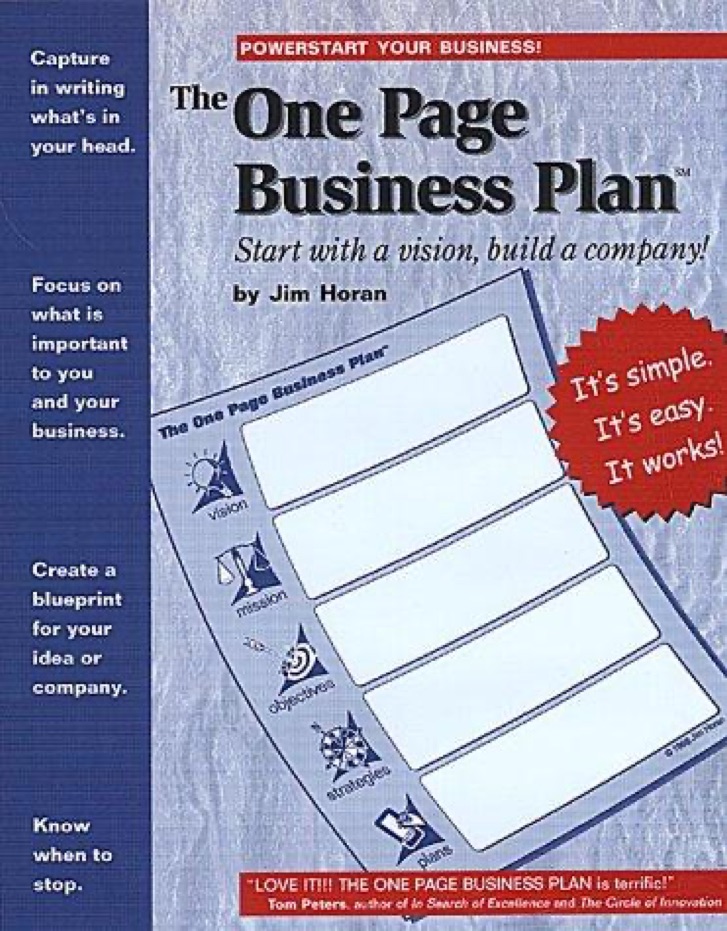
"The One Page Business Plan: Start with a Vision, Create a Plan, and Grow Your Business" by Jim Horan is a revolutionary management tool designed to strip away the bureaucracy and complexity often associated with traditional business planning. The book provides a practical, highly structured template that forces entrepreneurs and leaders to distill their entire strategic direction into a single, concise page. By focusing on five essential elements—Vision, Mission, Objectives, Strategies, and Action Plans—Horan offers a system that ensures every team member understands the company's trajectory and their specific role within it. It serves as both a creative brainstorming guide and a rigid operational framework for those who need to move from idea to execution with speed and precision.
Summary:
-
The Vision Statement: - This section focuses on defining the ultimate destination of the organization by answering the question, "What are we building?" Horan argues that a vision must be a clear, mental image of the future state of the company, typically projected three to five years out, and must be stated in the present tense to make it feel attainable and real. - By forcing this statement into a concise format, the author ensures that leaders do not get lost in vague aspirations, but instead commit to a specific scale, market position, or impact that serves as the North Star for all subsequent decisions.
-
The Mission Statement: - The mission addresses the fundamental purpose of the entity by answering, "Why does this business exist?" and "Who do we serve?" It defines the core services or products provided and identifies the specific target market or customer base that the company intends to satisfy. - Horan emphasizes that a strong mission statement provides the boundaries for the business, helping leaders say "no" to opportunities that do not align with their core purpose, thereby preventing the "mission creep" that often derails growing startups.
-
Objectives: - Objectives are the measurable, quantifiable results that indicate whether the business is succeeding. These are not broad goals but specific numbers, such as revenue targets, patient volume, or market share percentages, typically set for a one-year period. - The book teaches that without hard data points, a business plan is merely a list of wishes; objectives provide the accountability necessary to track progress and make data-driven adjustments during quarterly reviews.
-
Strategies: - This section outlines the broad approaches or "how" the organization will achieve its objectives over time. Strategies are the creative themes—such as aggressive digital marketing, strategic partnerships, or operational excellence—that will drive the company toward its goals. - Horan suggests that while objectives are the ends, strategies are the means; they provide the logical framework for resource allocation and help the team understand the general path they are taking to outperform competitors.
-
Action Plans: - The final component of the plan is the most granular, focusing on the specific tasks, projects, and initiatives required to implement the strategies. These plans include deadlines and identify the individuals responsible for execution, turning the strategic document into a living to-do list. - By documenting these actions on the same page as the vision and mission, Horan ensures that the daily grind of the business remains directly connected to the high-level goals, preventing busywork that doesn't move the needle.
-
The Philosophy of Distillation: - A recurring theme throughout the book is that "less is more." Horan posits that a plan no one reads is useless, and by forcing a plan onto a single page, leaders are required to think more deeply about what truly matters, discarding the fluff and technical jargon that clouds judgment. - This brevity is presented as a leadership superpower, enabling rapid communication with investors, employees, and partners who may not have the time to digest a fifty-page document but can easily memorize and align with a single-page strategy.
This book is significant because it democratizes the planning process, making it accessible to creative entrepreneurs who might be intimidated by traditional MBA-style business plans. It bridges the gap between high-level strategic thinking and daily operational execution, providing a common language for organizations to achieve alignment and rapid growth.