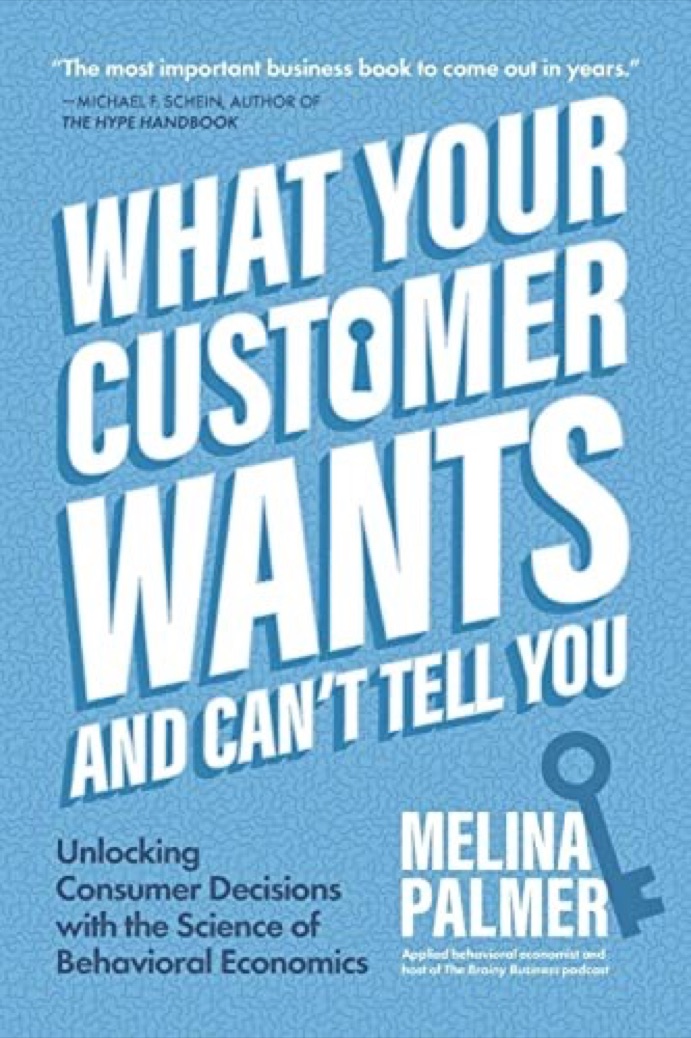
What Your Customer Wants and Can't Tell You: Unlocking Consumer Decisions with the Science of Behavioral Economics
Applying the lessons from "What Your Customer Wants and Can't Tell You" by Melina Palmer to your life can be a transformative exercise in refining how you influence and lead others across various professional domains. Here are some ways you might integrate these lessons:
- Optimizing Healthcare Delivery and Patient Compliance: - As a physician, you can use choice architecture to improve patient outcomes by framing treatment plans in a way that minimizes perceived loss. By understanding that patients operate largely in System 1 during stressful medical encounters, you can design "nudges" in clinical workflows that make the healthiest or safest choice the easiest one to follow.
- Refining the Pitch in Venture Capital: - When evaluating or presenting investment opportunities, you should look beyond the raw data and consider the framing of the narrative. Recognizing that even sophisticated investors are subject to anchoring and social proof allows you to better position a startup’s value proposition or more critically assess the subconscious biases at play in a deal.
- Enhancing Entrepreneurial Marketing Strategy: - In your ventures, you can move away from traditional surveys that ask customers what they want and instead focus on behavioral experiments. By testing small changes in pricing anchors or the sequence of product offerings, you can discover the "unspoken" needs of your market and create more effective, friction-less customer journeys.
- Improving Legal and Negotiation Outcomes: - Using the principle of anchoring, you can more effectively set the stage in legal negotiations or contract discussions. Understanding that the first number or condition mentioned often dictates the boundaries of the entire conversation allows you to lead with a strategic "anchor" that favors your position while making the other party feel they have gained a win.
- Applying Behavioral Science to Aviation and Safety: - In high-stakes environments like the cockpit, recognizing the limitations of the subconscious brain is vital. You can apply the lessons of cognitive load and heuristics to streamline checklists and procedures, ensuring that critical safety actions are designed to align with instinctive reactions rather than requiring complex logical processing during an emergency.
- Cultivating Personal Growth through Self-Nudging: - You can apply these behavioral principles to your own habits by "choice architecting" your environment. By removing friction for positive behaviors (like leaving gym clothes out) and adding it for negative ones, you leverage the science of the brain to maintain your "Stay Hungry" momentum without relying solely on limited willpower.
By integrating these lessons, you will develop a more sophisticated understanding of the hidden forces that drive human interaction, allowing you to lead with greater empathy, negotiate with more precision, and build healthcare and business systems that truly align with how people function.
What the book covers
"What Your Customer Wants and Can't Tell You: Unlocking Consumer Decisions with the Science of Behavioral Economics" by Melina Palmer is a comprehensive guide to understanding the psychological triggers that drive consumer behavior. Palmer, a behavioral economist and host of "The Brainy Business" podcast, bridges the gap between complex academic research and practical business application. The book explores why traditional marketing often fails and how businesses can use "nudges" and "choice architecture" to align with the subconscious way the human brain actually makes decisions.
Summary:
- The Dual Process Theory of the Brain: - Palmer explains the critical distinction between System 1 (the subconscious, intuitive, and fast-acting brain) and System 2 (the conscious, logical, and slow-acting brain). While most marketing strategies attempt to appeal to the logical System 2, research shows that up to 95% of purchasing decisions are actually made by the subconscious System 1, which relies on heuristics and emotional shortcuts.
- The Power of Framing and Perception: - The book demonstrates how the way information is presented, or "framed," significantly alters how it is perceived and acted upon. Palmer illustrates this through various experiments showing that consumers react differently to the same objective data depending on whether it is framed as a gain or a loss, or if it is presented alongside specific comparative anchors.
- Pricing Psychology and Anchoring: - Palmer delves into the science of pricing, explaining that the brain does not process numbers in a vacuum. By using "anchors"—initial pieces of information that serve as a reference point—businesses can influence a customer's perception of value, making a premium price point seem reasonable or a discount seem like an irresistible opportunity.
- The Endowment Effect and Loss Aversion: - One of the book's core arguments is that humans are evolutionary hardwired to fear loss more than they value gain. Palmer explains how the "endowment effect" makes people overvalue things they already own or even things they merely imagine owning, which can be leveraged in marketing through trials, samples, and language that implies possession.
- Social Proof and Relatability: - The text explores the herd mentality, where individuals look to others to determine correct behavior, especially in uncertain situations. Palmer provides strategies for utilizing testimonials, "best-seller" labels, and community-driven data to reduce the friction of decision-making and build trust through the subconscious reassurance of the crowd.
- Choice Architecture and Nudging: - Palmer introduces the concept of being a "choice architect," someone who designs the environment in which decisions are made. By subtly changing the default options or the order in which choices are presented, businesses can "nudge" customers toward specific outcomes without removing their freedom of choice, effectively guiding them down the path of least resistance.
- The Truth About Consumer Feedback: - A central theme of the book is that customers often cannot accurately articulate what they want because their subconscious motivations are inaccessible to their conscious minds. Palmer argues that businesses should prioritize observing actual behavior over relying on surveys or focus groups, which often reflect what customers think they should want rather than what they will actually buy.
By synthesizing cognitive psychology with marketing strategy, Palmer provides a toolkit for any professional looking to influence human behavior. The book’s significance lies in its ability to take dense academic concepts like time discounting and reciprocity and turn them into actionable maneuvers for improving customer engagement and organizational growth.