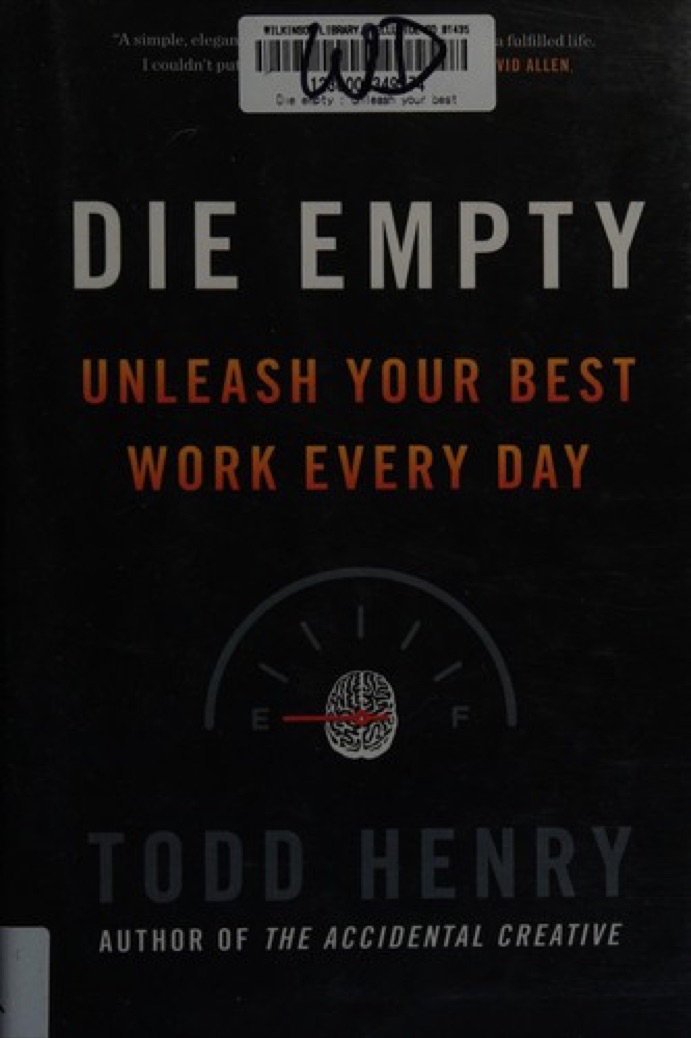
Die Empty: Unleash Your Best Work Every Day
Applying the lessons from "Die Empty: Unleash Your Best Work Every Day" by Todd Henry to your life can be the catalyst for moving from a state of busy-ness to a state of profound impact across your professional and personal spheres. Here are some ways you might integrate these lessons:
-
Adopt an Emergency Medicine Mindset toward Time: - You should treat your professional contributions with the same urgency as a critical care situation, recognizing that the window for making a specific impact is often smaller than you think. By acknowledging the "expiration date" on your opportunities, you can bypass procrastination and tackle your most important "Making" work first each day.
-
Audit Your Three Kinds of Work: - Whether you are managing a medical practice, a law firm, or a venture fund, you must regularly assess if you are over-allocating time to "Mapping" at the expense of "Making." Ensure that your schedule reflects a balance where you are not just planning for the future but actively producing the results that define your legacy.
-
Combat the "Comfort Trap" in Leadership: - As you achieve success in entrepreneurship or medicine, it is easy to default to the path of least resistance; however, you must intentionally seek out challenges that keep you in a state of productive discomfort. Recognize that professional stagnation often begins the moment you stop asking "How can I make this better?" and start asking "How can I make this easier?"
-
Cultivate a "Meshing" Practice for Lifelong Learning: - To remain a versatile polymath—mixing medicine, law, and business—you should formalize your "Meshing" time by reading outside your primary fields and engaging with diverse thinkers. This cross-pollination of ideas is what allows you to find unique solutions in complex markets or high-stakes environments like aviation.
-
Identify Your Throughline to Streamline Decisions: - You should define a singular, guiding principle for your life’s work to serve as a filter for new ventures. If a potential investment or project does not align with your core mission of contribution and growth, you must have the discipline to say no, protecting your energy for the work that truly matters.
-
Establish a Personal Battle Rhythm: - Just as a pilot relies on a pre-flight checklist, you should implement daily and weekly rituals to check your "mental instruments." Use these checkpoints to ensure you are staying humble and hungry, adjusting your course before the "Seven Deadly Sins of Mediocrity" can take root in your routine.
By integrating these lessons, you will transform your daily routine into a deliberate practice of contribution, ensuring that your multifaceted expertise in medicine, law, and business is fully utilized. This commitment to "dying empty" ensures that your legacy is not just a collection of titles or acquisitions, but a tangible record of every great idea and effort you poured into the world.
What the book covers
"Die Empty: Unleash Your Best Work Every Day" by Todd Henry is a provocative call to action for anyone who feels they are coasting through their professional or personal life without tapping into their full potential. Henry argues that the most valuable land on earth is the graveyard, as it is filled with unwritten books, unlaunched businesses, and unshared ideas that the deceased took with them. The book provides a practical framework for cultivating a "contribution mindset" to ensure that you exhaust your creative energy and leave nothing behind when your time is up.
Summary:
-
The Concept of Dying Empty: - Henry introduces the central metaphor of the book: the goal of life should not be to accumulate comfort, but to empty yourself of your best work every single day. This requires a shift from a "consumption mindset," where you focus on what you can get from the world, to a "contribution mindset," where you focus on what you can give. - He emphasizes that time is a non-renewable resource and that "the graveyard is the richest place on earth" because of the untapped potential buried there. To avoid this fate, you must treat your work and your presence as a finite opportunity to add value.
-
The Three Kinds of Work: - Henry categorizes all human activity into three types: Mapping, Making, and Meshing. Mapping involves the planning and strategic thinking required to set a course; Making is the actual execution and production of work; and Meshing is the process of learning, connecting ideas, and developing your character. - He argues that most people fail because they are imbalanced, often spending too much time on Mapping (over-planning) or Making (busy work) while neglecting Meshing, which provides the long-term fuel for innovation and personal growth.
-
The Seven Deadly Sins of Mediocrity: - The book identifies seven traps that lead to a stagnant life: Aimlessness, Boredom, Comfort, Delusion, Ego, Fear, and Guardedness. These "sins" act as friction that slows down progress and prevents individuals from engaging deeply with their most important tasks. - Henry provides strategies for identifying which of these traps currently hinder your productivity, suggesting that comfort is often the most dangerous because it masquerades as success while slowly eroding your drive to excel.
-
Defining Your Throughline: - A "throughline" is a core set of values or a central mission that guides your decisions and work. Henry suggests that without a clear throughline, you will find yourself reacting to the demands of others rather than pursuing your own unique contribution. - Identifying your throughline helps you decide what to say "no" to, ensuring that your limited energy is focused on the work that only you can do, rather than being diluted across a dozen mediocre projects.
-
Establishing a Battle Rhythm: - Henry advocates for a "Battle Rhythm," which consists of daily, weekly, and monthly rituals that protect your creative time and ensure you are making progress on your most vital work. This involves setting specific "checkpoints" to evaluate your output and your health. - By automating the mundane aspects of life and scheduling time for reflection, you create a structure that allows for spontaneous creativity and prevents the drift toward aimlessness.
-
The Ethos of Contribution: - The final sections of the book focus on the internal shifts necessary to maintain high performance over decades. This includes cultivating curiosity and staying "hungry" for new challenges regardless of past successes. - Henry argues that true fulfillment comes from the realization that your work is a service to others, and by emptying yourself, you are actually making room for more growth and deeper connections.
Ultimately, "Die Empty" serves as a manual for living with urgency and intentionality. It challenges the reader to treat every day as a discrete opportunity to contribute, ensuring that when the end comes, their best work is already out in the world rather than trapped inside them.