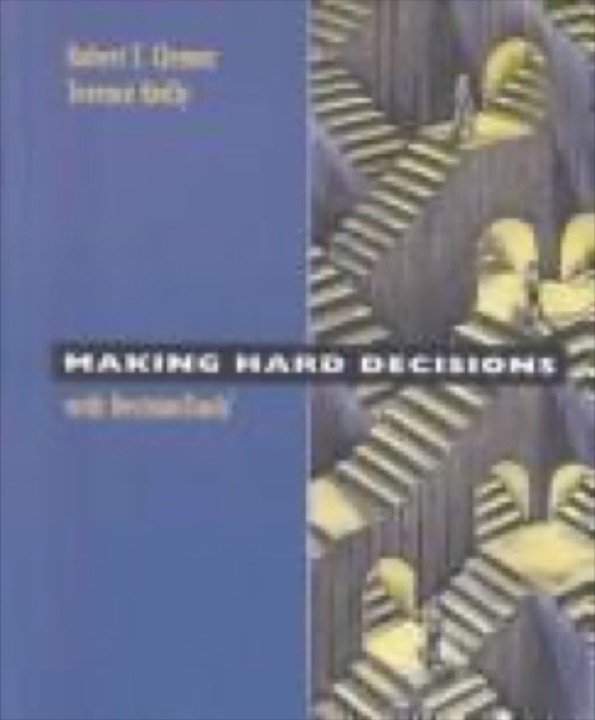
Making Hard Decisions: An Introduction to Decision Analysis
Applying the lessons from "Making Hard Decisions" by Robert T. Clemen to your life can enhance your decision-making process, especially given your rich experiences and values. Here’s how you might integrate some of the book's key concepts:
-
Structured Decision-Making: - Use decision trees and influence diagrams to map out complex decisions, whether in your professional life as a physician or personal life. This can help you visualize potential outcomes and make more informed choices.
-
Probability Assessment: - Given your experiences with high-risk situations, like plane crashes, you might already have a keen sense of assessing risk. Applying formal probability assessments can further refine your ability to evaluate uncertainties in both everyday and critical decisions.
-
Utility Theory: - Reflect on your personal preferences and risk tolerance when making decisions. Constructing utility functions could help you weigh different options, especially when considering significant life choices or investments.
-
Value of Information: - Before seeking additional information, consider its potential value. This can prevent unnecessary data collection and help you focus on acquiring insights that truly impact your decisions, whether in your advocacy work or personal endeavors.
-
Decision-Making Under Uncertainty: - Use strategies like expected value and decision criteria to navigate uncertainty. This approach can be particularly useful in your medical practice, where decisions often involve weighing uncertain outcomes.
-
Multi-Attribute Decision Making: - When faced with decisions involving multiple objectives, such as balancing family, work, and personal growth, use techniques like weighted scoring to prioritize what matters most to you.
-
Awareness of Biases: - Acknowledge and mitigate cognitive biases in your decision-making process. Your awareness of societal issues and personal experiences can help you recognize biases and strive for more objective decisions.
-
Behavioral Aspects: - Consider the psychological and behavioral factors influencing your decisions. Your humor and resilience can be strengths, but being mindful of impulsivity and balance can lead to more thoughtful choices.
-
Applications and Case Studies: - Draw on real-world examples and case studies from the book to see how decision analysis can be applied in various contexts, from your medical career to personal projects and advocacy work.
By integrating these decision analysis techniques, you can enhance your ability to make well-informed, rational decisions that align with your values and aspirations. This structured approach can help you navigate life's complexities while staying true to your core beliefs and goals.
What the book covers
"Making Hard Decisions" by Robert T. Clemen is a comprehensive guide to decision analysis, a systematic approach to making complex decisions. The book is widely used in both academic and professional settings to teach decision-making skills, particularly in situations involving uncertainty and risk.
Summary:
-
Introduction to Decision Analysis: - The book begins by introducing the concept of decision analysis, emphasizing its importance in making informed and rational decisions. It outlines the basic components of decision-making, including objectives, alternatives, consequences, and uncertainties.
-
Structuring Decisions: - Clemen discusses how to structure decision problems using decision trees and influence diagrams. These tools help in visualizing and organizing the elements of a decision, making it easier to analyze complex situations.
-
Probability Assessment: - A significant portion of the book is dedicated to understanding and assessing probabilities. Clemen explains how to quantify uncertainty and use probability distributions to represent uncertain events.
-
Utility Theory: - The book introduces utility theory as a way to incorporate personal preferences and risk attitudes into decision-making. It explains how to construct utility functions and use them to evaluate different decision alternatives.
-
Value of Information: - Clemen explores the concept of the value of information, helping readers understand when and how additional information can improve decision-making. This section covers both perfect and imperfect information scenarios.
-
Decision-Making Under Uncertainty: - The book provides strategies for making decisions under uncertainty, including the use of expected value and decision criteria like maximin, maximax, and minimax regret.
-
Multi-Attribute Decision Making: - Clemen addresses decisions involving multiple objectives, introducing methods for evaluating and prioritizing different attributes. Techniques such as weighted scoring and the Analytic Hierarchy Process (AHP) are discussed.
-
Behavioral Aspects: - The book acknowledges the psychological and behavioral factors that can influence decision-making. It covers common biases and heuristics that can lead to suboptimal decisions.
-
Applications and Case Studies: - Throughout the book, Clemen provides real-world examples and case studies to illustrate the application of decision analysis in various fields, including business, healthcare, and public policy.
Key Takeaways and Lessons:
- Structured Approach: A structured approach to decision-making helps clarify complex problems and leads to more rational and consistent decisions.
- Quantifying Uncertainty: Understanding and quantifying uncertainty is crucial for making informed decisions, especially in high-stakes situations.
- Incorporating Preferences: Decision-making should account for personal or organizational preferences and risk tolerance, which can be systematically incorporated using utility theory.
- Value of Information: Not all information is equally valuable; understanding the value of information can prevent unnecessary data collection and focus efforts on acquiring useful insights.
- Awareness of Biases: Being aware of cognitive biases and heuristics can help mitigate their impact and lead to better decision outcomes.
- Practical Application: Decision analysis is not just theoretical; it has practical applications across various domains, providing valuable tools for professionals in diverse fields.
Overall, "Making Hard Decisions" equips readers with the tools and frameworks necessary to tackle complex decision-making challenges effectively.