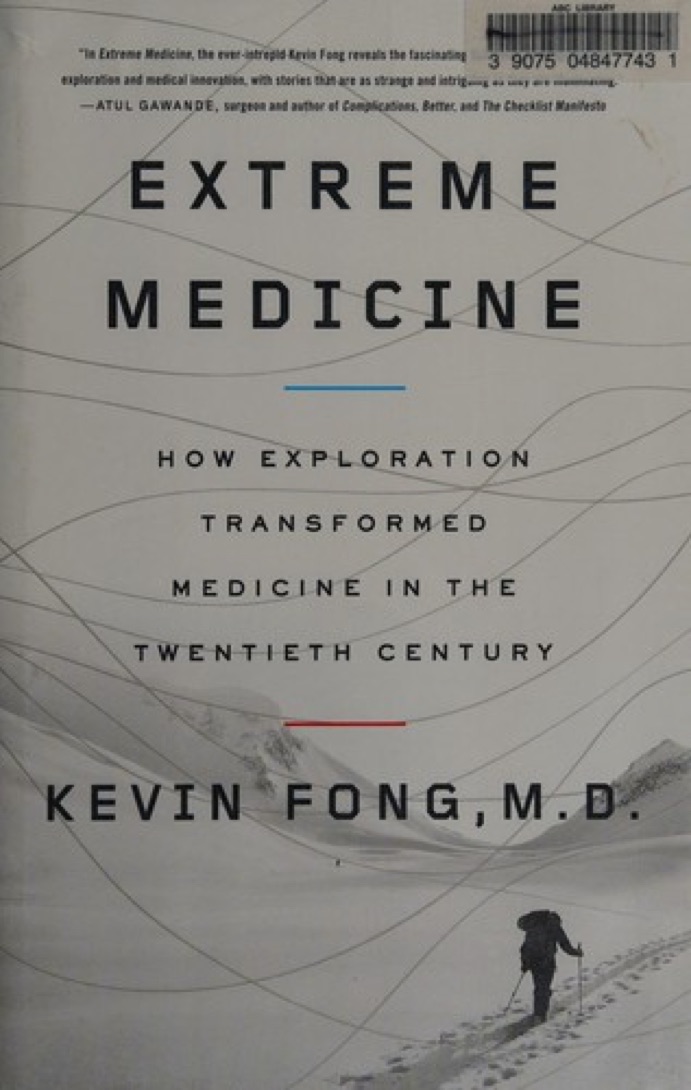
Extreme Medicine: How Exploration Transformed Medicine in the Twentieth Century
Applying the lessons from "Extreme Medicine: How Exploration Transformed Medicine in the Twentieth Century" by Kevin Fong to your life can be a transformative exercise in building resilience, fostering innovation, and maintaining a perspective of lifelong learning. Here are some ways you might integrate these lessons:
-
Seek the Boundary Conditions: - In your career as an entrepreneur or physician, you should actively look for "edge cases" or extreme challenges rather than avoiding them. Fong demonstrates that it is only at the limits of a system—whether biological or organizational—that its true mechanics and potential for innovation are revealed.
-
Adopt a Multi-Disciplinary Mindset: - You are encouraged to look beyond your primary field to solve complex problems, much like the integration of aviation engineering and physiology described by Fong. Whether you are leading a VC firm or flying an aircraft, the most elegant solutions often come from applying the safety protocols of one discipline to the life-saving maneuvers of another.
-
Reframe Failure as Physiological Data: - Just as explorers documented their physical decline to aid future generations, you should treat your professional setbacks as vital data points. In the "Stay Hungry" mindset, a failure is not a terminal point but a map of where the current boundaries lie, providing the necessary information to push further next time.
-
Cultivate Cool Under Pressure: - The book highlights that the most effective pioneers are those who can maintain analytical thinking while the environment is crashing around them. You can apply this by practicing deliberate stress inoculation—putting yourself in high-stakes environments, such as emergency medicine or solo flight, to sharpen your decision-making for the boardroom.
-
Practice Radical Humility: - Despite our technological advancements, Fong emphasizes that the human body is a fragile entity governed by the laws of physics. You should maintain the "Stay Humble" mantra by acknowledging the limits of your own expertise and remaining open to the harsh lessons that reality and nature can teach.
-
Prioritize Systems over Symptoms: - The evolution of the ICU shows that managing the whole person is more effective than just treating the injury. In your leadership roles, focus on the systemic health of your organizations and ventures, ensuring the underlying infrastructure can support growth even when individual components fail.
By integrating these lessons, you transition from a practitioner of the known to an explorer of the possible, ensuring that your endeavors in medicine, business, and life are always pushing the envelope of what is achievable.
What the book covers
"Extreme Medicine: How Exploration Transformed Medicine in the Twentieth Century" by Kevin Fong is a gripping exploration of how the human body reacts to extreme environments and how those reactions have driven medical innovation. Fong, an anesthesiologist with a background in astrophysics, weaves together historical narratives of exploration with modern clinical practice to show that our understanding of life is often forged at the edge of death. The book serves as both a history of 20th-century medicine and a tribute to the pioneers who risked their lives to map the limits of human physiology.
Summary:
-
The Frontier of Cold: - Fong details the harrowing expeditions of Robert Falcon Scott and how the physiological realities of hypothermia transitioned from a death sentence to a surgical tool. He explains how modern surgeons use "suspended animation" via extreme cooling to perform complex cardiac repairs, proving that the boundary between life and death is more fluid than previously imagined.
-
The Thin Air of Survival: - The book examines the history of high-altitude exploration and the discovery of hypoxia. By studying how the body fails—or adapts—on peaks like Everest, physicians developed the foundational principles of respiratory medicine and the critical care protocols used to treat oxygen-starved patients in intensive care units today.
-
Gravity and the Limits of Velocity: - Through the story of Colonel John Stapp, the "fastest man on earth," Fong illustrates the development of aviation medicine. Stapp’s brutal rocket-sled experiments provided the data necessary to design safer aircraft, cars, and trauma-care systems, highlighting the necessity of human-centered engineering in high-risk environments.
-
The Crucible of War: - Fong argues that the chaos of the battlefield has been the greatest laboratory for trauma medicine. From the development of blood transfusions in the trenches of WWI to the rapid triage and vascular surgery techniques refined in later conflicts, the book demonstrates how the necessity of saving lives under fire transformed civilian emergency rooms.
-
The Birth of Intensive Care: - One of the most pivotal moments described is the 1952 Copenhagen polio epidemic. Fong recounts how a desperate shortage of "iron lungs" led to the invention of positive-pressure ventilation, a breakthrough that moved medicine away from passive observation toward the active, technology-dependent management of failing organs.
-
The Spaceflight Paradox: - As humans look toward the stars, Fong explores how microgravity affects the body, causing rapid bone loss and fluid shifts. These observations in healthy astronauts provide unique insights into the mechanics of aging and the treatment of sedentary, chronically ill patients on Earth.
By framing medical progress as a series of successful navigations through extreme environments, Fong reminds us that the most significant breakthroughs occur when we step outside the comfort zone of the hospital. Extreme Medicine is a testament to the fact that to understand the human body in health, we must first understand it at its absolute breaking point.