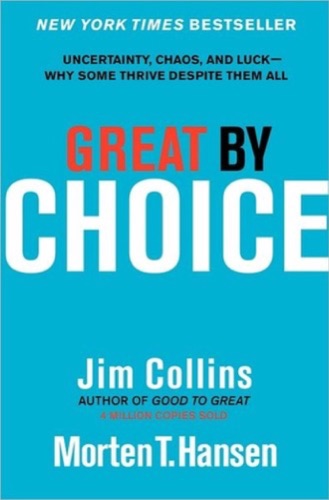
Great by Choice
Applying the lessons from "Great by Choice" to your life can be a meaningful way to enhance your personal and professional growth, especially given your rich experiences and values. Here’s how you might integrate some of the book’s principles:
-
20 Mile March: - Set consistent, achievable goals in your personal and professional life. For instance, maintain your daily routine of exercise and self-reflection, ensuring steady progress in your physical and mental well-being. This disciplined approach can help you achieve long-term goals, like living to 130 with a sound mind and body.
-
Fire Bullets, Then Cannonballs: - When exploring new interests or hobbies, such as skydiving, start with small steps. Perhaps take a tandem jump or attend a skydiving class before committing fully. This cautious experimentation aligns with your approach to decision-making and risk management.
-
Leading Above the Death Line: - Continue to prepare for unexpected challenges by maintaining a buffer of resources, whether financial, emotional, or social. Your experience in emergency situations and your calm demeanor are assets that can help you navigate life's uncertainties.
-
SMaC Recipe: - Develop a clear set of personal principles or routines that guide your daily actions, much like your morning routine. While being consistent, remain open to adapting these practices as your circumstances or goals evolve.
-
Productive Paranoia: - Stay vigilant about potential risks in your life, whether related to health, family, or career. Your awareness of societal changes and your proactive stance on social issues reflect this mindset. Continue to prepare for and address these challenges thoughtfully.
-
Level 5 Ambition: - Focus on your ambitions for the greater good, such as your advocacy work and desire to leverage technology for societal betterment. Your humility and dedication to helping others align with the qualities of Level 5 leaders.
Additional Applications:
-
Discipline and Consistency: Your commitment to kindness and empathy can be reinforced by consistently applying these values in all interactions, ensuring they remain central to your identity.
-
Empirical Creativity: When pursuing new projects or ideas, gather data and feedback to inform your decisions. This approach can enhance your effectiveness in both personal and professional endeavors.
-
Preparedness and Resilience: Continue to build resilience by learning from past experiences, as you have done with your near-death experiences and personal challenges.
-
Adaptability within a Framework: While you have a strong personal philosophy, remain open to adapting your views as you encounter new information or perspectives.
-
Luck is Not a Strategy: While you acknowledge the role of luck, focus on creating opportunities through preparation and persistence, as you have demonstrated throughout your life.
By integrating these principles into your life, you can continue to thrive in the face of uncertainty and chaos, much like the successful companies studied in "Great by Choice."
What the book covers
"Great by Choice: Uncertainty, Chaos, and Luck—Why Some Thrive Despite Them All" is a book by Jim Collins and Morten T. Hansen, published in 2011. It explores why some companies thrive in uncertain and chaotic environments while others do not. The authors conducted a nine-year research study to identify the principles that differentiate successful companies from their less successful counterparts. Here is a thorough summary of the book, including key takeaways and lessons:
Summary:
Research and Methodology:
Collins and Hansen studied companies that achieved exceptional performance over a long period despite facing significant uncertainty and chaos. They called these companies "10Xers" because they outperformed their industry index by at least ten times. The research compared these 10X companies with similar companies that failed to achieve the same level of success.
Key Concepts:
-
20 Mile March: - Successful companies set consistent, achievable performance targets and hit them year after year, regardless of external conditions. This concept emphasizes discipline and consistency over erratic, high-risk strategies.
-
Fire Bullets, Then Cannonballs: - This principle involves testing ideas with low-risk, low-cost experiments (bullets) before making large-scale investments (cannonballs). It encourages companies to innovate cautiously and scale successful ideas.
-
Leading Above the Death Line: - Companies must prepare for and manage risks to avoid catastrophic failures. This involves maintaining a buffer of resources and being prepared for unexpected challenges.
-
SMaC Recipe: - SMaC stands for Specific, Methodical, and Consistent. It refers to a set of operating practices that are clear and consistent, yet adaptable when necessary. Successful companies have a clear formula for success that they follow rigorously.
-
Productive Paranoia: - Leaders of successful companies remain vigilant and constantly consider what could go wrong. They prepare for potential threats and maintain a healthy level of paranoia to stay ahead of the competition.
-
Level 5 Ambition: - Building on Collins' earlier work, this concept highlights the importance of leaders who are ambitious for the company rather than for themselves. These leaders combine personal humility with professional will.
Key Takeaways and Lessons:
-
Discipline and Consistency: - Success in uncertain environments requires disciplined action and consistent performance. Companies should focus on steady progress rather than erratic leaps.
-
Empirical Creativity: - Innovation should be grounded in empirical evidence. Companies should experiment and gather data before making significant commitments.
-
Preparedness and Resilience: - Companies must prepare for adversity by maintaining a buffer of resources and being ready to adapt to changing circumstances.
-
Leadership Matters: - Effective leadership is crucial. Leaders should be humble, focused on the company's success, and willing to make tough decisions.
-
Adaptability within a Framework: - While consistency is important, companies must also be willing to adapt their strategies when necessary. A clear framework (SMaC) helps balance consistency and adaptability.
-
Luck is Not a Strategy: - While luck plays a role in success, it is not a reliable strategy. Successful companies make their own luck by being prepared and disciplined.
"Great by Choice" provides valuable insights into how companies can thrive in unpredictable environments by focusing on disciplined action, empirical creativity, and effective leadership. The book emphasizes that success is not about predicting the future but about being prepared and adaptable in the face of uncertainty.