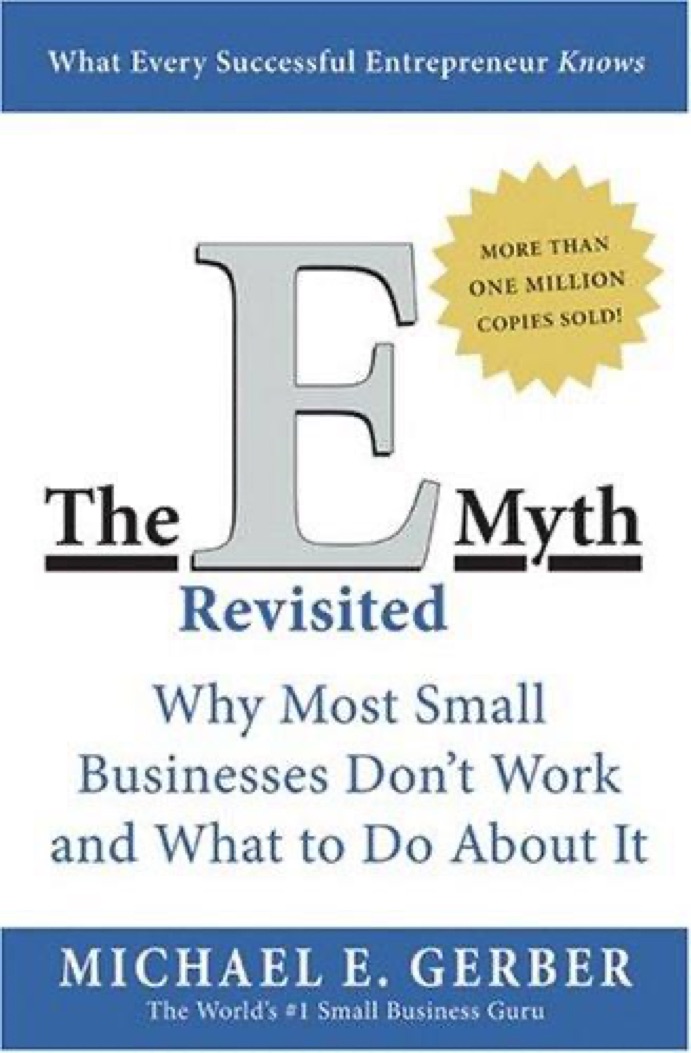
The E-Myth Revisited: Why Most Small Businesses Don't Work and What to Do About It
Applying the lessons from "The E-Myth Revisited" by Michael E. Gerber to your life can be a transformative step toward achieving operational freedom and long-term scaling. Here are some ways you might integrate these lessons:
-
Balance Your Internal Triad: - You must recognize when your internal "Technician" is taking over—especially in demanding fields like medicine or law—and consciously carve out time for your "Entrepreneur" to dream and your "Manager" to organize. By acknowledging these distinct roles, you can prevent yourself from becoming the bottleneck in your own ventures and ensure you are leading rather than just laboring.
-
Shift from Physician to Healthcare Architect: - If you are running a practice or a startup, you should treat the clinical or technical delivery as a system to be optimized. Instead of being the only one who can solve a problem, focus on building standard operating procedures (SOPs) that allow your team to deliver high-quality care and service with the same precision you would expect in a well-run emergency department or cockpit.
-
Adopt the Franchise Mindset for Scalability: - Even if you never intend to franchise your business, you should act as if you are building the prototype for 1,000 more. This requires you to document every process—from how a patient is greeted to how a VC deal is vetted—ensuring that the success of the organization is a result of the system's integrity rather than a single individual's heroics.
-
Utilize Orchestration and Quantification: - Much like an aviator relies on flight data and checklists, you must quantify the key metrics of your business to know exactly where you stand. Once a process is proven to work through data, "orchestrate" it by making it the mandatory way of doing things, which eliminates chaos and provides a predictable experience for both your clients and your employees.
-
Design Your Business to Serve Your Primary Aim: - You should define your personal goals—your "Primary Aim"—before you define your business's goals. Whether your aim is to have more time for family, your law practice, or flying, your business should be the vehicle that gets you there, not a destination that requires you to sacrifice your lifestyle and values.
By integrating these lessons, you can move beyond the limits of individual effort and build a legacy of systems that continue to perform at a high level long after you have moved on to your next challenge. This approach fosters a culture of excellence, scalability, and personal fulfillment that defines a truly mature entrepreneur.
What the book covers
"The E-Myth Revisited" by Michael E. Gerber is a foundational business text that deconstructs the common misconception that technical expertise is the primary driver of entrepreneurial success. Gerber introduces the "Entrepreneurial Myth," explaining that most small businesses are started by "technicians" who are struck by an entrepreneurial seizure, only to find themselves enslaved by the very work they sought to master. The book provides a comprehensive framework for shifting from a person-dependent business to a system-dependent one, offering a roadmap for achieving scalability and operational freedom.
Summary:
-
The Fatal Assumption: - Gerber identifies the core reason for the high failure rate among small businesses: the assumption that understanding the technical work of a business means you understand how to run a business that does that technical work. This leads the expert—whether a doctor, a lawyer, or a baker—to create a "job" for themselves rather than a scalable enterprise, eventually resulting in burnout and stagnation.
-
The Three Business Personalities: - The author posits that every business owner must balance three internal personas: The Entrepreneur (the visionary and strategist), The Manager (the pragmatic organizer), and The Technician (the hands-on worker). Most owners are dominated by their internal Technician, which causes them to focus on the "how" of the work rather than the "why" or the "whither" of the business's future growth.
-
The Three Stages of Business Growth: - Gerber describes the lifecycle of a business through Infancy, Adolescence, and Maturity. Infancy is characterized by the owner doing everything; Adolescence begins when the owner hires help but often "abdicates" responsibility rather than delegating it; Maturity is reached when the business is designed as a system that functions independently of the owner’s constant presence.
-
The Turn-Key Revolution and the Franchise Prototype: - The book introduces the concept of the Franchise Prototype as the ideal model for any business. By treating a business as if it were the first prototype for a national franchise, the owner is forced to create a "turn-key" system where the business provides a predictable result to the customer and a predictable environment for the employee.
-
Working On vs. Working In the Business: - This is the central thesis of the book: an owner must spend their time working "on" the business (designing systems and strategy) rather than "in" the business (performing the day-to-day tasks). By viewing the business as a product to be designed rather than a place to go to work, the owner can create a self-sustaining entity that produces value consistently.
-
The Business Development Process: - This process consists of three essential activities: Innovation, Quantification, and Orchestration. Innovation looks for better ways to serve the customer; Quantification measures the impact of those changes; and Orchestration documents the best practices into a system that every employee can follow, ensuring the business operates like a well-oiled machine.
-
The Seven-Step Business Development Program: - Gerber outlines a structured path to maturity, starting with the Primary Aim (personal life goals) and moving through the Strategic Objective, Organizational Strategy, Management Strategy, People Strategy, Marketing Strategy, and finally, Systems Strategy. This holistic approach ensures that the business is built on a foundation of clear intention and rigorous process.
By providing a clear distinction between technical work and business development, Gerber offers a timeless methodology for creating an organization that is both profitable and sustainable. The book remains significant because it challenges founders to elevate their perspective from the microscopic details of their craft to the macroscopic design of their company.