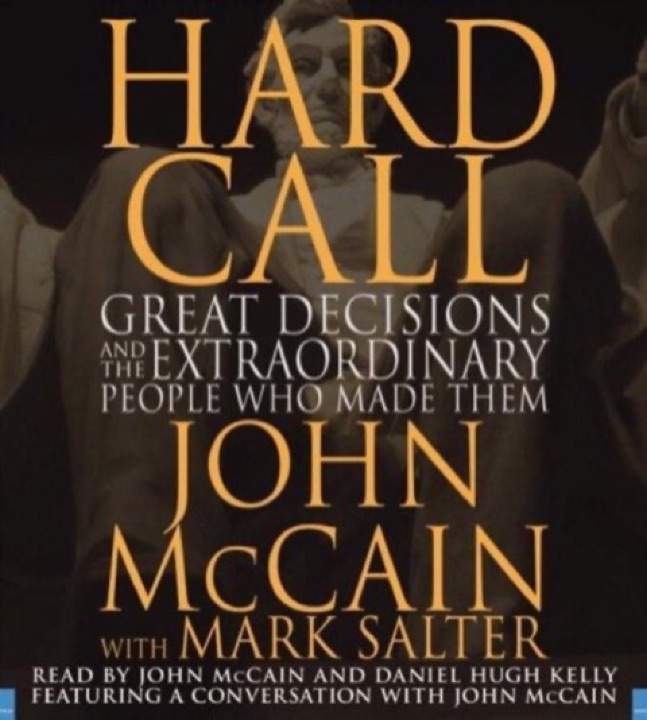
Hard Call
Applying the lessons from "Hard Call" by John McCain to your life involves integrating the six qualities McCain identifies as essential for making impactful decisions: awareness, foresight, timing, confidence, humility, and inspiration. Here's how you might incorporate these qualities into your life:
-
Awareness: Given your diverse experiences and interests, continue to cultivate a deep understanding of the contexts in which you operate. Whether it's in your professional life as a physician or your personal life, being aware of the broader environment and the nuances of each situation can help you make more informed decisions. This aligns with your practice of evaluating your daily wins and losses and considering how your actions affect others.
-
Foresight: Use your forward-thinking approach to anticipate future challenges and opportunities. Your interest in technological advancements and their societal impacts can be a platform for applying foresight. Consider how emerging technologies might influence your field or personal interests, and prepare to adapt to these changes.
-
Timing: Your ability to make quick decisions, as demonstrated in emergency situations, shows an understanding of timing. Continue to refine this skill by recognizing when to act decisively and when to wait for more information. This can be particularly useful in your advocacy work and personal growth endeavors.
-
Confidence: Your persistence and resilience are strengths that contribute to your confidence. Trust in your ability to make decisions, even when faced with opposition or uncertainty. This confidence can help you navigate complex situations, such as those involving ethical dilemmas or controversial issues.
-
Humility: Your direct and humorous communication style, combined with your emphasis on kindness and empathy, reflects humility. Continue to embrace this quality by acknowledging your limitations and being open to learning from others. This approach can enhance your relationships and decision-making processes.
-
Inspiration: Your passion for social issues and advocacy work demonstrates your ability to inspire others. Use your experiences and values to motivate those around you to engage in meaningful actions. Whether it's through your professional work, activism, or personal interactions, strive to be a source of inspiration for positive change.
By integrating these qualities into your life, you can enhance your decision-making abilities and continue to make a positive impact in your personal and professional spheres. Additionally, reflecting on the historical narratives in "Hard Call" can provide valuable insights and guidance as you navigate your own challenges and opportunities.
What the book covers
"Hard Call: Great Decisions and the Extraordinary People Who Made Them" is a book by John McCain, co-authored with Mark Salter. In this work, McCain explores the nature of decision-making through a series of historical narratives. He examines the lives and choices of various individuals who faced significant challenges and made impactful decisions. The book is structured around six qualities McCain identifies as essential for making hard calls: awareness, foresight, timing, confidence, humility, and inspiration.
Summary:
-
Awareness: McCain discusses the importance of understanding the context and environment in which a decision is made. He uses examples like Winston Churchill, who recognized the threat posed by Nazi Germany early on and took steps to prepare Britain for war.
-
Foresight: This section highlights the ability to anticipate future challenges and opportunities. McCain illustrates this with the story of Ronald Reagan and his strategic vision during the Cold War, which contributed to the eventual collapse of the Soviet Union.
-
Timing: McCain emphasizes the significance of choosing the right moment to act. He recounts the story of Anwar Sadat, the Egyptian president who made the bold decision to visit Israel in 1977, leading to the Camp David Accords and a peace treaty between the two nations.
-
Confidence: The book explores the necessity of having confidence in one's decisions, even in the face of opposition. McCain uses the example of Harry Truman, who made the controversial decision to use atomic bombs during World War II, believing it would save lives in the long run.
-
Humility: McCain argues that humility allows leaders to recognize their limitations and learn from others. He discusses the leadership of Mahatma Gandhi, whose humility and commitment to nonviolence inspired a movement that led to India's independence.
-
Inspiration: The final quality is the ability to inspire others to follow and support a decision. McCain shares the story of Martin Luther King Jr., whose vision and oratory inspired a nation to confront racial injustice and work towards equality.
Key Takeaways and Lessons:
-
Complexity of Decision-Making: McCain illustrates that making hard calls is rarely straightforward. It involves balancing various factors and often requires moral courage and a willingness to take risks.
-
Leadership Qualities: The book underscores the importance of certain qualities in effective leadership. Awareness, foresight, timing, confidence, humility, and inspiration are crucial for making decisions that have a lasting impact.
-
Learning from History: By examining historical figures, McCain suggests that contemporary leaders can learn valuable lessons from the past. Understanding how others navigated difficult situations can provide guidance for current and future challenges.
-
Moral and Ethical Considerations: Many of the decisions discussed in the book involve significant moral and ethical dilemmas. McCain emphasizes the importance of considering the broader implications of one's choices.
-
Resilience and Adaptability: The stories highlight the need for resilience and the ability to adapt to changing circumstances. Successful leaders often have to adjust their strategies in response to new information or unforeseen events.
Overall, "Hard Call" is a reflection on leadership and the art of decision-making, offering insights into how great leaders have navigated some of history's most challenging moments.