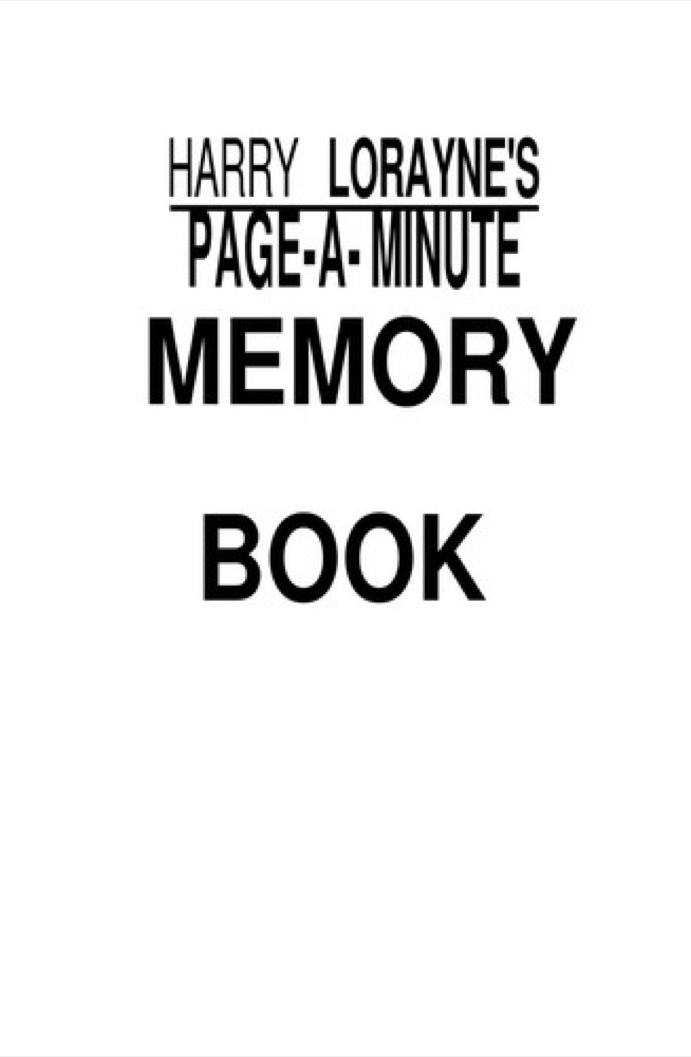
Harry Lorayne's Page-a-Minute Memory Book
Applying the lessons from "Harry Lorayne's Page-a-Minute Memory Book" by Harry Lorayne to your life can be a transformative step toward achieving professional mastery and maintaining cognitive agility throughout a multifaceted career. Here are some ways you might integrate these lessons:
-
Enhance Clinical and Technical Precision: - In the high-stakes environment of emergency medicine or aviation, use the Peg System to internalize dosages, checklists, and complex protocols. By converting abstract numbers and sequences into vivid mental images, you can reduce cognitive load during crises, ensuring that critical data is available instantaneously without the need for manual reference.
-
Optimize Entrepreneurial Networking: - As a venture capitalist and serial entrepreneur, your network is your net worth; utilize Lorayne’s names-and-faces technique to build immediate rapport with founders and partners. By associating a person’s name with a distinct visual hook during your first encounter, you demonstrate a level of respect and attention to detail that sets a powerful foundation for long-term business relationships.
-
Streamline Continuous Learning and Reading: - Use the Page-a-Minute technique to keep pace with the relentless flow of legal updates, medical journals, and business literature. By training yourself to extract and associate key concepts rather than reading every word, you can maintain your "lifelong learner" status without becoming overwhelmed by the sheer volume of information inherent in your various roles.
-
Master Complex Legal and Regulatory Frameworks: - Apply the Link System to memorize the structure of legal arguments or the specific components of healthcare regulations. This allows you to walk into a boardroom or a courtroom with the confidence that your mental map of the material is robust, enabling more fluid communication and more agile responses to counter-arguments.
-
Cultivate Leadership and Executive Presence: - Leverage the ability to speak without notes by using the Link System for presentations and board meetings. This allows you to maintain eye contact and engage with your audience more authentically, projecting the "Humble but Hungry" image of a leader who is fully prepared and cognitively sharp.
-
Maintain Mental Agility and Longevity: - View memory training as a form of "cognitive fitness" that is just as essential as physical health. By regularly challenging your brain to create complex associations and visualize data, you build a cognitive reserve that supports long-term mental clarity and prevents the intellectual stagnation that can often accompany high-level success.
By integrating these lessons, you can transform your mind into a high-performance engine capable of managing the complexities of medicine, law, and business with unprecedented ease. This disciplined approach to memory not only enhances your productivity but also reinforces the humility of a student and the hunger of an innovator, ensuring that you remain at the top of your game across every discipline you pursue.
What the book covers
"Harry Lorayne's Page-a-Minute Memory Book" by Harry Lorayne is a comprehensive manual designed to transform the way individuals process, store, and retrieve information. Lorayne, a world-renowned memory expert, posits that a "bad memory" is simply an untrained one and provides a suite of mnemonic systems to bridge the gap between reading and retention. The book focuses on the "Page-a-Minute" technique, which allows readers to absorb written material at an accelerated pace while building mental hooks for near-instant recall.
Summary:
-
The Foundation of Association: - Lorayne introduces the core principle that all memory is based on association—connecting something new to something you already know. He emphasizes that for an association to be effective, it must be visualized as a ridiculous, exaggerated, or impossible mental image that forces the brain to pay attention. - By moving away from rote memorization and toward creative visualization, the reader learns to engage the right hemisphere of the brain, making the process of learning both faster and more enjoyable than traditional study methods.
-
The Link System of Memory: - This section teaches the reader how to memorize lists of items in sequence by linking the first item to the second, the second to the third, and so on. This creates a mental chain where one thought inevitably leads to the next, preventing the "blanking out" often associated with public speaking or itemized tasks. - Lorayne demonstrates how to use this system for everything from grocery lists to complex speech outlines, ensuring that even if one link is momentarily obscured, the logic of the visual chain remains intact.
-
The Peg System for Numbers and Data: - The author introduces a phonetic alphabet that translates numbers into consonant sounds, which are then turned into "peg words." These words act as permanent mental filing cabinets for storing numerical data such as dates, prices, phone numbers, or statistical figures. - This system eliminates the abstraction of numbers, replacing them with concrete images that can be easily manipulated and recalled, providing a significant advantage in professional and academic settings where data accuracy is paramount.
-
The Page-a-Minute Reading Technique: - Lorayne outlines his signature method for rapid information absorption, which involves scanning text for "key words" and immediately forming associations. Instead of subvocalizing every word, the reader learns to pick out the essential concepts and "peg" them to a mental structure. - This technique aims to synchronize the speed of reading with the speed of thought, allowing the reader to consume a page of text in approximately sixty seconds while maintaining a high level of comprehension and the ability to summarize the content later.
-
Mastering Names and Faces: - One of the most practical sections of the book focuses on the social and professional importance of remembering people. Lorayne teaches readers to look for "outstanding features" on a person's face and associate them with a visual representation of their name. - He provides techniques for breaking down complex or foreign names into substitute words that can be easily visualized, ensuring that the reader never suffers the embarrassment of forgetting a client’s or colleague’s name again.
-
Retention and Long-Term Storage: - The final chapters deal with the mechanics of moving information from short-term to long-term memory. Lorayne explains the importance of initial "over-learning" and periodic mental reviews to solidify the neural pathways created by his systems. - He provides a framework for applying these systems to various specialized fields, including learning new languages, mastering technical terminology, and remembering complex legal or medical codes.
This book remains a cornerstone in the field of cognitive performance because it provides a bridge between speed reading and deep retention. By treating memory as a disciplined skill rather than a static trait, Lorayne empowers readers to handle the information overload of the modern era with confidence and efficiency.