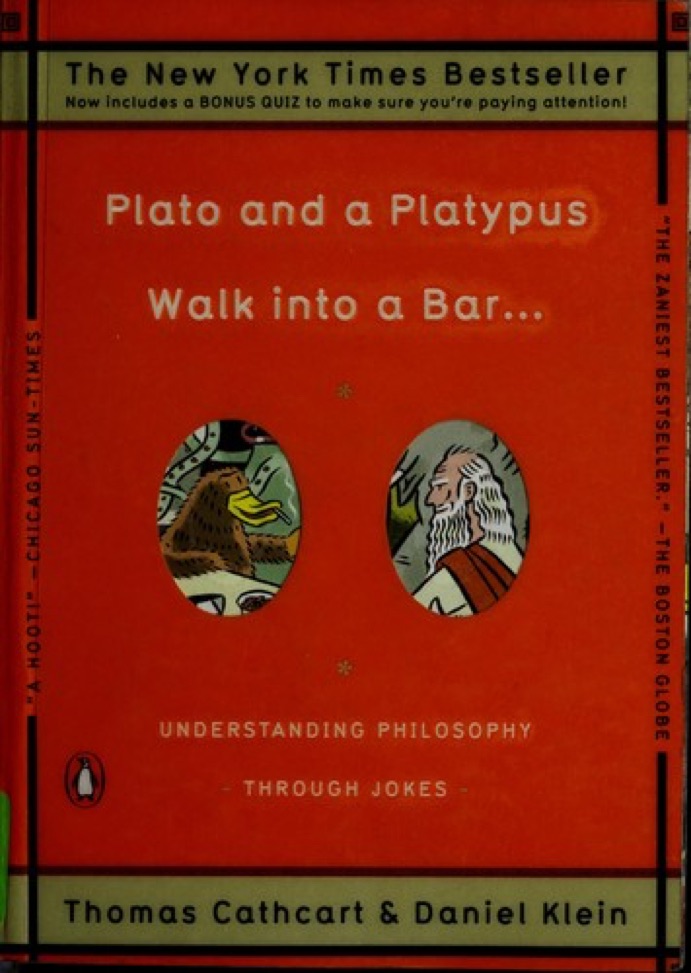
Plato and a Platypus Walk into a Bar…: Understanding Philosophy Through Jokes
Applying the lessons from "Plato and a Platypus Walk into a Bar…: Understanding Philosophy Through Jokes" by Thomas Cathcart and Daniel Klein to your life can be a transformative exercise in intellectual agility and emotional intelligence. Here are some ways you might integrate these lessons:
-
Sharpen Your Logical Filter: - In your roles as a physician or attorney, you should use the book’s breakdown of logical fallacies to audit your own decision-making processes. By recognizing where your "internal punchline" relies on a faulty premise, you can avoid diagnostic errors or legal pitfalls that stem from inductive leaps or deductive inconsistencies.
-
Leverage Humor as a Leadership Tool: - Use the "platypus" approach to bridge communication gaps in high-stakes entrepreneurship or clinical settings. By using wit to illustrate complex concepts, you can lower the defenses of your team, foster a culture of transparency, and make difficult strategic pivots feel like a shared, insightful discovery rather than a top-down mandate.
-
Practice Intellectual Humility: - Embrace the Socratic irony demonstrated throughout the text by acknowledging the limits of what you truly know. In pilot training or medical research, this "Stay Humble" mindset allows you to remain open to new data points that contradict your current worldview, ensuring that your expertise never becomes a barrier to further learning.
-
Navigate Ethics with Nuance: - Move beyond binary right-and-wrong thinking by applying the ethical frameworks mentioned in the book to your daily professional dilemmas. When faced with a choice between Utilitarian outcomes and Deontological duties, use the book's humorous scenarios to visualize the potential absurdities of each path, leading to more balanced and empathetic leadership.
-
Maintain Perspective in High-Stress Environments: - Utilize the existentialist lesson of embracing the absurd when dealing with the pressures of the ER or the courtroom. Recognizing that some chaos is inherent to the human condition allows you to maintain your focus and composure, finding personal meaning and mission even when the immediate situation seems nonsensical or overwhelming.
-
Refine Your Communication through Precision: - Pay close attention to the "Philosophy of Language" lessons to ensure your instructions and intentions are unambiguous. Whether drafting a legal brief or a business proposal, remember that meaning is often contextual, and clarity is the best defense against the miscommunications that lead to both bad jokes and bad business.
By integrating these lessons, you will cultivate a more resilient and versatile mind, capable of deconstructing complex problems with the same ease that one dissects a joke, ultimately leading to a more enlightened and effective approach to both your professional ventures and your personal growth.
What the book covers
"Plato and a Platypus Walk into a Bar…: Understanding Philosophy Through Jokes" by Thomas Cathcart and Daniel Klein is a clever and accessible exploration of the world's most complex philosophical ideas through the lens of humor. The authors, both philosophy graduates from Harvard, argue that the structure of a joke often mirrors the logic of a philosophical argument, making humor a perfect pedagogical tool for "Phil 101." By pairing classic gags with rigorous academic concepts, the book demystifies the pursuit of wisdom for the layperson while providing a refreshing review for the scholar.
Summary:
-
Metaphysics and the Nature of Reality: - This section explores the study of existence and what lies beyond the physical world, using jokes to illustrate the difference between appearance and reality. The authors explain concepts like Teleology—the idea that things have a design or purpose—and the ontological argument for the existence of God by showing how our assumptions about the world often lead to humorous subversions of logic.
-
Logic and the Structure of Reasoning: - Cathcart and Klein break down the mechanics of deductive and inductive reasoning, highlighting how fallacies can lead to absurd conclusions. They use "Dumb Blonde" jokes and linguistic puns to demonstrate how a shift in context or a faulty premise can dismantle an otherwise sound-looking argument, emphasizing that logic is the essential plumbing of clear thinking.
-
Epistemology or the Theory of Knowledge: - The authors tackle the question of how we know what we know, moving from Empiricism to Rationalism. Through stories of misunderstood instructions and perspectival errors, they explain the challenges of sensory perception and the radical skepticism of Descartes, ultimately questioning whether we can ever achieve objective certainty about the external world.
-
Ethics and Moral Philosophy: - This chapter navigates the complexities of right and wrong, contrasting Utilitarianism—the greatest good for the greatest number—with Kantian Deontology. Jokes about moral dilemmas and hypocritical behavior are used to show the tension between abstract ethical rules and the messy reality of human motivation and social pressure.
-
Philosophy of Religion: - The book examines the various proofs for the existence of a higher power and the problem of evil, often utilizing "heaven and hell" jokes to frame the debate. They cover Pascal’s Wager, which treats religious belief as a logical bet, and the nuances of theodicy, exploring why a benevolent deity would allow suffering in a structured universe.
-
Existentialism and the Search for Meaning: - Drawing on the works of Sartre, Camus, and Kierkegaard, the authors explore the themes of angst, authenticity, and the inherent absurdity of life. They use jokes about the futility of certain human endeavors to illustrate the existentialist view that we must create our own meaning in a universe that offers none.
-
Social and Political Philosophy: - This section addresses the foundations of society, including the Social Contract and the nature of justice. By looking at jokes regarding bureaucracy and political doublespeak, the authors explain how different philosophers, from Hobbes to Rawls, have attempted to balance individual liberty with the needs of the collective state.
This book is significant because it democratizes philosophy, removing the ivory-tower barrier by showing that the search for truth is a deeply human, and often hilarious, endeavor. It proves that wit and wisdom are two sides of the same coin, encouraging readers to think more deeply about the world by first learning to laugh at its contradictions.