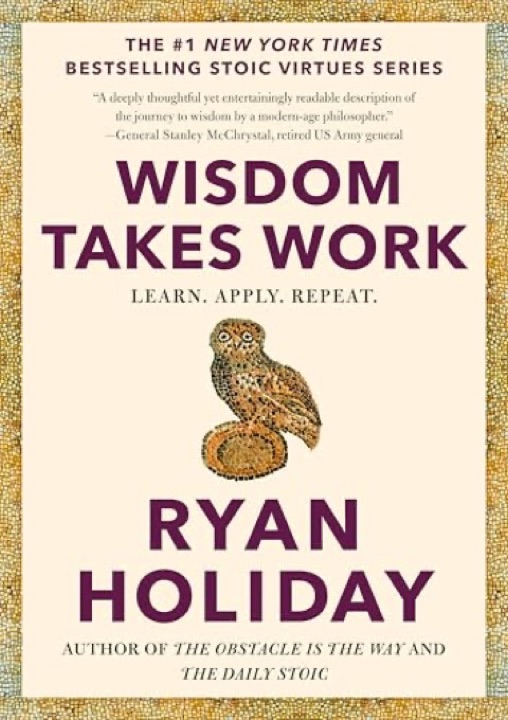
Wisdom Takes Work: Learn. Apply. Repeat.
Applying the lessons from "Wisdom Takes Work: Learn. Apply. Repeat." by Ryan Holiday to your life can be a transformative shift from theoretical knowledge to operational excellence. Here are some ways you might integrate these lessons:
- Operationalize Philosophy in High-Stakes Environments: - Treat your philosophical principles like a pilot’s pre-flight checklist or a surgeon’s sterile technique. You should not wait for a crisis in the ER or the boardroom to decide what you stand for; instead, memorize your core values so they become reflexive during high-pressure decision-making, ensuring that your responses are governed by logic rather than adrenaline.
- Adopt the Entrepreneurial Feedback Loop: - View your personal growth through the lens of an iterative startup. Use the "Learn, Apply, Repeat" cycle to test mental models in your business ventures; when a strategy fails, treat it as a data point in your "Apply" phase, refine your understanding in the "Learn" phase, and pivot quickly without letting ego bruise your momentum.
- Maintain Professional Humility Through Constant Learning: - Even as an expert in medicine, law, or aviation, you must cultivate the "beginner’s mind" described by Holiday. Guard against the arrogance that often accompanies multiple degrees and successes by intentionally seeking out new disciplines where you are the novice, ensuring you truly embody the mantra of staying hungry and staying humble.
- Implement a Rigorous Daily Review: - Just as a legal case requires a debrief or a flight requires a post-landing log, you should implement a nightly journaling practice to audit your behavior. Ask yourself where you fell short of your ideals and where you succeeded, turning each day into a laboratory for character development and incremental improvement.
- Leverage Adversity as a Training Ground: - When faced with a difficult patient, a complex legal battle, or a turbulent market, reframe the obstacle as the "work" required to gain wisdom. Instead of wishing for the situation to be easier, use the friction to sharpen your Stoic practice, recognizing that resilience is a muscle that only grows when it is pushed to its limit.
By integrating these lessons, you move beyond being a consumer of ideas and become a practitioner of excellence. This disciplined approach ensures that your diverse experiences—from the cockpit to the clinic—are synthesized into a coherent, powerful way of living that honors both your ambition and your integrity.
What the book covers
"Wisdom Takes Work: Learn. Apply. Repeat." by Ryan Holiday is a concentrated exploration of Stoic philosophy designed to bridge the gap between intellectual curiosity and lived experience. Distilling over a decade of the author’s work with The Daily Stoic, the book argues that wisdom is not a static state of being but a continuous, effortful process of refinement. Holiday provides a tactical framework for readers to move beyond the mere consumption of self-help literature and into the rigorous practice of character building through a three-stage cycle of development.
Summary:
- The Philosophy of Action: - Holiday begins by challenging the modern tendency to treat philosophy as an academic subject rather than a practical tool. He posits that wisdom is a "work" because it requires active resistance against our basest impulses and the constant application of reason to external events. The core thesis is that reading Marcus Aurelius or Seneca provides no benefit unless their principles are stress-tested in the reality of daily life, business, and personal relationships.
- The Learn Phase: Curated Input: - This section emphasizes the importance of deep, selective learning over broad, superficial consumption. Holiday suggests that the path to wisdom begins by identifying a small number of core dogmas—universal truths—that serve as an internal compass. He advocates for the "Commonplace Book" method and repetitive reading, arguing that we do not learn a principle once, but rather must rediscover it through different stages of our lives and careers.
- The Apply Phase: The Stress Test of Reality: - The author describes the transition from theory to practice as the most difficult stage where most people fail. Application involves using Stoic tools like the "Premeditatio Malorum" (premeditation of evils) and the "Amor Fati" (love of fate) during moments of actual crisis. Holiday illustrates this with historical examples of leaders who remained calm under pressure, showing that the value of a philosophy is proven only when things go wrong.
- The Repeat Phase: The Necessity of Routine: - Holiday argues that wisdom is perishable and must be maintained through consistent rituals. He highlights the role of journaling, morning meditations, and evening reviews as the "gymnastics of the mind." By repeating the cycle of learning and applying, the individual creates a feedback loop that slowly narrows the gap between who they are and who they aspire to be, eventually turning effortful action into an ingrained character trait.
- The Dangers of Intellectual Hubris: - A significant portion of the book is dedicated to the warning that "learning" can often become a form of procrastination. Holiday critiques the "armchair philosopher" who can quote the classics but lacks the discipline to control their temper or manage their ego. He insists that true wisdom requires the humility to acknowledge that one is always a student and that every success is a potential trap for complacency.
- Forging Resilience Through Struggle: - The book concludes by reframing hardship as the necessary raw material for wisdom. Holiday suggests that we should not seek an easy life, but rather the strength to endure a difficult one. He posits that the "work" of wisdom is ultimately about building an inner citadel that remains unshaken regardless of economic shifts, personal losses, or professional setbacks, ensuring that the practitioner remains effective in all circumstances.
By emphasizing that wisdom is an earned commodity rather than an innate talent, Holiday provides a refreshing and demanding roadmap for personal excellence. The book serves as a vital reminder that the pursuit of a meaningful life is a full-time job that requires equal parts intellectual curiosity and gritty execution.