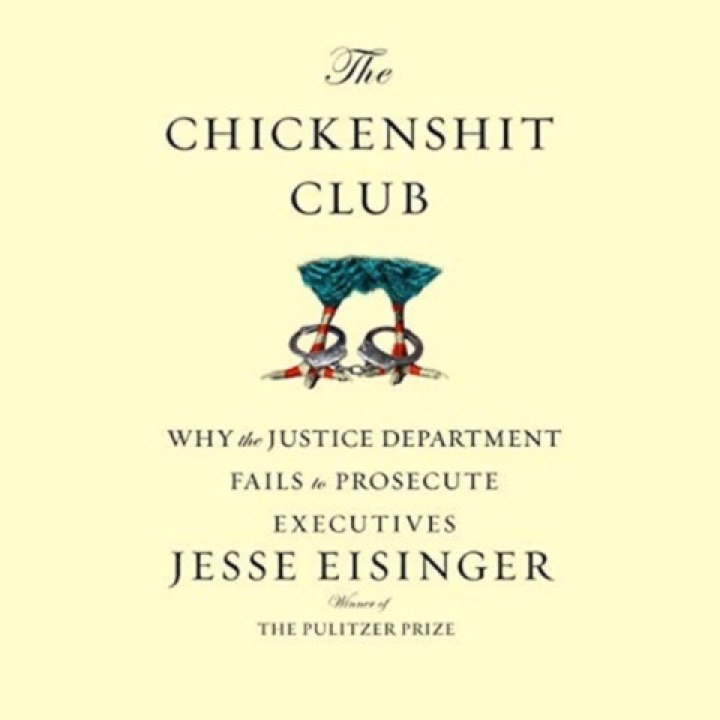
The Chickenshit Club
Applying the lessons from "The Chickenshit Club" by Jesse Eisinger to your life involves embracing accountability, courage, and a commitment to justice and integrity. Here are some ways you might integrate these lessons into your personal and professional life:
-
Embrace Accountability: Just as the book emphasizes the importance of holding individuals accountable, you can apply this by taking responsibility for your actions and decisions. This aligns with your value of kindness and empathy, ensuring that you own up to mistakes and learn from them.
-
Courage in Decision-Making: The book highlights the need for prosecutors to take on challenging cases. Similarly, you can apply this by being courageous in your decisions, whether in your personal life or career. Don't shy away from difficult choices or situations that require you to stand up for your beliefs.
-
Commitment to Justice and Integrity: Eisinger discusses the importance of pursuing justice. In your life, this could translate to advocating for fairness and equality, as you already do through your activism and advocacy work. Continue to champion causes that align with your values and strive to make a positive impact.
-
Continuous Learning and Growth: The book suggests reforms and improvements within the DOJ. You can apply this by maintaining your mindset of being in a constant state of beta and aspiring to be a lifelong learner. Seek opportunities for personal and professional development to enhance your skills and understanding.
-
Challenge the Status Quo: Eisinger points out systemic issues within the DOJ. In your life, don't be afraid to question and challenge existing systems or practices that you find unjust or ineffective. Use your resilience and persistence to drive change and innovation.
-
Balance Risk and Reward: The book discusses the fear of losing high-profile cases. In your life, weigh the risks and rewards of your actions, and don't let fear of failure prevent you from pursuing meaningful goals. Your approach to decision-making, as described, already reflects this balance.
-
Foster a Culture of Accountability: Encourage those around you, whether in your personal or professional circles, to take responsibility for their actions. Lead by example and create an environment where accountability is valued and practiced.
By integrating these lessons, you can continue to live a life aligned with your values of kindness, empathy, and integrity, while also striving for personal growth and societal impact.
What the book covers
"The Chickenshit Club: Why the Justice Department Fails to Prosecute Executives" by Jesse Eisinger is an investigative exploration into why the U.S. Department of Justice (DOJ) has struggled to hold top executives accountable for corporate crimes, particularly in the aftermath of the 2008 financial crisis. Eisinger, a Pulitzer Prize-winning journalist, delves into the systemic issues within the DOJ and the broader legal and financial systems that contribute to this failure.
Summary:
Origins and Context:
- Title Significance: The title refers to a term used by James Comey, former U.S. Deputy Attorney General, to describe prosecutors who are afraid to take on challenging cases against powerful corporate executives.
- Historical Context: Eisinger traces the history of corporate prosecution in the U.S., highlighting a shift from aggressive pursuit of corporate crime in the 1970s and 1980s to a more cautious approach in recent decades.
Key Themes:
-
Cultural Shift in the DOJ: - Eisinger argues that there has been a cultural shift within the DOJ from a focus on prosecuting individuals to settling cases with corporations through deferred prosecution agreements and fines. - This shift is partly due to fear of losing high-profile cases, which could damage careers and reputations.
-
Legal and Structural Barriers: - The book discusses how legal standards and evidentiary requirements have become more stringent, making it harder to prosecute individuals. - There is also a lack of resources and expertise within the DOJ to tackle complex financial crimes.
-
Influence of Wall Street and Big Law: - Eisinger highlights the revolving door between the DOJ and large law firms, which often defend corporations, creating potential conflicts of interest. - The influence of Wall Street and its lobbying power also plays a role in shaping policies that favor settlements over prosecutions.
-
Case Studies: - The book provides detailed case studies of major financial institutions and their executives, illustrating how they avoided prosecution despite evidence of wrongdoing. - Eisinger examines cases like Enron, WorldCom, and the 2008 financial crisis, showing patterns of leniency and lack of accountability.
Key Takeaways and Lessons:
-
Need for Accountability: - Eisinger emphasizes the importance of holding individuals accountable to deter future corporate misconduct and restore public trust in the justice system.
-
Reform in Legal Practices: - The book suggests reforms in legal practices, such as revising the standards for corporate prosecution and increasing transparency in settlements.
-
Strengthening the DOJ: - Eisinger advocates for better resources, training, and incentives for DOJ prosecutors to pursue complex cases against powerful executives.
-
Cultural Change: - A cultural change within the DOJ is necessary to encourage prosecutors to take risks and pursue justice without fear of failure.
-
Public and Political Will: - The book calls for greater public and political will to demand accountability and reform in the justice system to address corporate crime effectively.
Overall, "The Chickenshit Club" provides a critical examination of the failures in prosecuting corporate crime and offers insights into how the justice system can be reformed to ensure accountability and fairness.