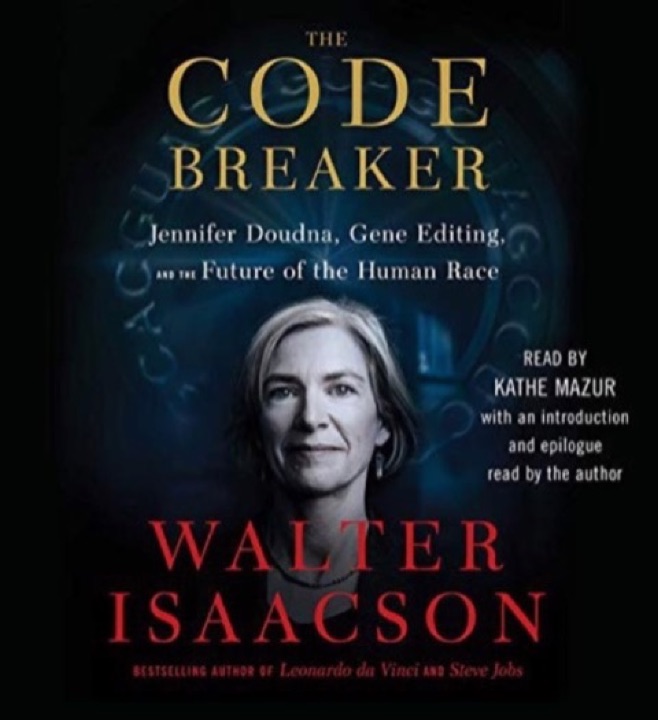
The Code Breaker
"The Code Breaker" by Walter Isaacson offers several lessons that you can apply to your life, given your interests, values, and experiences:
-
Embrace Interdisciplinary Collaboration: - Just as the development of CRISPR required collaboration across various scientific disciplines, you can apply this lesson by seeking diverse perspectives and expertise in your personal and professional endeavors. Whether it's in your medical practice, advocacy work, or personal projects, collaborating with others can lead to innovative solutions and enrich your experiences.
-
Ethical Responsibility: - The book emphasizes the importance of ethical considerations in scientific advancements. You can apply this lesson by continuing to uphold your strong ethical beliefs in your medical practice and advocacy work. Engage in discussions about the ethical implications of new technologies and advocate for responsible use, especially in areas like gene editing.
-
Persistence and Resilience: - Your life story already reflects a strong sense of persistence and resilience, qualities that are also evident in the journey of Jennifer Doudna. Continue to leverage these strengths in overcoming challenges and pursuing your goals, whether it's in your career, personal growth, or aspirations like skydiving.
-
Lifelong Learning: - Doudna's journey underscores the importance of continuous learning and adaptation. You can apply this lesson by maintaining your mindset of being in a constant state of beta and seeking new knowledge and experiences. This aligns with your aspiration to be a lifelong learner and your daily routine of self-evaluation and growth.
-
Balancing Innovation and Caution: - The book highlights the balance between innovation and caution, especially in the context of CRISPR's potential risks and benefits. Apply this lesson by carefully weighing the pros and cons of new opportunities or technologies in your life, ensuring that you make informed decisions that align with your values.
-
Advocacy for Equality: - The societal implications of CRISPR technology, such as the potential for "designer babies," relate to broader issues of equality and access. Continue your advocacy work for social issues like equality and anti-human trafficking, using your platform to promote fairness and justice in the face of technological advancements.
-
Inspiration from Role Models: - Just as Doudna was inspired by James Watson's "The Double Helix," you can draw inspiration from figures like Winston Churchill and the philosophers who have influenced your worldview. Use their resilience and wisdom to guide your actions and decisions, especially in challenging times.
By integrating these lessons into your life, you can continue to make meaningful contributions to society, nurture your personal growth, and inspire those around you.
What the book covers
"The Code Breaker: Jennifer Doudna, Gene Editing, and the Future of the Human Race" by Walter Isaacson is a comprehensive biography that delves into the life and work of Jennifer Doudna, a pioneering scientist in the field of genetics. The book not only chronicles Doudna's journey but also explores the broader implications of CRISPR technology, a revolutionary tool for gene editing.
Summary:
-
Early Life and Education: - Jennifer Doudna grew up in Hawaii, where her curiosity about the natural world was nurtured. Her interest in science was sparked by reading James Watson's "The Double Helix," which led her to pursue a career in biochemistry.
-
Scientific Journey: - Doudna's academic path took her through Pomona College and Harvard University, where she studied under renowned scientists. Her work focused on RNA, a molecule crucial to genetic processes.
-
Discovery of CRISPR-Cas9: - The book details the collaborative and competitive environment of scientific research that led to the discovery of CRISPR-Cas9, a groundbreaking gene-editing technology. Doudna, along with Emmanuelle Charpentier, played a pivotal role in developing this tool, which allows for precise modifications to DNA.
-
Ethical and Societal Implications: - Isaacson explores the ethical dilemmas posed by CRISPR, such as the potential for "designer babies" and the impact on human evolution. Doudna herself is portrayed as a thoughtful scientist who is deeply concerned about the responsible use of gene-editing technology.
-
Nobel Prize and Recognition: - In 2020, Doudna and Charpentier were awarded the Nobel Prize in Chemistry for their work on CRISPR. The book highlights the significance of this achievement and its impact on the scientific community.
-
Impact on Medicine and Agriculture: - CRISPR has vast applications, from treating genetic disorders to enhancing crop resilience. Isaacson discusses how this technology is being used to tackle diseases like sickle cell anemia and improve food security.
Key Takeaways and Lessons:
- Interdisciplinary Collaboration:
-
The development of CRISPR underscores the importance of collaboration across disciplines and international borders. Scientific breakthroughs often result from the collective efforts of diverse teams.
-
Ethical Responsibility:
-
With great power comes great responsibility. The book emphasizes the need for ethical guidelines and public discourse to navigate the moral complexities of gene editing.
-
Innovation and Competition:
-
The story of CRISPR is also one of intense competition, highlighting how rivalry can drive innovation but also create conflicts over credit and patents.
-
The Role of Women in Science:
-
Doudna's journey sheds light on the challenges and triumphs of women in STEM fields, inspiring future generations to pursue careers in science.
-
The Future of Humanity:
- CRISPR has the potential to reshape the future of humanity, offering solutions to some of the world's most pressing problems. However, it also poses risks that must be carefully managed.
In "The Code Breaker," Walter Isaacson provides a nuanced portrait of Jennifer Doudna and the transformative impact of CRISPR technology, offering readers a deep understanding of the scientific, ethical, and societal dimensions of gene editing.