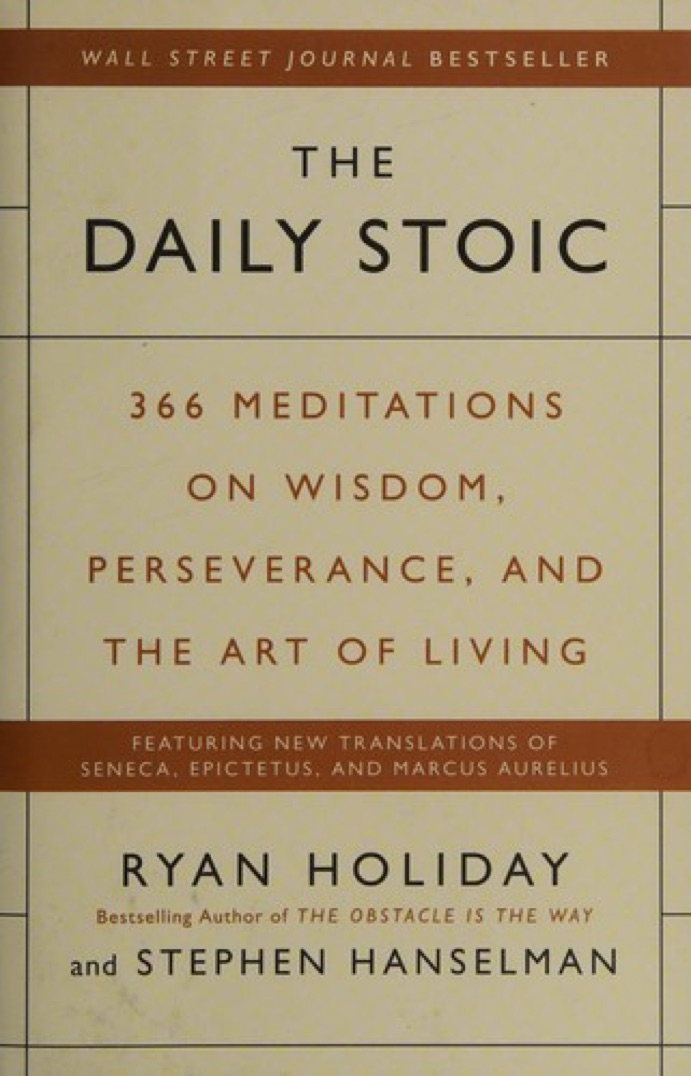
The Daily Stoic: 366 Meditations on Wisdom, Perseverance, and the Art of Living
Applying the lessons from "The Daily Stoic: 366 Meditations on Wisdom, Perseverance, and the Art of Living" by Ryan Holiday and Stephen Hanselman to your life can be a transformative exercise in mental discipline and leadership. Here are some ways you might integrate these lessons:
- Mastering the Dichotomy of Control in High-Stakes Environments: - Whether you are in the emergency room, the cockpit, or the boardroom, you must relentlessly distinguish between the "controllables" and the "uncontrollables." You cannot control the weather, the patient’s arrival state, or the macro economy, but you can control your preparation, your response, and your composure. Focusing your mental bandwidth only on where you have agency prevents burnout and optimizes performance.
- Utilizing Objective Judgment in Complex Decision-Making: - In your roles as an attorney and VC investor, you can apply the Stoic practice of stripping away labels to see facts without the coloring of emotion or ego. By practicing "objective perception," you remove the narrative of "this is a disaster" and replace it with "these are the current variables," allowing for a more analytical and effective strategy when navigating legal disputes or high-stakes acquisitions.
- Viewing Obstacles as Strategic Opportunities: - Adopt the mindset that every setback in entrepreneurship is fuel for growth. Instead of seeing a failed venture or a regulatory hurdle as a stop sign, treat it as a data point or a challenge to refine your process. This Stoic resilience allows you to remain "hungry" for progress while staying "humble" enough to learn from the friction that every serial entrepreneur inevitably faces.
- Practicing Memento Mori to Prioritize Impact: - Use the awareness of your own mortality not as a source of dread, but as a filter for your time and energy. As a lifelong learner and multifaceted professional, this lesson encourages you to say no to the trivial and yes to the legacy-building work in healthcare and venture capital that truly moves the needle for humanity.
- Maintaining the Inner Citadel Through Self-Reflection: - Commit to a daily practice of internal check-ins to ensure your actions align with your virtues. By building this "Inner Citadel," you ensure that your sense of self-worth is tied to your character and effort rather than the fluctuating valuations of your companies or the external accolades of your career.
By integrating these lessons, you will cultivate a temperament that is both unshakeable and highly adaptive, ensuring that you lead your firms and your family with the same calm precision required in medicine and aviation. This philosophy reinforces the "Stay Hungry, Stay Humble" mantra by providing the intellectual framework to pursue excellence without losing your grounding in what truly matters.
What the book covers
"The Daily Stoic: 366 Meditations on Wisdom, Perseverance, and the Art of Living" by Ryan Holiday and Stephen Hanselman is a daily devotional designed to bring the ancient wisdom of Stoic philosophy into the modern era. Through a collection of original translations and insightful commentary, the authors present one meditation for every day of the year, focusing on the teachings of Marcus Aurelius, Seneca, and Epictetus. The book serves as a practical manual for developing mental toughness, emotional resilience, and a clear-eyed perspective on life's inevitable challenges.
Summary:
- The Core Framework of Stoic Disciplines: - The book is organized into three primary disciplines: Perception, Action, and Will. The first four months focus on the Discipline of Perception, teaching readers how to see the world clearly and objectively; the next four focus on the Discipline of Action, emphasizing the importance of virtuous and purposeful conduct; and the final four focus on the Discipline of Will, which deals with how we respond to things we cannot change.
- The Dichotomy of Control: - A central argument throughout the meditations is the vital distinction between what is within our control and what is not. Holiday and Hanselman emphasize that our own thoughts, impulses, and actions are the only things we truly govern, while external events, the opinions of others, and outcomes remain outside our power. By focusing energy exclusively on the former, an individual can maintain inner peace regardless of external chaos.
- Clarity of Perception and Judgment: - The meditations challenge the reader to strip away subjective interpretations and emotional reactivity. By viewing events as neutral rather than inherently "good" or "bad," one can respond with logic and reason. This section highlights the Stoic practice of objective observation, where one removes the narrative layer we often place over reality to find a clearer path forward.
- The Commitment to Virtuous Action: - Stoicism is portrayed not as a passive philosophy of endurance, but as a call to right action. The text argues that we must contribute to the common good and act with justice, courage, and temperance. Each daily entry encourages the reader to align their professional and personal behaviors with a high moral standard, ensuring that every effort serves a higher purpose beyond mere self-interest.
- Building the Inner Citadel: - Through the Discipline of Will, the book explores the concept of the "Inner Citadel," a fortress of mental strength that protects the individual from the shocks of fortune. This involves the practice of premeditatio malorum—the premeditation of evils—where one mentally prepares for potential setbacks to minimize their impact, as well as the acceptance of fate, or amor fati.
- Reflections on Mortality and Time: - The final sections heavily feature the concept of memento mori, or the remembrance of death. The authors argue that a constant awareness of our limited time should not lead to nihilism but should instead fuel a sense of urgency and gratitude. This perspective helps in prioritizing what truly matters and discarding the trivial distractions that consume so much of human life.
By distilling thousands of years of philosophical tradition into accessible, daily bite-sized lessons, Holiday and Hanselman provide a roadmap for living a life of character and purpose. The book’s enduring significance lies in its ability to prove that the struggles of a Roman Emperor or a Greek slave remain identical to the struggles of a modern leader, offering timeless solutions for the human condition.