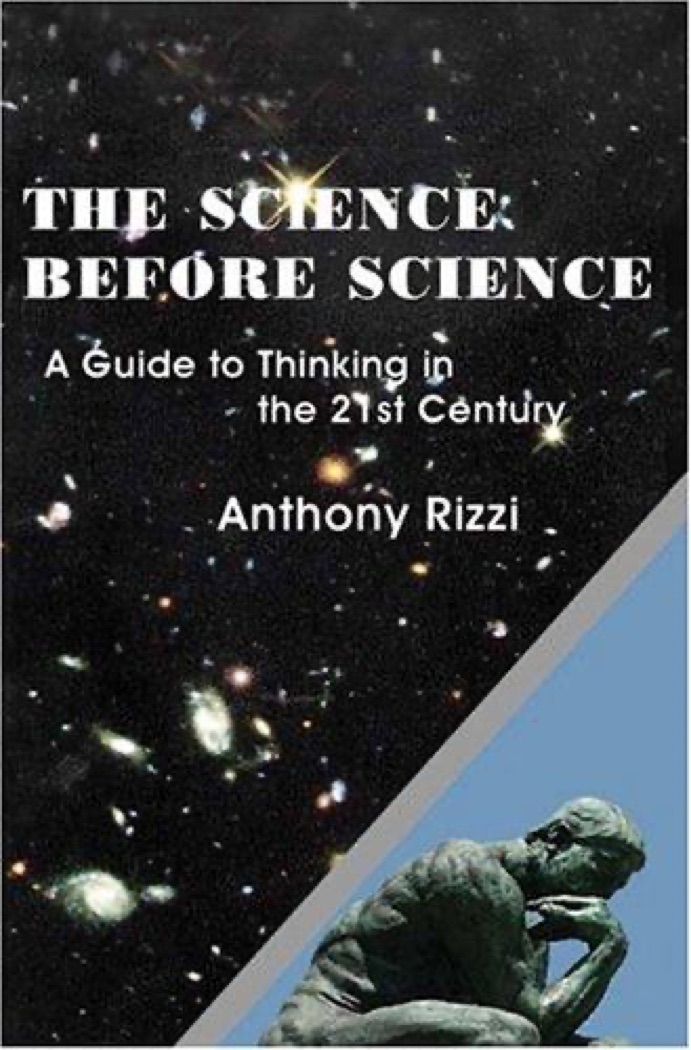
The Science Before Science: A Guide to Thinking in the 21st Century
Applying the lessons from "The Science Before Science" by Anthony Rizzi to your life can be a transformative exercise in intellectual clarity and foundational reasoning. Here are some ways you might integrate these lessons:
-
Return to First Principles in Leadership: - In your roles as a VC lead and entrepreneur, you should constantly audit the "common sense" foundations of your ventures. Before diving into complex spreadsheets or market projections, ask if the core assumptions about the product's utility and the human need it fills are grounded in reality or merely in abstract trends.
-
Avoid the Trap of Pure Metrics: - Whether in medicine or business, it is easy to become obsessed with "empiriometric" data—telehealth patient volumes, RVUs, or EBITDA. You must remember that these numbers are symbols of a deeper reality; never let the measurement of the patient's health replace the actual, qualitative care of the human being standing in front of you.
-
Think Through the Four Causes: - When solving problems in law or aviation, apply the four causes to find the root of an issue. Don't just look at the "efficient cause" (what triggered the event); look at the "formal cause" (the structure of the system) and the "final cause" (the ultimate purpose of the mission) to ensure your solutions are holistic and sustainable.
-
Cultivate Epistemological Humility: - As a lifelong learner with multiple degrees, use Rizzi’s insights to remain "Humble" by acknowledging the limits of specialized knowledge. Realize that being an expert in the "how" (technology/math) does not automatically make one an expert in the "why" (philosophy/ethics), and strive to bridge that gap in your personal study.
-
Ground Innovation in Human Nature: - As you lead Xcellerant Ventures, evaluate healthcare startups not just on their technical novelty, but on how well they align with the objective nature of the human person. The most successful and ethical disruptions will be those that respect the integrated reality of the mind and body rather than treating patients as mere data-processing machines.
-
Sharpen Your Critical Thinking via Realism: - Use the principle of non-contradiction as a sharp tool in your legal and medical practice. Train yourself to spot when modern discourse deviates from basic logical axioms, allowing you to cut through "noise" and maintain a clear, objective perspective in high-stakes environments like the ER or the cockpit.
By integrating these lessons, you will develop a more unified and robust way of thinking that transcends professional silos. Embracing the "science before science" ensures that your pursuit of innovation, justice, and healing remains anchored in the immutable truths of the physical and moral world.
What the book covers
"The Science Before Science: A Guide to Thinking in the 21st Century" by Anthony Rizzi is a foundational treatise that seeks to reconnect modern scientific inquiry with its essential philosophical roots. Rizzi, a theoretical physicist, argues that the specialized sciences have become untethered from the "common sense" realism and first principles required to truly understand the nature of physical reality. By reviving the Aristotelian-Thomistic tradition of the "science of nature," the book provides a rigorous framework for navigating the logical and metaphysical prerequisites that must precede mathematical modeling and empirical experimentation.
Summary:
-
The Necessity of First Principles: - Rizzi establishes that all scientific knowledge begins with what he calls the "science before science," or the fundamental understanding of reality that we gain through our senses. He argues that before one can engage in complex equations or quantum mechanics, one must accept basic axioms such as the principle of non-contradiction and the fact that things exist independently of our thoughts. - The book posits that modern man has fallen into a "Cartesian trap," where we trust mathematical abstractions more than our direct sensory experience of the world. Rizzi emphasizes that if our foundational philosophical principles are flawed, then any scientific superstructure built upon them will eventually lead to logical absurdities or a disconnect from human life.
-
The Distinction Between Physics and Empiriometrics: - A central theme is the distinction between "Physica" (the broad science of nature) and modern "empiriometric" science. Rizzi explains that while modern physics focuses on what can be measured and captured in mathematical symbols, it often ignores the intrinsic nature or "substance" of the things being measured. - He asserts that the empiriometric method is a powerful tool for prediction and technology but remains an incomplete way of knowing. To truly understand a physical entity, one must look beyond the data points to the underlying reality that the math is attempting to describe.
-
The Four Causes and the Nature of Change: - Rizzi revives the Aristotelian framework of the four causes—material, formal, efficient, and final—to explain the complexity of the natural world. He argues that modern science often limits itself to efficient and material causes, thereby losing the ability to explain the purpose (teleology) or the essential structure of physical beings. - He further explores the concepts of "act" and "potency" to define change. By understanding change as the actualization of a potential, Rizzi provides a logical solution to ancient paradoxes and a more stable ground for understanding the transformations observed in chemistry and physics.
-
Quantity, Quality, and the Five Senses: - The book examines how our primary access to the world is through the five senses, which reveal the qualities of things. Rizzi argues that modern science attempts to reduce all qualities (like color or heat) to quantities (like wavelength or kinetic energy), which can lead to a dehumanized view of the universe. - He maintains that quantity is just one accident of a substance. By acknowledging the reality of both quantity and quality, Rizzi bridges the gap between the "hard" data of the laboratory and the lived experience of the human person.
-
The Human Mind and the Limits of Materialism: - Rizzi tackles the problem of consciousness and the intellect, arguing that the human mind has the unique capacity to grasp universals and abstract truths that are not purely material. This suggests that the human person is more than just a collection of atoms governed by deterministic laws. - He contends that a purely materialistic science is self-defeating because it cannot account for the validity of the very logic and reasoning used to conduct scientific research. Understanding the "science before science" allows for a coherent view of the soul and its relation to the physical body.
-
Ethics and the Purpose of Technology: - The final chapters explore how a return to philosophical realism affects our moral and technological choices. Rizzi warns that without a proper understanding of the nature of things, technology becomes a tool for raw power rather than a means to serve the true good of humanity. - He argues that ethics must be grounded in the nature of the human person as a rational animal. By recognizing the inherent ends of human nature, we can develop a science and a society that are aligned with objective truth and human flourishing.
"The Science Before Science" is a significant work because it challenges the modern divorce between faith, philosophy, and science. Rizzi successfully demonstrates that far from being obsolete, ancient philosophical insights are the only things capable of providing a coherent and unified worldview in an age of hyper-specialization and intellectual fragmentation.