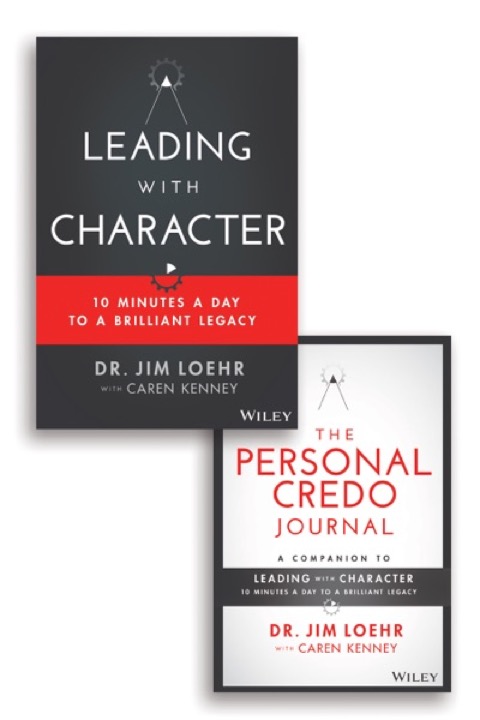
The Personal Credo Journal: A Companion to Leading with Character: 10 Minutes a Day to a Brilliant Legacy
Applying the lessons from "The Personal Credo Journal: A Companion to Leading with Character" by Jim Loehr and Caren Kenney to your life can be a transformative step toward becoming a more principled and effective leader. Here are some ways you might integrate these lessons:
-
Drafting Your Moral Flight Manual: - For a pilot or an emergency physician, checklists and protocols are essential for navigating turbulence and crisis. You should treat your Personal Credo as a "moral flight manual" that provides pre-determined ethical headings, ensuring that when you encounter professional or personal storms, your course is already set by your deepest values rather than by panic or expediency.
-
Building Moral Muscle in the Boardroom: - As a serial entrepreneur and venture capitalist, the pressure to scale and succeed can be immense. You can use the journal’s exercises to identify "character gaps" in your leadership style, treating integrity as a performance metric that requires the same rigorous training and tracking as an MBA case study or a clinical trial.
-
Integrating the Polymath’s Values: - Juggling the roles of physician, attorney, pilot, and CEO requires a unified internal identity. You can use the credo-writing process to ensure that your "Stay Hungry, Stay Humble" mantra is not just a slogan but a lived reality that remains consistent across the ER, the cockpit, and the venture capital firm.
-
The Discipline of Daily Character Audits: - Leveraging your habit of lifelong learning, you should adopt the book's practice of a daily 10-minute character review. By auditing your actions against your credo every evening, you create a feedback loop that prevents small ethical compromises from snowballing into a loss of direction.
-
Managing Energy for Ethical Endurance: - Recognize that your ability to lead with character is tied to your physical and emotional reserves. You can apply Loehr’s performance psychology by ensuring your schedule allows for the recovery needed to maintain "moral resilience," understanding that a fatigued leader is more prone to the shortcuts that undermine trust.
-
Modeling Humility through Accountability: - Use your credo as a tool for transparency with your teams and family. By sharing the standards you hold yourself to, you foster an environment where others are encouraged to lead with character, effectively scaling your personal mission of humility and service across your entire professional ecosystem.
By integrating these lessons, you move beyond the intellectual understanding of virtue and into the disciplined application of character, ensuring that your vast professional achievements are anchored by a legacy of unwavering integrity and purposeful living.
What the book covers
"The Personal Credo Journal: A Companion to Leading with Character" by Jim Loehr and Caren Kenney is a tactical, introspective workbook designed to help individuals codify their internal values into a functional moral compass. Developed by renowned performance psychologist Jim Loehr, the book acts as a guided journey for leaders to define who they are and who they want to become through the creation of a formal "Personal Credo." It operates on the premise that character is not an innate, fixed trait, but rather a set of "moral muscles" that must be intentionally trained and strengthened through daily practice and reflection. By bridging the gap between performance psychology and ethical leadership, the journal provides a roadmap for aligning one's daily conduct with their highest aspirations.
Summary:
-
The Concept of the Personal Credo: - The authors introduce the Personal Credo as a written declaration of an individual's most deeply held values and the standard of behavior they commit to upholding. This document serves as a private constitution that guides decision-making, particularly during times of high stress, professional crisis, or personal temptation. - Unlike a vague mission statement, a credo is intensely personal and specific. It requires the writer to articulate not just what they value, but how those values manifest in their roles as a leader, spouse, parent, and citizen.
-
Character as a Performance Muscle: - Loehr and Kenney argue that character is the ultimate foundation of high performance. They categorize character into "performance character" (traits like grit and discipline) and "moral character" (traits like integrity and compassion), asserting that the latter is what truly sustains a legacy. - The journal posits that character muscles atrophy without use. Just as an athlete trains for physical endurance, a leader must engage in deliberate "moral training" to ensure their ethical responses become instinctive rather than situational.
-
The Three Lenses of Self-Discovery: - The workbook guides users through an evaluation process using three distinct perspectives: the "Current Self" (how you behave now), the "Perceived Self" (how others actually experience you), and the "Ideal Self" (the person you aspire to be). - This exercise often reveals a "character gap"—the distance between one's stated values and their actual behavior—which serves as the primary motivation for the journaling process and subsequent behavioral change.
-
Identifying and Hierarchizing Core Values: - Readers are tasked with distilling a broad list of virtues down to a few non-negotiable core values. The authors emphasize that having too many priorities means having none; therefore, the journal forces a rigorous prioritization process. - Each chosen value must be defined in the user’s own words, accompanied by specific examples of what "success" looks like in the context of that value, moving the concept from an abstract ideal to a concrete behavioral target.
-
The Practice of Daily Reflection: - A central component of the book is the daily training log, which requires users to review their actions at the end of each day against their credo. This practice creates a feedback loop that highlights moments of misalignment and celebrates small victories of integrity. - This consistent monitoring is intended to build self-awareness, making the user more conscious of their choices in real-time and fostering the humility needed to admit when they have strayed from their path.
-
Energy Management and Moral Resilience: - Drawing on Loehr's expertise in human performance, the journal explores how physical and emotional energy levels impact character. It argues that when we are depleted, we are most likely to compromise our values. - The journal encourages users to manage their energy—through sleep, nutrition, and emotional regulation—not just for productivity, but as a prerequisite for maintaining the moral strength required for ethical leadership.
This journal is a significant contribution to leadership literature because it transforms the abstract pursuit of "integrity" into a measurable, disciplined practice. It moves character development out of the realm of philosophy and into the realm of performance science, providing a practical toolkit for anyone seeking to live a life of consistency and purpose.