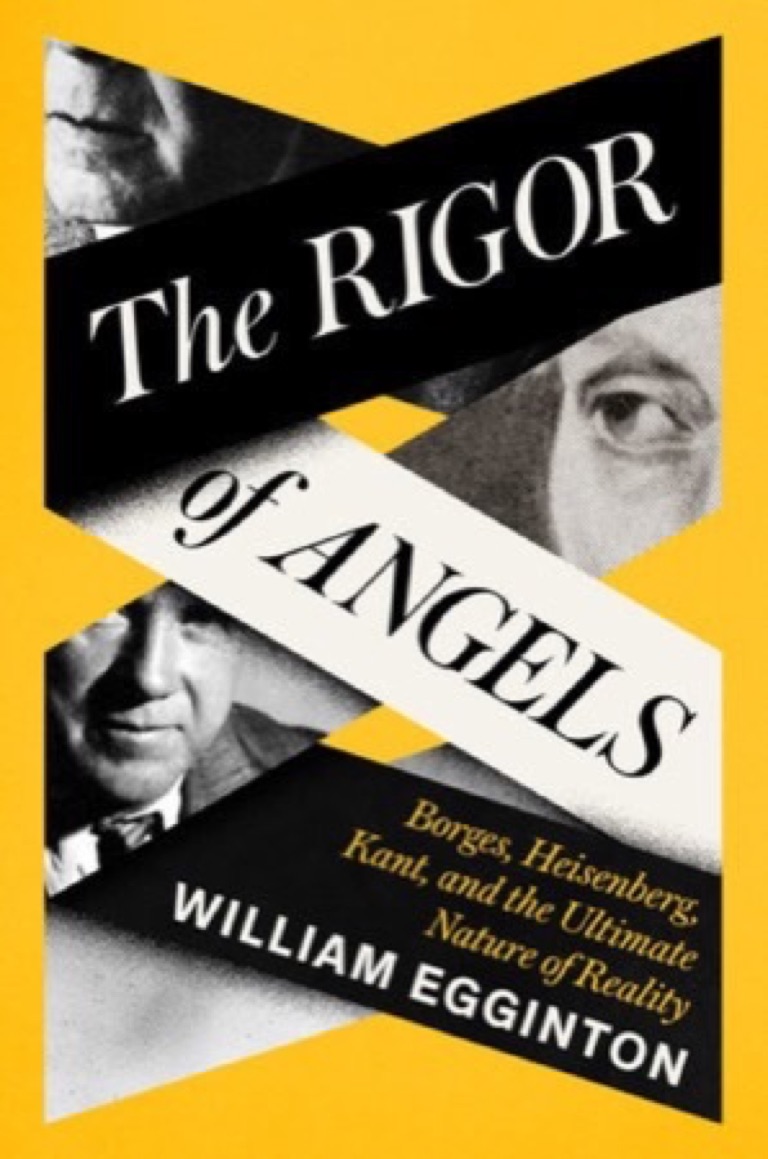
The Rigor of Angels: Borges, Heisenberg, Kant, and the Ultimate Nature of Reality
Applying the lessons from "The Rigor of Angels: Borges, Heisenberg, Kant, and the Ultimate Nature of Reality" by William Egginton to your life can be a transformative exercise in refining your perspective on leadership, decision-making, and the nature of truth. Here are some ways you might integrate these lessons:
-
Embrace Intellectual Humility: - As a leader and investor, you must recognize that your "map" of the world is not the "territory." In medicine or venture capital, data is often filtered through subjective lenses; acknowledging the limits of your knowledge allows you to remain "Stay Hungry, Stay Humble" and prevents the arrogance that leads to catastrophic errors.
-
Understand the Observer Effect: - In both the ER and the boardroom, your presence and the questions you ask change the system you are observing. By understanding Heisenberg’s insights, you can become more mindful of how your leadership style influences team dynamics and project outcomes, ensuring that your interference doesn't inadvertently skew the results you seek.
-
Navigate Labyrinths with Strategy: - Borges’ stories teach us that complexity is often a product of our own mental frameworks. When facing intricate legal or entrepreneurial challenges, you should look for the underlying philosophical structures at play rather than getting lost in the infinite details, allowing for more elegant and decisive solutions to emerge.
-
Reject the Lure of the Absolute: - Egginton warns against the "rigor of angels"—the belief that one possesses the ultimate truth. In your career as an attorney or a physician, maintain a healthy skepticism toward "perfect" solutions, as they often blind you to the nuanced, human reality of the patient or client standing before you.
-
Balance the Discrete and the Continuous: - Recognize that progress often happens in "quantum leaps" rather than smooth, linear paths. In your ventures, be prepared for sudden shifts in the market or medical technology, and understand that your long-term vision is a construction built upon these individual, sometimes fragmented, moments of change.
-
Cultivate Interdisciplinary Wisdom: - Like the three figures in the book, you should seek answers across disparate fields. By combining the rigor of science with the imagination of literature and the ethics of philosophy, you develop a more holistic approach to problem-solving that transcends the boundaries of any single profession.
By integrating these lessons, you will develop a more resilient and nuanced approach to your diverse professional roles, finding that the most effective leadership comes from a place of deep curiosity and a profound respect for the mysteries that remain beyond our grasp.
What the book covers
"The Rigor of Angels: Borges, Heisenberg, Kant, and the Ultimate Nature of Reality" by William Egginton is a profound exploration of the limits of human reason and the structure of reality through the lives and works of three intellectual giants. Egginton masterfully weaves together the metaphysical labyrinths of Jorge Luis Borges, the revolutionary physics of Werner Heisenberg, and the transcendental philosophy of Immanuel Kant. The book argues that by acknowledging the boundaries of what we can know, we gain a deeper appreciation for the beauty and mystery of existence. It serves as both an intellectual history and a philosophical call to arms for humility in an age of absolute certainty.
Summary:
-
The Architecture of Reason: - Kant's "Critique of Pure Reason" serves as the fundamental anchor, where he identifies the "antinomies"—logical contradictions that arise when reason attempts to grasp the infinite. Egginton explains how Kant revolutionized thought by recognizing that while we can never know the "thing-in-itself," our cognitive structures, specifically our innate concepts of space and time, determine the entirety of how we experience the world.
-
The Quantum Leap: - Werner Heisenberg’s development of the uncertainty principle is presented as the scientific manifestation of Kantian limits. Egginton details Heisenberg’s struggle with the mathematics of quantum mechanics, demonstrating that the act of measurement fundamentally influences the outcome, suggesting that reality is not an independent backdrop but is intimately intertwined with the act of observation.
-
Labyrinths of the Mind: - The literary genius Jorge Luis Borges is used as the bridge between philosophy and physics, using his fiction as a laboratory for these dizzying concepts. In stories like "The Library of Babel," Borges dramatizes the paradoxes of the infinite and the search for a totalizing truth, illustrating the psychological consequences of a mind trying to map a reality that exceeds its cognitive capacity.
-
The Transcendental Illusion: - A central argument of the book is the human tendency to mistake our mental models for reality itself, a phenomenon Kant called the "transcendental illusion." Egginton discusses how this cognitive shortcut is necessary for daily life but becomes dangerous when applied to metaphysics or politics, as it leads to the delusion that we can achieve a god-like, objective view of the universe.
-
The Discrete and the Continuous: - The book delves into the tension between the discrete and the continuous, particularly through the lens of Zeno’s paradoxes and Heisenberg’s quantum "jumps." Egginton argues that our sense of a continuous reality is a sophisticated construction layered over a world that may be fundamentally fragmented or beyond our linear comprehension of time and motion.
-
The Ethics of the Unknown: - The final sections explore the "rigor of angels" as a metaphor for the drive toward absolute, uncompromising truth. Egginton connects the philosophical overreach of the 20th century to political and social disasters, arguing that true rigor lies not in achieving total certainty, but in the constant, humble awareness of our own perspective's inherent limitations.
"The Rigor of Angels" is a testament to the power of interdisciplinary thinking, demonstrating that literature, science, and philosophy are all seeking to solve the same fundamental riddle. Egginton’s work invites readers to embrace intellectual humility, suggesting that our greatest strength lies not in achieving total certainty, but in the rigorous pursuit of understanding despite our limitations.